Note: This article originally published on April 14, 2014 is being re-posted on Applied Unificationism due to its relevance on the first anniversary of the 2022 invasion of Ukraine.
Blog of Unification Theological Seminary
In a sermon I gave in Kiev in late 1991, I warned that the Israelites, upon escaping slavery in Egypt, still had to endure 40 years of suffering in the desert. So it has been for the Ukraine since the break-up of the Soviet Union. I had arrived there as a missionary a few months before and would stay in Kiev until the end of 1994, when my family moved to Moscow.
Warning of a potentially troubled future, I was reminded of the words of Leon Trotsky: “The Ukrainian question, which many…have tried to forget or to relegate to the deep strongbox of history…is destined in the immediate future to play an enormous role in the life of Europe.” Despite its own desires, Ukraine remains caught between two powers far greater than itself – Europe and Russia.
In December 1991, I witnessed Lenin’s massive head finally separated from his shoulders, hanging motionless from a crane above us at October Square (now Independence Square) in Kiev. The wildly cheering crowd was bursting with hope this would be the beginning of the end of Lenin’s communist legacy and the start of real freedom and a brighter future.
Ukraine had suffered the horrors of Stalin’s “dekulakization,” forced famine, the Holodomor (1932-33 extermination by hunger, with up to 10 million dead), “Russification,” the horrors of World War II (up to seven million Ukrainian dead), and life after the war under the heel of Moscow. It just wanted to be free and decide its own future.
This dismantling of Lenin’s giant statue followed the referendum on the Act of Declaration of Independence, supported by over 92% of the Ukrainian population with a voter turnout of almost 85%. Ominously for today, the lowest figures came from the Crimea – 54% of a 60% turnout – and throughout Ukraine only 55% of ethnic Russians voted “yes.” Ukraine’s decision effectively ended the Soviet Union, which was formally dissolved a week later with the signing of the Belavezha Accords by Russia, Ukraine and Belorussia (now Belarus), two of whose leaders, Mikhail Gorbachev and Stanislav Shushkevich, became friends of Reverend Moon.
In the recent ousting of President Yanukovych’s pro-Russian regime by the seemingly pro-European opposition, the choice of December 8, 2013 for the destruction of one of Kiev’s remaining Lenin statues was not haphazard. It symbolized the continuing desire of many Ukrainians to shake off the long shadow from the north. But how to accomplish this with a Russian president, Vladimir Putin, who declared in 2005 that the collapse of the Soviet empire “was the greatest geopolitical catastrophe of the (20th) century,” and that Russia’s “place in the modern world will be defined only by how successful and strong we are”?
In 2008, Russia annexed 20% of Georgia, with significant casualties, but with few diplomatic repercussions. The pro-European president, Mikheil Saakashvili, was ousted, and Georgia returned to Russia’s sphere of influence. Vice President Dick Cheney threatened that “Russian aggression must not go unanswered, and that its continuation would have serious consequences for its relations with the United States, as well as the broader international community.”
President George W. Bush told Russia that “bullying and intimidation are not acceptable ways to conduct foreign policy in the 21st century,” but it was soon business as usual. There was no talk of the 2014 Winter Olympics being withdrawn from Sochi and Russia was later awarded the World Cup for 2018! Putin learned that such actions would produce little more than a blizzard of words from the West. This background is critical to comprehend the seeming audacity of the Russian military in the Crimea.
Putin knew there would be sanctions (so far only against certain individuals), and the planned G-8 meeting in Sochi canceled. But beyond that, he knew the U.S., EU, and NATO would only bluster, as in Secretary of State John Kerry’s statement about this “incredible act of aggression.” Where was the follow-up to his prior remark that it would be a “grave mistake” if any military intervention occurred? What else was to be expected? Europe gets 40% of its natural gas from Russia. Germany would be particularly reluctant to get into a sanctions war since it imports more than a third of its oil and gas from Russia.
Moscow knew there would be many questions and it could add to the confusion about what actually occurred in Kiev and what were the forces behind the regime change – a former boxing champion, neo-Nazis, etc. Particularly worrying was the leaked phone call between Assistant Secretary of State Victoria Nuland and the U.S. Ambassador in Kiev, Geoffrey Pratt, bantering about whom they’d like to see lead the Ukrainian opposition and her now infamous F-bomb directed at the EU.
The first question is: “Why the Crimea?”
The territory is an important agricultural region with vineyards and rich tobacco plantations, and is a popular tourist region because of its subtropical climate and numerous seaside resorts. Sevastopol has also been the continuous home of the Russian Black Sea Fleet since 1783, except during the German World War II occupation. It is the issue of Russia’s Black Sea Fleet that has been a thorn in the side of relations between Ukraine and Russia since the Soviet Union collapsed.
In 2010, after years of negotiations, Ukraine agreed to extend Moscow’s lease on Sevastopol until 2042 in exchange for a 30% reduction in the price of Russian gas on which Ukraine depends. But Russia remained wary about its reliance on Ukraine, and disliked some of the conditions imposed by the deal — including the need for Ukrainian consent each time it wanted to upgrade or replace ships at Sevastopol. It also feared the new government in Kiev might cancel the lease deal.
Since 2008, Russia has been pumping money into building a new base on its own territory further east on the Black Sea at the much less suitable Novorossiysk. The long-term plan was to move the region’s new and flagship vessels there. But, with Sevastopol again under Moscow’s jurisdiction, this very costly endeavor, which the Russian economy can ill-afford, will be mothballed. Many noted that immediately following the Crimean vote this past March 16 to realign itself with Moscow, Russian Prime Minister Dmitry Medvedev said it may revoke its deal with Ukraine which would oblige Kiev to return $11 billion which Russia paid to lease the bases.
The second, more important question is: “What’s next on Putin’s agenda?” Will Russia move further into eastern Ukraine to support others, such as those bloodied in ongoing pro-Russian demonstrations in Kharkiv, Donetsk and Luhansk? There are 10-15,000 Russian troops in the Transnistra, a tiny, unrecognized, still-communist country on Ukraine’s border with Moldova.
Given that Ukraine’s regular army has only 65,000 soldiers, compared with 300,000 deployed in Russia’s western and southern military districts bordering Ukraine, anything might seem possible. However, the Russian military is for the most part ill-trained and ill-equipped, and Kiev has had a cooperation pact with NATO. It is hard to envision further escalation of the conflict. The direct result of the Crimean aggression on the Russian stock market has also highlighted the current fragility of its economy, which would suffer greatly in the event of a war. But we can be sure that the 19,000 Russian soldiers in the Crimea will remain and there will be a return to the status quo prior to Nikita Khrushchev’s “gifting” the Crimea to Kiev in 1954.
More worrying is if Putin will be emboldened to act in other sovereign nations to “protect the rights of ethnic Russians,” having seemingly gotten away with it in Georgia and the Crimea? Where’s next for Moscow to intercede? Estonia, a NATO and EU member? No. But, like Estonia, Kazakhstan also has a sizeable, unhappy Russian population.
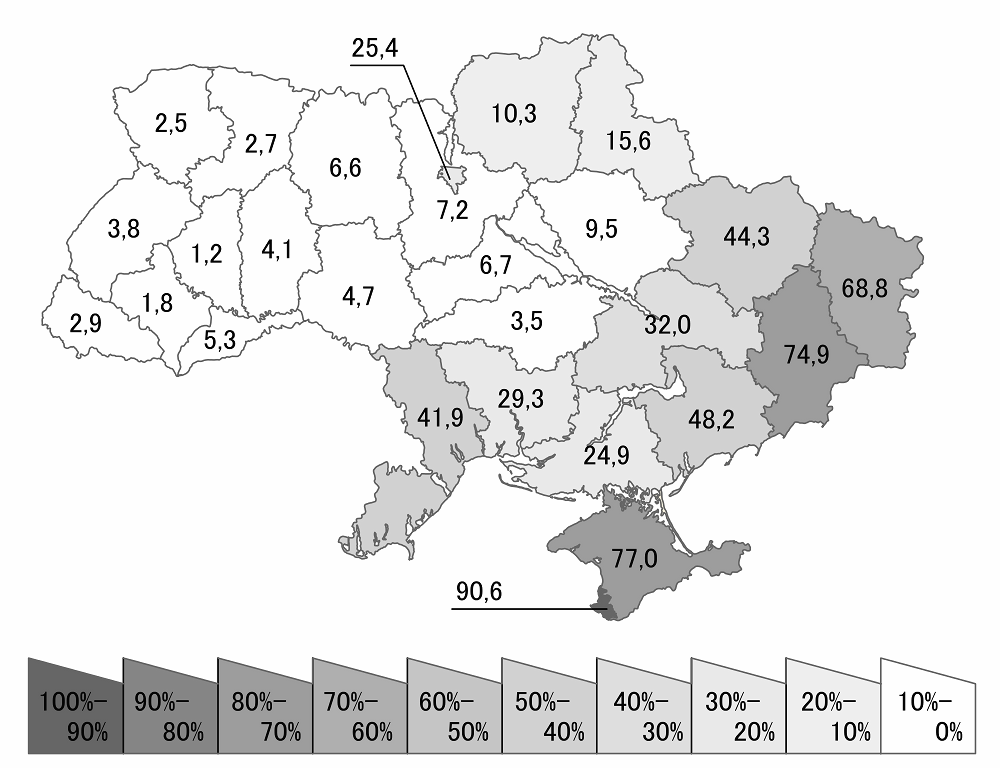
In 1999, Russians made up 30% of Kazakhstan’s population, after almost two million left the country that decade. The oil-rich nation has been developing closer ties with China to Russia’s annoyance, though the EU remains its largest trading partner. Last July, Kazakhstan sold a $5 billion stake in one of the world’s largest oil fields to China’s CNPC. Would Putin be tempted to “save” his fellow Kazakh Russians? Unlikely.
Is there a solution to the tension, violence and threat of a divided Ukraine and further Russian expansion? Will Russia withdraw its agents provocateurs from within the Ukraine, and troops from its borders if the international community accepts its annexation of the Crimea (where on April 18 all residents will automatically become Russian citizens) as a “fait accompli?” Probably, but not if the policy of the West is that “Putin wins in the short-term, but Russia pays in the long.”
The proposed talks between Russia, Ukraine, the U.S., and the EU must take place and through very careful, respectful diplomacy, produce a solution acceptable to all. Russia has significant domestic problems, which its Crimean annexation aimed to ease, not exacerbate. If Russia feels punished or threatened, the “bear” may lash out with potentially disastrous consequences. The Dalai Lama wrote, “[W]hereas the twentieth century has been a century of war and untold suffering, the twenty-first century should be one of peace and dialogue.” As Reverend Moon said during his 2005 world tour, when proposing the establishment of a “peace kingdom corps,” first mentioned in Kiev, we have to enter “a new dimension of dialogue.”♦
David Stewart (UTS Class of 1985) studied modern history at Oxford. He worked as a state leader in the U.S. after UTS graduation, then moved to the USSR in April 1991. He left in 1996 to move with his family to Venezuela as a national messiah. He now lives in Canada and visits Caracas as often as possible.
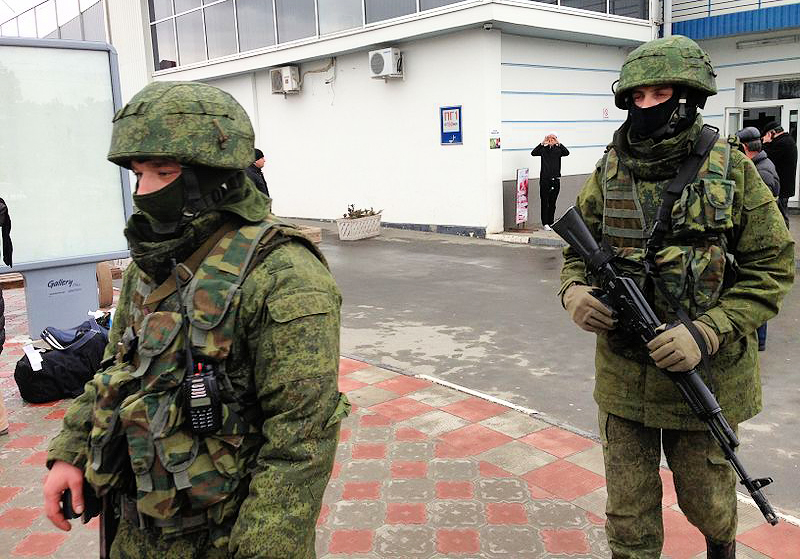
Photo at top: Russian soldiers (without insignia) on patrol at Simferopol International Airport, February 28, 2014 (source: Voice of America).
Kyiv, not Kiev, please
When visiting Kyiv in 2005, True Father spent almost two hours explaining mistakes of communism ideology and communists’ actions during morning HDH meeting.
After World War II, Germany went through denazification, and Japan went through demilitarization.
They both relate as internal (elimination of ideology) and external (disarmament) aspects.
Since Russia did not go through these processes after the Cold War, it invaded Ukraine, annexed Crimea and terrible war happened.
Accordingly, Russia must now inevitably go through denazification (decommunization) and demilitarization (nuclear disarmament).
Shortly we can summarize this article in few following sentences. The recent events in Ukraine, specifically the annexation of Crimea by Russia, can be traced back to the country’s breakaway from the Soviet Union. Ukraine, caught between Europe and Russia, just wanted to be free and decide its own future after years of oppression, but the low turnout of ethnic Russians voting for independence foreshadowed the current conflict. Despite Ukraine’s decision to declare independence, it remained reliant on Russia for gas and other resources. The annexation of Crimea is linked to the region’s strategic importance, its tourism and agriculture, but mostly, its importance to Russia’s Black Sea Fleet. Putin knows that sanctions from the US, EU, and NATO will likely only be rhetoric as they are dependent on Russian resources.
This article by Mr. Stewart is rather shallow, external and outdated.
When proclaiming “Peace corps” and “Peace police” in Kyiv, Ukraine, Reverend Sun Myung Moon gave following speech in inner circle during HDH. In it he calls for the creation of a Peace Army and Peace Police, composed of volunteers who pledge to use only words to educate people and establish peace on Earth. He urges the people of Ukraine and Russia to unite as Abel and Cain and work together to correct the mistakes of the past and create a peaceful world. Reverend Moon emphasizes the need for sacrifice and education, and he hopes that the Peace Army will eventually surpass the number of soldiers in the Russian and American armies. He also urges people to learn the Principle, that he believes hold the key to solving the world’s problems.
https://www.tparents.org/moon-talks/sunmyungmoon05/SunMyungMoon-051021a.pdf