
Investigative journalist: Reporting contrary to government narrative is blocked on editorial level or censored by Japanese authorities
Prepared by Knut Holdhus
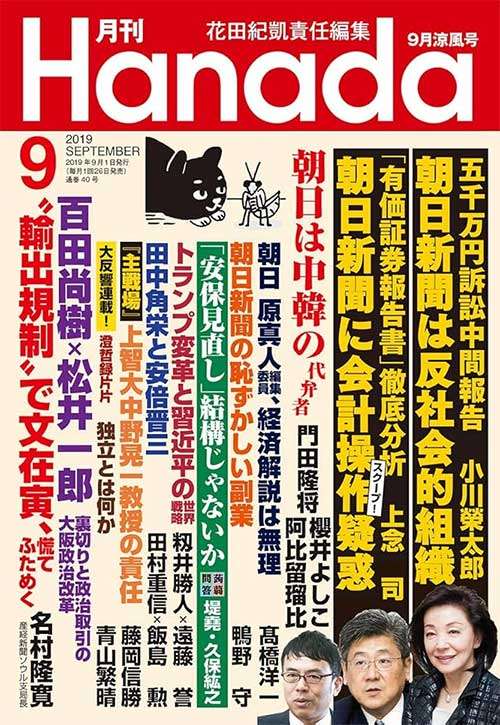
The Japanese magazine Monthly Hanada published in its September 2023 issue a report by award-winning Japanese author Masumi Fukuda (福田ますみ), who is known for her investigative journalism. She exposes a blatant media bias as well as an aggressive censorship imposed by the authorities. She reveals how a government body – Agency for Cultural Affairs – reprimanded and threatened some media outlets that went against the grain and dared to publish viewpoints expressed by the Family Federation in the middle of the authorities’ campaign against the religious minority.
Her extensive report was headlined “Dissolution Request Push – Censorship of Speech by Tetsuo Goda, Deputy Director-General of the Agency for Cultural Affairs”. We publish it now because of its high relevance in the ongoing witch hunt against the Family Federation in Japan. In addition, the content has never before been published outside the land of the rising sun.
The Inability to Report Truth
The investigative journalist points out that since the assassination of former Prime Minister Shinzo Abe (安倍晋三) in July 2022, the relentless criticism of the Family Federation for World Peace and Unification (formerly known as the Unification Church) shows no sign of abating, even after more than a year. A troubling narrative persists in which the actual victim, Abe, along with the Family Federation, is misrepresented as a perpetrator, while the perpetrator, Tetsuya Yamagami (山上哲也), is painted as a victim. This distortion of public perception continues to take hold in a manner that reflects deliberate manipulation.
An invisible barrier appears to dominate media coverage, prohibiting any reporting that might present the Family Federation in a positive or even neutral light. This phenomenon bears resemblance to a kind of modern “press code,” where content favorable to the federation is suppressed outright.
Historical Context of Media Control
Masumi Fukuda explains how the term “press code” originates from the post-World War II occupation of Japan by Allied forces. During this period, the General Headquarters (GHQ) imposed strict media guidelines to suppress criticism of the occupation forces and certain sensitive topics, such as the atomic bombings. While the 1946 Japanese Constitution enshrined freedom of expression, the GHQ’s pre-publication censorship was a glaring contradiction to those ideals. This hypocrisy – espousing democratic values while restricting speech – was largely hidden from public awareness.
Today, a similar situation seems to exist, particularly regarding coverage of the Family Federation. Major media outlets, including television networks, newspapers, and magazines, avoid providing balanced or fact-based commentary on the organization. Only a few niche publications make an effort to present a different perspective.
The Breakdown of Media Neutrality
A journalist from a prominent media outlet who has covered the Family Federation reveals a troubling reality. He confesses, “I’ve spoken with members and found them to be kind-hearted people. I’ve also realized that the Nationwide Lawyers’ Network’s claims lack credibility. Despite my desire to report the truth, any content even slightly favorable to the Family Federation is blocked at the editorial level.”
The societal narrative of “Family Federation = evil” has effectively created a chilling effect on objective journalism.
This self-censorship among media professionals suggests the existence of an unwritten rule that restricts fair reporting on the organization. But is the media’s silence solely a matter of following societal expectations?
The Case of FNN’s Report
Fukuda writes that an illustrative example of the media’s reluctance to report openly on the Family Federation comes from a news segment aired by Fuji News Network (FNN) on 6th January 2023. The broadcast reported on a response document submitted by the Family Federation to the Ministry of Education, Culture, Sports, Science, and Technology (MEXT). The document addressed issues of abduction and confinement aimed at coercing members to leave the organization.
Faith-breaking and civil casesThe segment attempted to highlight a graph included in the federation’s submission. This graph demonstrated a correlation between the number of abduction and confinement cases and the number of plaintiffs involved in civil lawsuits against the religious organization. However, the report’s presentation was confusing and lacked critical context, making it difficult for viewers to grasp its significance. Without prior knowledge, phrases such as “abduction and confinement aimed at forcing individuals to leave the church” were likely incomprehensible to the average audience. Moreover, the lack of explanation for why abduction cases corresponded to lawsuits left the report’s message unclear.
The Graph and Its Implications
The Family Federation’s graph showed a striking pattern: as abduction and confinement incidents increased, so did the number of plaintiffs in lawsuits against the federation. Conversely, when such incidents decreased, the number of plaintiffs also declined. The organization attributed this correlation to incidents in which parents, influenced by professional faith-breakers or pastors, forcibly confined their own family members to pressure them into leaving the religious organization. According to the federation, over 4,700 such cases have occurred, with nearly 70% of victims renouncing their faith under duress.
Fukuda mentions that despite the critical insights provided by this data, FNN omitted necessary explanations, rendering the broadcast ineffective in conveying the gravity of the issue. This omission underscores the media’s broader unwillingness to tackle the subject with the depth and clarity it deserves.
Institutional Backlash
Following the broadcast, FNN faced immediate repercussions. Deputy Director-General Tetsuo Goda (合田哲雄) of the Agency for Cultural Affairs summoned FNN executives and explicitly instructed them to avoid airing “one-sided claims from the church.” This intervention extended to banning a journalist who happened to be reporting at the Agency for Cultural Affairs at the time, further illustrating the institutional resistance to open discourse on the Family Federation.
Attorney Nobuya Fukumoto (福本修也), a legal representative for the Family Federation, shared this account with the author. Fukumoto confirmed that FNN’s journalist who covered the story had fully understood the implications of the graph when preparing the report. However, editorial decisions diluted the content to the point of incoherence. Efforts to verify these claims directly with the journalist met with evasive responses, underscoring the pressures reporters face when navigating sensitive topics.
Media Taboo
The phrase “abduction and confinement of Family Federation members” has become a taboo across media platforms. Even prominent figures like comedian Hikari Ota (太田光) have faced backlash for broaching the subject. When Ota mentioned it on the TBS program Sunday Japon, he was met with intense criticism, reflecting the pervasive stigma surrounding the issue.
FNN’s January 2023 broadcast appears to have inadvertently crossed a line by using the term during a sensitive period when the Agency for Cultural Affairs was gathering evidence to potentially dissolve the Family Federation. The agency’s response to the broadcast suggests a coordinated effort to suppress discussions that could challenge the dominant narrative.
The Broader Implications
The reluctance to openly discuss the Family Federation’s issues points to a troubling erosion of journalistic principles. In theory, media outlets are tasked with providing balanced, factual reporting that serves the public interest. Yet in practice, societal pressure and institutional intervention have created an environment where certain topics are effectively off-limits. This dynamic not only undermines freedom of expression but also deprives the public of the information needed to form nuanced opinions.
Conclusion
The ongoing vilification of the Family Federation and the suppression of alternative narratives reflect a deeper malaise within Japan’s media landscape. The parallels to the postwar “press code” are striking: just as the GHQ’s censorship disguised itself as a champion of free speech, today’s media restrictions operate under the guise of preserving societal harmony.
Addressing this issue requires a commitment to upholding journalistic integrity, even in the face of societal and institutional resistance. Only by fostering an open and honest discourse can the media fulfill its role as a watchdog for truth and accountability. For now, however, the truth remains an elusive commodity, buried beneath layers of silence and suppression.
Featured image above: Censorship. Illustration: Censorship Vectors by Vecteezy