International human rights expert exposes in report to UN how Japan violates rights of 600,000 members of religious minority Family Federation
Tokyo, 23rd December 2024 – Published as the 55th article in a series in the Japanese newspaper Sekai Nippo. Republished with permission. Translated from Japanese. Original article
Dissolution Proceedings Violate International Standards
French Human Rights Lawyer Reports to the UN
by the Religious Freedom Investigative Team of the editorial department of Sekai Nippo
Prepared by Knut Holdhus
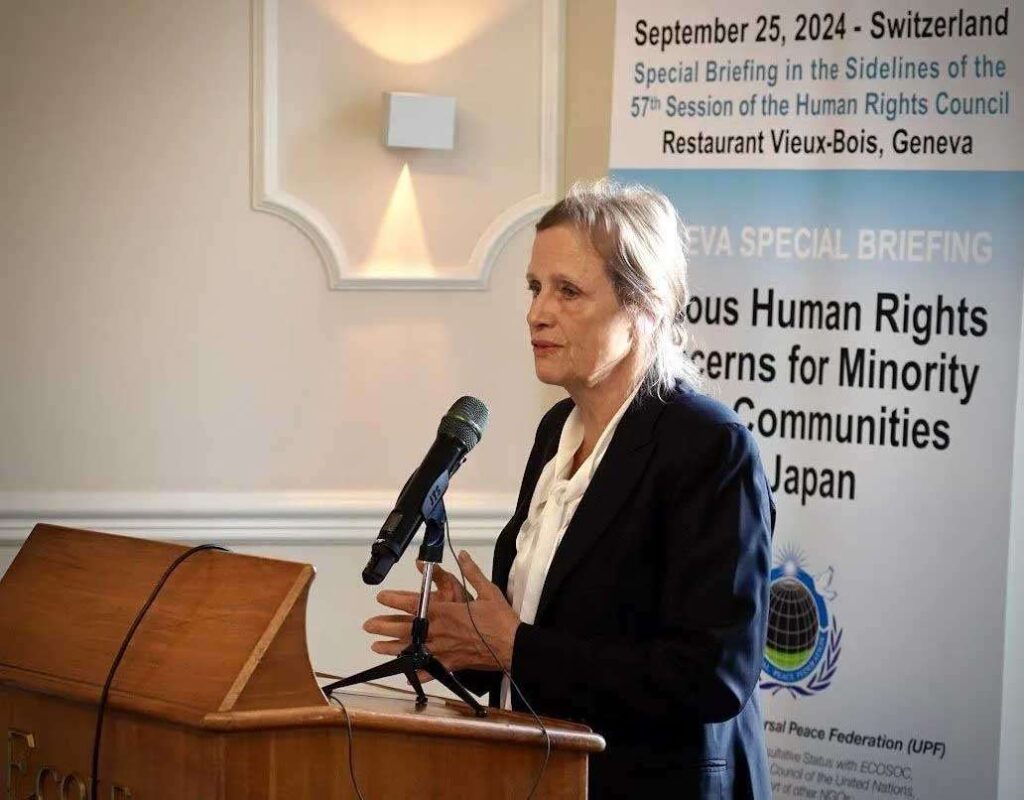
Patricia Duval, a French international lawyer specializing in human rights issues, submitted a report to the United Nations in September, calling for reforms. She stated that the Japanese government’s request for a dissolution order against the Family Federation for World Peace and Unification (FFWPU, formerly the Unification Church) “violates international human rights law in many respects and infringes upon treaties Japan has ratified to guarantee fundamental rights and freedoms.”
At a presentation in Geneva, Switzerland, Duval highlighted that civil lawsuits demanding the return of donations from the Family Federation stem from former members who left the church after experiencing “abduction and forcible faith-breaking (deprogramming)”. She emphasized that the Japanese government is using these lawsuits as grounds to initiate currently pending dissolution proceedings against the church.
The Human Rights Committee, which oversees the implementation of the International Covenant on Civil and Political Rights (ICCPR), has called on the Japanese government to make amends, claiming that it has “unlawfully restricted the right to freedom of religion or belief on the basis of the ‘public welfare’.” In its recommendations, the committee expressed concern that the “concept of ‘public welfare’ is vague and open-ended” and that it “may allow for restrictions that go beyond what is permissible.”
However, according to Duval, the Japanese government has ignored these recommendations. She pointed out that Japan’s Religious Corporations Act, which justifies dissolution orders based on “violations of public welfare”, must be repealed to align with international human rights standards.
Furthermore, following the assassination of former Prime Minister Shinzo Abe (安倍晋三), Patricia Duval pointed out that “a media onslaught against the former Unification Church, led by the National Network of Lawyers Against Spiritual Sales (Zenkoku-benren), began.” This led to many cases of believers being discriminated against, subjected to domestic violence, and divorced have occurred.
The National Network used “spiritual sales” as a pretext to criticize the Family Federation, a narrative amplified by the media to sway public opinion. This media frenzy, in turn, pressured the Japanese government to sever all ties with the church, culminating in the initiation of dissolution proceedings. Duval described how this cycle extended to the judiciary, which, under pressure from the media and public opinion, has repeatedly handed down rulings unfavorable to the church.
Concerning the 32 lawsuits cited as grounds for the dissolution request, Duval noted two major issues:
- Courts relied on the discredited theory of “mental manipulation” (mind control).
- The “social acceptability” standard used to determine the legality of donation solicitation was deemed “arbitrary and vague”.
These ambiguous and discriminatory concepts, Duval argued, have been exploited to restrict the former Unification Church‘s right to proselytize. Furthermore, judges displayed a “presumption of guilt” against believers, often ignoring their claims.
On the other hand, regarding the Japanese government’s justification for restricting “freedom to manifest religion or belief”, it was pointed out that the International Covenant on Civil and Political Rights (ICCPR) does not include “public welfare” or “social acceptability” as valid grounds. The Japanese government was accused of “continuing to violate the UN covenants it has signed and ratified.”
The report also criticized “anti-cult” counseling in schools, describing it as a new form of “state-led deprogramming” that doesn’t involve physical abduction but still violates the rights of religious “second-generation” individuals. Such measures were condemned for infringing on parents’ rights to educate their children based on their faith, as guaranteed under human rights covenants.
Considering the series of actions taken by the government, one cannot shake the impression that this is a state-led project aimed at eradicating a specific religious organization. Some media outlets have reported on the closed-door hearings at the Tokyo District Court regarding the Ministry of Education, Culture, Sports, Science, and Technology’s (MEXT) request for a dissolution order against the Family Federation for World Peace and Unification. During witness examinations involving former and current believers, current members reportedly argued that “the claims made by former members contain falsehoods.”
Could MEXT be leveraging former members to support its arbitrary assertions? Continuing to violate UN covenants risks Japan being perceived by the international community as a nation that suppresses religious freedom.
Click here to read more on Religious Persecution
Featured image above: Patricia Duval presenting her report in Geneva, Switzerland 25th September 2024. Photo: FOREF