Tokyo paper exposes how members of the Diet and network of lawyers have close ties to professional faith-breakers earning large amounts on abductions, forcible detentions, and coercive manipulation of members of the Family Federation in Japan
Tokyo, 21st December 2024 – Published as the 54th article in a series in the Japanese newspaper Sekai Nippo. Republished with permission. Translated from Japanese. Original article
The Constitutional Democratic Party (CDP) invited to a public hearing faith-breaker Miyamura, found guilty of being involved in abductions
A perverted sense of human rights
by the Religious Freedom Investigative Team of the editorial department of Sekai Nippo
prepared by Knut Holdhus
In cases involving abduction and confinement, members of the Family Federation for World Peace and Unification (formerly the Unification Church) were subjected to daily “persuasion” by their parents, faith-breakers, pastors, former members, and others. Even when these individuals held captive had “realized what the ‘errors’ of the church and its doctrines were” and expressed a desire to leave, their freedom was not immediately restored. This was because numerous “tests of commitment” were imposed to confirm their intent to leave.
This process can be described as rewriting the lives of “former members” from an anti-Family Federation perspective. At this stage, the media and lawyers play crucial roles.
In the case of Dr. Hirohisa Koide (小出浩久), he was given specific instructions by pastor Yasutomo Matsunaga (松永堡智):
- Organize and correct the errors of the Divine Principle (the church’s doctrine).
- Learn the correct interpretation of the Bible.
- Restore trust in parent-child relationships.
- Recover from harm.
- Reintegrate into society.
Of these, particular attention is drawn to points 1, 4, and 5.
For “organizing errors,” individuals were made to read critical works such as The Fear of Mind Control (published by Koyu Shuppan) by Sadao Asami (浅見定雄), a leading critic of the church, and other similar materials. They were then required to write reflective essays, summarize their personal experiences of faith (e.g., divine encounters, spiritual experiences), and state how they currently felt about these.
For “recovery from harm”, individuals had to first write a “resignation statement” and list the names, affiliated churches, and addresses of church members they knew. They were also required to list the names of people who introduced them to products from companies related to the Unification Movement and the amounts they spent on such items. These lists were used to manipulate other believers into leaving and to sue the Family Federation for compensation.
Through this process, after confirming the intent to leave the church, individuals would gradually gain their freedom, such as being allowed to go out accompanied by their parents. At the same time, full-fledged efforts toward “recovery from harm” and “social reintegration” (rehabilitation) would begin.
At this stage, journalist Yoshifu Arita (有田芳生 – currently a member of the House of Representatives for the Constitutional Democratic Party) and a reporter for the Weekly Bunshun “interviewed” Dr. Koide by going through Takashi Miyamura. [Editor’s note: Arita was born 1952, named Yoshifu after Joseph Stalin, and is journalist, writer, anti-religious activist and politician for Japanese Communist Party 1990-2007, elected to House of Councillors (Upper House) in the Diet 2010-2022 for Constitutional Democratic Party and to House of Representatives (Lower House) for the same party in 2024]
Around July 1993, they conducted a 3 to 4-hour interview, after which, Koide recalls, “Both of them (Arita and the Weekly Bunshun reporter) said, ‘It’s amazing that you endured being confined for a year.’”
They were aware that Koide had been abducted and confined. However, the article published in the 16th September 1993 issue of the magazine made no mention of the abduction or confinement.
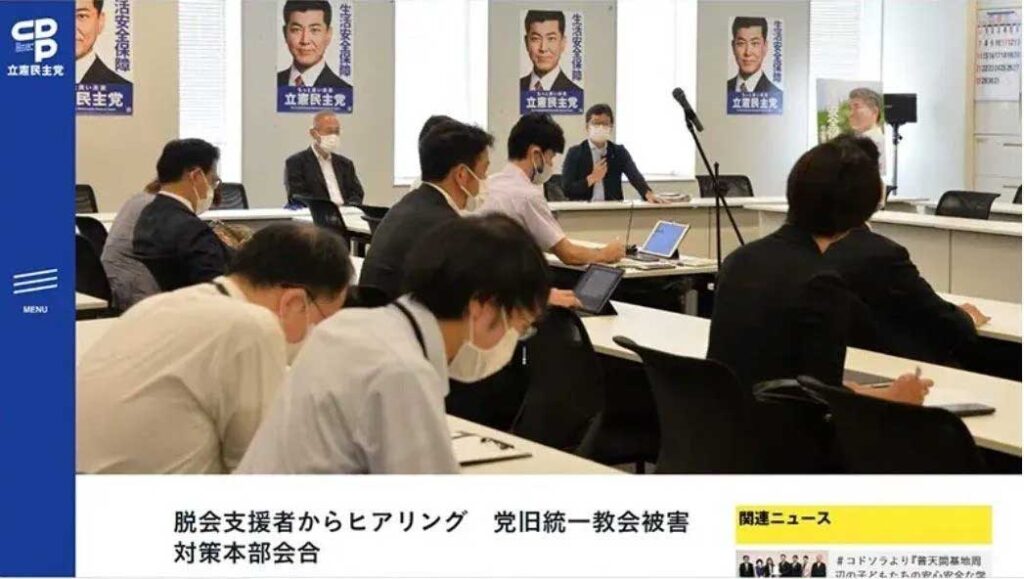
Arita described Miyamura as “pure like a child, unpretentious, […]” suggesting a close relationship. Indeed, on 18th August 2022, Miyamura participated in the seventh meeting of the CDP’s task force – (led by Representative Chinami Nishimura (西村智奈美) – on damages caused by the former Unification Church. According to the CDP’s official website, Miyamura attended as “Takashi Miyamura, who has been supporting individuals in leaving the former Unification Church.” Arita was also present.
After the mass media reported on a daily basis that the shooter of former Prime Minister Shinzo Abe (安倍晋三) had spoken out about his hatred for the Family Federation, the CDP set up a task force and conducted hearings with various government agencies. Simultaneously, starting with Miyamura on the same day, they began interviewing former members, their families, and second-generation individuals. Miyamura was the first to testify.
Miyamura was found liable in a civil suit brought by Toru Goto (後藤徹氏), who was confined for 12 years and five months starting in September 1995 and coerced to leave the church (Supreme Court ruling on 29th September 2015). The court recognized Miyamura’s unlawful acts of “instigation” or “aiding and abetting” the abduction and confinement carried out by Goto’s relatives and ordered Miyamura to pay compensation. The CDP must have been aware of this fact. Even if they had the backing of Arita, who also served as a member of the House of Councillors for the CDP, it is fair to say that the CDP’s sense of human rights has fallen to new lows.
After the hearing, Michihiro Ishibashi (石橋通宏), a CDP member of the House of Councillors, told reporters, “We received valuable insights from Takashi Miyamura on how difficult it is to leave when completely under mind control.”
While the theory of mind control has long been dismissed in Western countries, in abduction and confinement cases, it becomes according to Toru Goto “a highly convenient theory for justifying forcible faith-breaking, as individuals are considered incapable of thinking for themselves and thus unable to leave voluntarily.” This claim entirely disregards the human rights of Family Federation members, but the biased nature of such hearings seems to prevent any acknowledgment of this reality.
Miyamura also set a condition for Koide’s attendance at his younger brother’s wedding, scheduled for September 1993: “You must appear on an upcoming TBS [Tokyo Broadcasting System] special report and clearly demonstrate a confrontational stance against the church and the hospital.”
Koide agreed, and a recording session took place on the banks of the Shinano River on September 5th. The program was aired on September 13th. During this process, the TBS director remarked, “Miyamura has been guiding us on various matters related to the Unification Church.” After the filming, staff members commented, “We’ve had a long relationship with Miyamura. […] we’d love to create a special feature program about him someday.” Given this mutually beneficial relationship with Miyamura, it would be highly unlikely for TBS to address the issue of abduction and confinement.
Collaboration between lawyers’ network and faith-breakers: A double standard on human rights
A similar mutually beneficial relationship with Takashi Miyamura can also be observed among the lawyers of the National Network of Lawyers Against Spiritual Sales (NNLASS). These lawyers often relied on Miyamura and others to introduce them to “victims”, former church members seeking “recovery from damages”.
Around late September of that year, Koide was finally allowed to attend services accompanied by his father at pastor Yasutomo Matsunaga’s church. Miyamura introduced him to two NNLASS lawyers, Hiroshi Yamaguchi (山口広) and Masaki Kito (紀藤正樹). Initially, they met at a lawyer’s office in Niigata, as requested by Miyamura. Afterward, they met monthly in Tokyo.
At each meeting, the two lawyers would say, “It should be okay to let him act freely by now. Well, it’s best to check with Miyamura about that.”
This indicated that they were well aware of Koide living under his parents’ surveillance and understood Miyamura’s role. Yamaguchi and Kito were not unaware at the time that Miyamura had incited and assisted in the abduction and confinement of Family Federation members.
Yoshiro Ito (伊藤芳朗), another lawyer who worked with Yamaguchi and Kito at NNLASS, addressed this in a testimony submitted for Toru Goto’s trial. In an interview, Ito recounted that he told Yamaguchi, “Miyamura’s methods are problematic.”
Then, Yamaguchi replied, “Our role is to get involved after members leave. We should not involve ourselves in what happens before they leave.”
When asked whether Yamaguchi knew about Miyamura’s abduction and confinement tactics, Ito answered, “Of course!” He described Yamaguchi’s response as “cunning”.
Furthermore, Ito testified that Miyamura exclusively referred multi-billion-yen “high-value cases” involving lawsuits against the church to Masaki Kito, indicating a close relationship between the two.
Yoshiro Ito stated, “Takashi Miyamura’s activities for encouraging members to leave were nothing more than profit-driven schemes disguised as ‘exit assistance’. In reality, they amounted to abduction, confinement, and forcible faith-breaking.”
Backed by support from Yamaguchi and Kito, among others, Yoshiro Ito testified that he was able to exclude Miyamura from the National Network of Lawyers Against Spiritual Sales (NNLASS) from 1994 until 2005, when Ito himself resigned from the organization. However, he also noted that Masaki Kito maintained contact with Miyamura, and after Ito’s resignation, Miyamura seemingly regained his connection with NNLASS.
NNLASS included lawyers such as Masaki Gouro (郷路征記), who led a defense team of 122 attorneys to oppose a habeas corpus petition [See editor’s note below] filed on behalf of Tadashi Yoshimura (吉村正). Yoshimura, a Kyoto University graduate and member of the Unification Church, was abducted in Kyoto in 1987 and confined in an iron-barred apartment belonging to Mitsuo Toda (戸田実津男), a professional faith-breaker, in Hokkaido.
Due to the defense team’s delays, Yoshimura was forced to escape on his own and filed a criminal complaint. Toda admitted in a written apology dated 10th November 1988, that he had engaged in “abduction, confinement, and coercive faith-breaking”, acknowledging that such actions violated criminal law. This admission spared him from criminal punishment. However, Gouro consistently denied any involvement in abduction or confinement.
The coercive methods used against thousands of Family Federation members to force them to renounce their faith serve as a stark indicator of Japan’s human rights situation.
Since the assassination of former Prime Minister Shinzo Abe, the mass media – including television and newspapers – has extensively reported on the Family Federation, with the government and various political parties also addressing the issue. While the media has highlighted problems such as donation-related controversies and issues faced by “second-generation members”, it has completely avoided reporting on the issue of abduction and confinement except for coverage in a few weekly magazines, and if the issue was raised by some Diet members. This demonstrates a clear double standard in addressing human rights issues.
Additionally, lawsuits and claims for damages filed by former members against the church, following their renunciation of faith after abduction and confinement, have garnered significant attention from the government, political parties, and the media. However, these claims stem from a background of prolonged confinement and deprivation of freedom. Accepting such claims at face value raises questions about fairness and legitimacy. How is this different from the methods used in countries like China and North Korea to extract confessions through prolonged detention? It is difficult to view such practices as consistent with the values of a nation that prides itself on human rights and democracy.
[Editor’s note: A habeas corpus petition is a legal request to a court, usually made by someone who is detained or imprisoned, asking the court to determine whether their detention or imprisonment is lawful. The main purpose of a habeas corpus petition is to protect individuals from unlawful or arbitrary detention. The detainee, or someone acting on their behalf (such as a lawyer or family member), files the petition with a court. The court reviews the petition and may issue a writ of habeas corpus, compelling the custodian (such as a prison warden or government authority) to bring the detainee before the court. At the hearing, the custodian must provide legal justification for the detention. If the court finds the detention unlawful, it may order the detainee’s release. Habeas corpus is considered a cornerstone of individual liberty and rule of law. It is enshrined in many constitutions and international human rights frameworks, including the U.S. Constitution (Article I, Section 9).]
Click here to read more on Religious Persecution
Featured image above: From the official website of the Constitutional Democratic Party (CDP) where it 18th August 2022, published news regarding a public hearing to which professional faith-breaker Takashi Miyamura was invited, the seventh meeting of the party’s task force on alleged harm caused by the former Unification Church. Photo: Screenshot