Japanese politician censured for his attack on religious minority when using Nazi ideas and the same kind of totalitarian thinking and eugenics ideology as that of Hitler
Tokyo, 29th November 2024 – Published as the 43rd article in a series in the Japanese newspaper Sekai Nippo. Republished with permission. Translated from Japanese. Original article
Concerns about Media and Politics Getting Out of Control
Various Religious Denominations Make Statements
by the Religious Freedom Investigative Team of the editorial department of Sekai Nippo
Prepared by Knut Holdhus
In May last year, the Family Federation for World Peace and Unification (formerly the Unification Church) held an international mass wedding ceremony in South Korea. Prior to this, in February of the same year, at a hearing of opposition parties held in the National Diet, Kazunori Yamanoi (山井和則), a member of the House of Representatives from the Constitutional Democratic Party (CDP), stated, “A dissolution order must be issued before the mass wedding ceremony takes place. If it is delayed, it could lead to children born from the mass wedding asking, ‘Why didn’t you stop it?’”
This remark implied that children born to parents of this faith should not exist.
Norio Hosoya (細谷典男), a city council member from Toride City, Ibaraki Prefecture, took issue with this statement. On 20th July this year, he delivered a lecture at the “Niigata Prefectural Symposium to Protect Freedom of Religion and Human Rights”, which was organized by Family Federation believers. Hosoya criticized the statement, comparing it to the totalitarian and eugenic ideas of Nazi Germany, saying, “This is the same kind of totalitarian thinking and eugenics ideology as that of Hitler. For example, the Nazis killed disabled people because they were deemed a burden, and this later escalated into the Holocaust – the systematic genocide of Jewish people by state power.”
Hosoya warned that such rhetoric must not be overlooked, drawing parallels to how the Nazis gained power with popular support.
At the Niigata Prefectural Symposium, attendees represented a wide range of religious denominations, reflecting diverse voices and perspectives.
A man who follows the teachings of Ryokan (良寛和尚), a renowned Zen Buddhist monk, expressed deep concern, saying, “It’s abnormal that something like the Holocaust is even being discussed in modern times.”
He added, “I was moved by the fact that Family Federation members practice their faith with conviction, no matter how much criticism they receive.”
A priest from the Hokke School (法華宗 – Nichiren Buddhism) shared his worries about unchecked public sentiment, remarking, “The law should properly restrain the swelling tide of public opinion, but it is failing to do so. It is unhealthy to allow the vulnerable to be relentlessly attacked.”
A female member of Soka Gakkai, who started studying the teachings of the Family Federation after her son joined it two years ago, stressed, “We should not judge the essence, teachings, and activities of the Family Federation by looking at only a portion of it.”
She added, “As our organization also faces criticism, this gathering gave me courage.”
A pastor leading a branch of a Christian new religious movement attended a similar symposium held on 14th October in Osaka. He warned, “The media and the political left have run amok, with the legal community and public opinion completely capitulating. I sense an oppressive atmosphere close to totalitarianism.”
Haruhisa Nakagawa (中川晴久), Senior Pastor of the Christian Church of the Lord’s Sheep (主の羊クリスチャン教会 – based in Yokohama), has also spoken at gatherings organized by Family Federation believers across Japan. In his lectures, he has argued against the unjust nature of the dissolution order request targeting the organization.
Over 25 years ago, Pastor Nakagawa viewed the Family Federation as heretical. In 2013, harboring thoughts of “They should just collapse,” he covertly infiltrated one of their facilities in Yokohama, concealing his role as a pastor. However, after repeatedly interacting with members through his visits, his perspective underwent a complete transformation.
He stated, “The Family Federation fosters a sense of connection and bonds among its believers, creating a very positive community. Members sincerely practice their faith, encouraging and supporting one another. This experience resolved almost all the issues I had with the religious organization.”
Nakagawa also noted that the people he encountered in the Family Federation were “filled with a spirit of wanting to improve society.” He observed significant improvements in visible metrics such as lawsuits and complaints, particularly after 2009. However, he criticized the lack of recognition for these positive changes, arguing, “The absence of any acknowledgment of these efforts is, in itself, a problem.”
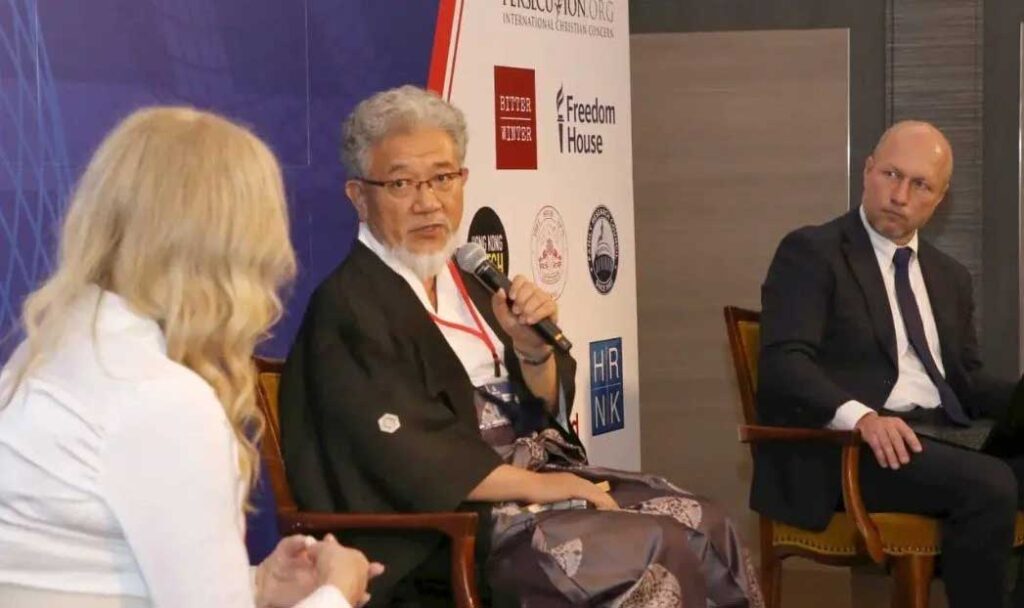
Religious leaders are beginning to raise their voices on international platforms. On 22nd July 2024, at the International Religious Freedom (IRF) Summit Asia held in Tokyo, Yoshinobu Miyake (三宅善信), Executive Director of the Shinto International Institute (神道国際学会), addressed the issue of the dissolution order request.
He remarked, “In the National Diet, which is the source of democratic power, lawmakers have turned a blind eye to the social annihilation of a particular new religious movement due to fears of being associated with it. Furthermore, the mass media has taken on the role of judge.”
His comments challenged the dominant narrative in major media outlets, which have overwhelmingly assumed a stance that “dissolution as inevitable” in their reporting.
Click here to read more on Religious Persecution
Featured image above: Yoshinobu Miyake (三宅善信) speaking at IRF Asia (center of photo), 22nd July 2024, Chiyoda Ward, Tokyo. Photo: Kato Reiwa (加藤 玲和)