The conflict between the secular and the sacred amidst fierce persecution brings up the question of the relationship between personal salvation and contributions to society
Tokyo, 26th December 2024 – Published as the 58th article (final) in a series in the Japanese newspaper Sekai Nippo. Republished with permission. Translated from Japanese. Original article
Challenge of the Family Federation – Striking a Balance Between “Salvation” and Social Contribution
by the Religious Freedom Investigative Team of the editorial department of Sekai Nippo
prepared by Knut Holdhus
On a Sunday morning, a little over two months after the assassination of former Prime Minister Shinzo Abe (8th July 2022), a loud voice was heard from a group of six elderly people at a café in Funabashi City, Chiba Prefecture, “Members of the Unification Church are all good people. The current TV reports are strange.”
At the time, television programs, especially infotainment shows, were heavily critical of the Family Federation for World Peace and Unification (formerly the Unification Church). The speaker was a man in his seventies, seemingly the leader of the group, who appeared to have significant personal interaction with members of the church.
The other five individuals in the group merely listened. There was a noticeable gap between the man’s perspective and the narrative presented by the media, creating a sense of dissonance. However, since their knowledge of the Family Federation was limited to media reports, the others did not say anything. Judging from their demeanor, I guess that is what was going through the minds of the five.
Approximately one month later, the Mainichi Shimbun published the results of a public opinion poll. It revealed that 82% of respondents believed a dissolution order against the Family Federation should be issued, compared to only 9% who thought it unnecessary. Seeing this data brought to mind the man’s voice from the café.
If more people had had direct experience interacting with members of the faith, the results of the opinion poll would probably have been quite different. As we continued to cover the Family Federation, we realized that the issue facing the religious organization was how to bridge the gap with society.
On the other hand, the poll figures highlighted the strong influence of the media. This year, newspapers and television, often derided as “old media”, have been criticized for their biased tendencies, which stray far from impartial reporting. Particularly, left-leaning media outlets, opposing the religious organization known for its strong anti-communist stance, appear to have played a significant role in shaping public opinion equating the organization with “anti-social elements”. The church, for its part, seems to have been caught off guard, failing to effectively communicate its true identity.
Among the religions that deal with human salvation, new religions tend to be more inward-looking. The shallow understanding of “religious freedom” in the mass media, which is based on “secular” values, has led to devout believers becoming more inward-looking, widening the gap between them and society. This is a manifestation of the classic conflict between the “sacred” and the “profane”.
Given the relentless media coverage – arguably amounting to “bashing” – it is unsurprising that believers feel increasingly victimized. However, when considering the passing on of their faith to second and third generations, it is an unavoidable task for them to earn the trust of society through their own efforts.
According to Tomihiro Tanaka (田中富広), the president of the Family Federation, the church‘s vision consists of three pillars:
- Building happy families that live for the sake of others.
- Churches that coexist with their local communities.
- Contributions to the nation and the world.
These visions underscore that the Family Federation is inherently a religious organization that does not confine itself to a sacred space but instead places importance on relationships with the community, the nation, and the world. This is evident from the church‘s involvement with political and volunteer organizations as affiliated groups.
However, one might question whether the followers truly shared and practiced this vision. If they had, voices like the one heard in the café at the beginning of the article might have been more widespread. The figure of 80% in favor of the request for the dissolution order not only indicates a shallow understanding of religious freedom among the media and the general public but also the believers’ excessive focus on personal salvation while their vision is not being shared sufficiently. This is likely one point the religious organization needs to reflect on.
How to connect the salvation of individual believers with the vision that the religious organization aims for
This year marks the organization’s 60th anniversary of recognition as a religious corporation, and we are in the midst of a generational change. Therefore, we would like to point out that it is a major challenge for the Family Federation to link the salvation of individual believers with the broader vision the religious organization aims to achieve.
Another factor contributing to the widening gap with Japanese society may stem from the fact that the religious organization originated in South Korea. This is also where the stigma of being an “anti-Japanese cult” came from.
The founder of the religion, Reverend Sun Myung Moon, was Korean, and his wife, Hak Ja Han, who is still alive and resides in South Korea, currently leads the organization. To her followers globally she emphasizes the importance of loving one’s own country. On the other hand, it is only natural that for both the individual members and the organization itself, the focus on the “sacred” would lead to a strengthening of ties with South Korea.
However, as a legally recognized entity in Japan, the Family Federation bears the obligation to comply with the law. In addition, the organization has secular responsibilities such as contributing to the development of society. It is incumbent upon leaders, including President Tomihiro Tanaka, to guide members in balancing these responsibilities while pursuing the organization‘s vision. That said, it is undeniable that, in the past, an excessive focus on devout faith may have led to a neglect of the latter responsibility.
Apart from the heinous crimes committed by Aum Shinrikyo (オウム真理教), topics related to freedom of religion – a cornerstone of democracy – rarely surfaced in postwar Japanese society. In this context, the issue of the dissolution order against the Family Federation has inadvertently demonstrated the limited understanding of religious freedom among politicians, the media, the general public, and even the judiciary.
At the same time, the conflict between the secular and the sacred brought to light by this issue seems to be prompting religious organizations to change and become more open to society. Likewise, its followers now appear to be encouraged to deepen and universalize their faith in a direction that links personal salvation to contributions to society.
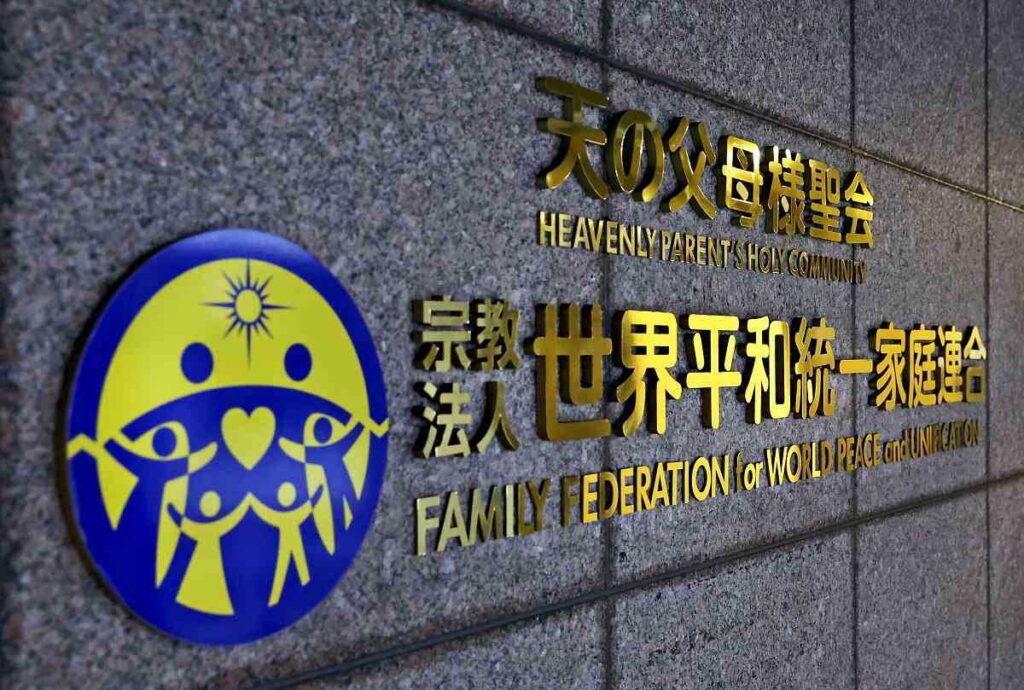
Featured image above: Sign at the main entrance of the Japanese headquarters of the Family Federation in Shibuya, Tokyo. Photo: Sekai Nippo