Persecuted believers from religious minority advised at symposium to use digital strategy and social media push
Tokyo, 10th March 2025 – Published as an article in the Japanese newspaper Sekai Nippo. Republished with permission. Translated from Japanese. Original article.
“Spread the Truth via Social Media”
NHK Party’s Tachibana Speaks in Chiba on Dissolution Request Issue
by the editorial department of Sekai Nippo
Prepared by Knut Holdhus
On 8th March 2025, the Chiba Citizens’ Association for Protecting Freedom of Religion and Human Rights, primarily composed of followers of the Family Federation for World Peace and Unification (formerly the Unification Church), held a symposium in Chiba City.
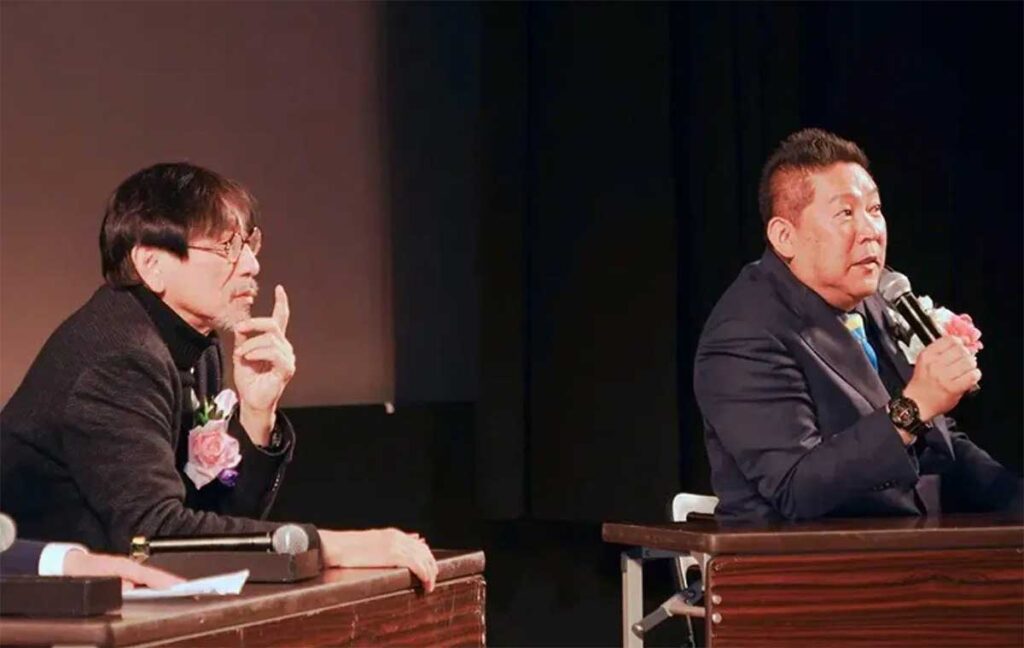
Takashi Tachibana (立花孝志), leader of the Party to Protect the People from NHK [See editor’s note 1 below], who appeared as a guest speaker, urged attendees to “use social media and YouTube to spread the truth” regarding issues surrounding the religious organization.
Tachibana emphasized, “We need to make sure that people who refuse to listen to our opinions will actually hear us out.”
He pointed out that the Family Federation already has a “weapon” in the form of claims regarding coercive faith-breaking [See editor’s note 2 below] through abduction and confinement. He said, “If they present this issue effectively, they will gain more allies. The key is how to use this strategically.”
He noted that in the past, the only way to get coverage was through television and newspapers, but now, he insisted, “The internet exists. If you create videos and invest money, you can advertise. That’s where you should start.”
Attorney Shinichi Tokunaga (徳永信一) also took the stage, discussing a lawsuit in which he represented the plaintiff against journalist Eito Suzuki (鈴木エイト). In the case, a Family Federation member had allegedly been confined for over 12 years by his family members opposed to his faith. He had been referred to as a “hikikomori” (social recluse), which was deemed defamatory. In January of this year, Suzuki was ordered to pay ¥110,000 in damages. Tokunaga highlighted the role of social media in spreading awareness of the court ruling, stating, “There’s an appeal coming up, so this is another chance to get the message out. It’s crucial to think strategically about how to appeal to public opinion.”
During their discussion, Tokunaga reflected on Tachibana’s efforts in the Hyogo gubernatorial election, describing him as someone who is “battling against the times”. Tachibana, in turn, likened YouTube to a “black ship” from the perspective of TV stations, explaining that traditional media is wary of the rise of new digital platforms.
[Editor’s note 1: The Party to Protect the People from NHK (NHKから国民を守る党, NHK kara Kokumin wo Mamoru Tō, often abbreviated as N-Koku) is a minor political party in Japan. It was founded in 2013 by Takashi Tachibana, a former NHK employee, with the primary goal of opposing Japan’s public broadcaster, NHK (Nippon Hōsō Kyōkai). The party criticizes NHK’s mandatory subscription fees and has campaigned to allow people to avoid paying for NHK if they don’t watch it.
Over time, the party has shifted its focus, rebranding multiple times and addressing broader issues, but its core stance remains opposition to NHK. It has gained attention for its unconventional campaigning methods and populist rhetoric but has had limited electoral success.]
[Editor’s note 2: Coercive faith-breaking in Japan refers to the practice of coercively attempting to separate individuals from their religious affiliations or beliefs, typically through intervention by family members, professional faith-breakers (deprogrammers) or organizations hostile to new religious movements (NRMs). This phenomenon often targets members of such movements, e.g. relatively large faiths like the Family Federation or Jehovah’s Witnesses, but also smaller groups like Happy Science (Kōfuku no Kagaku) and other newer religious movements. However, also Soka Gakkai, a Buddhist-based lay organization with more than 8 million Japanese members, and affiliated with Nichiren Buddhism, has occasionally been subject to faith-breaking attempts.
The practice gained attention in the latter half of the 20th century, particularly in the 1980s and 1990s. Parents or concerned family members often hired faith-breakers who taught them how to abduct and forcibly detain believers. Almost all such cases involved confining the individual believer and cutting him or her off from the religious community. During the confinement, the believer was subjected to intense questioning or indoctrination designed to break his or her faith. The aim was to “rescue” the person from what the family often had been tricked by faith-breakers or lawyers to regard as harmful influence from the religious organization.
Critics of forced de-conversion argue that it violates fundamental human rights, including freedom of thought, religion, and association. Reports of psychological trauma and accusations of unlawful detention have sparked debates over its ethical and legal implications. In response, some religious groups, particularly NRMs, have lobbied for greater protections against such practices.
Japanese courts have been inconsistent in addressing cases of coercive faith-breaking. While some verdicts have condemned the practice as illegal detention, others have been more lenient, citing family concerns about “mental health” or alleged “exploitation” as mitigating factors.]
Featured image above: Takashi Tachibana (right), leader of the “Party to Protect the People from NHK”, and lawyer Shinichi Tokunaga as guest speakers at a symposium on the afternoon of 8th March 2025, in Chiba City. Photo: Yasuhiro Uno (宇野泰弘)