Japan’s Crackdown on Religion Sparks Global Outcry. Most of the plaintiffs in civil lawsuits at the center of the dissolution case were forced to sue the Family Federation after having been coercively “deprogrammed.”
Tokyo, 26th April 2025 – Published as an article in the Japanese newspaper Sekai Nippo. Republished with permission. Translated from Japanese. Original article.
Using Coerced Renunciation of Faith as a Means of Dissolution
The Dark World of Deprogramming Spreading Amid the Move to Dissolve the Family Federation (3)
by the Religious Freedom Investigative Team of the editorial department of Sekai Nippo
Prepared by Knut Holdhus
“The Japanese government’s attempt to destroy religion is extremely dangerous,” warned former U.S. House Speaker Newt Gingrich at an international conference on religious freedom held in Seoul, South Korea, on 11th April. In an interview with this paper, Gingrich strongly criticized Japan’s moves to dissolve the Family Federation for World Peace and Unification (formerly the Unification Church) as a religious corporation.
Gingrich had also expressed opposition to the dissolution a day before the Tokyo District Court issued its order on 25th March, posting his views on X (formerly Twitter) on 24th March. Gingrich emphasized, “The most fundamental human right is the freedom of religion — the freedom to seek God.”
Reflecting this belief, the Trump administration had established the Faith and Opportunity Initiative at the White House. Pastor Paula White, who has been appointed as its chief advisor, sent a video message to a conference hosted by the Japan Committee of the International Religious Freedom Roundtable (ICRF) in Tokyo 8th December last year.
In her message, White raised the following concerns:
- The U.S. State Department’s Office of International Religious Freedom, in its 2022 and 2023 reports, expressed serious doubts about Japan’s respect for religious freedom. The 2022 report noted that following the assassination of former Prime Minister Shinzo Abe (安倍 晋三), the Family Federation became the target of intolerance, discrimination, and persecution campaigns.
- The 2023 report criticized the Japanese government’s request to dissolve the Family Federation even though it had not been found guilty of any criminal offenses, calling this a departure from established legal norms.
- On 23rd April 2024, the United Nations issued a recommendation through its Special Rapporteurs on religious freedom and human rights. It warned that Japan’s government guidelines – which could interpret parents urging their children to attend church as potential child abuse – may lead to persecution of religious groups such as Jehovah’s Witnesses and the Family Federation. The UN raised concerns about Japan’s compliance with the Universal Declaration of Human Rights and the International Covenant on Civil and Political Rights, both of which Japan has ratified.
- UN Special Rapporteur on Freedom of Religion or Belief, Nazila Ghanea, officially requested to visit Japan to investigate potential violations of religious freedom against minority religions, but the Japanese government refused. This refusal has sparked serious international concern about religious freedom in Japan.
White also voiced worries that parts of Japan’s media, government, and Ministry of Justice are withholding information from the public, preventing citizens from understanding the full facts.
Despite these international concerns, the Tokyo District Court’s dissolution ruling made no mention of them.
Moreover, most of the plaintiffs in the civil lawsuits cited by Japan’s Ministry of Education, Culture, Sports, Science, and Technology (MEXT) as evidence for dissolution were former believers who had left the religious organization through deprogramming (faith-breaking) – forced to abandon their faith through abduction and confinement.
Deprogramming (faith-breaking) first gained traction in the United States during the 1970s when members of the Family Federation, pejoratively called “Moonies”, were targeted alongside other new religious movements. Many deprogrammers (faith-breakers), often referred to as “exit counselors”, ended up facing prison sentences for their involvement in abduction and confinement cases. By the early 1990s, deprogramming was widely recognized as illegal in the United States.
Meanwhile, in Japan, the abduction and confinement of Family Federation believers peaked during the same period. With police turning a blind eye, deprogramming (faith-breaking) became rampant, affecting more than 4,000 believers.
In 2013, the international NGO Human Rights Without Frontiers submitted a report titled “Japan: Abductions and Confinement for the Purpose of Forced Apostasy” to the UN Human Rights Committee, calling for reforms.
In its 2014 final review of Japan’s human rights record, the UN committee explicitly stated that “abduction and forced apostasy activities against believers of new religions” violate the International Covenant on Civil and Political Rights and expressed formal concern.
Regarding MEXT’s request for the Family Federation’s dissolution, international human rights attorney Patricia Duval pointed out that the civil lawsuits used as grounds for dissolution were brought by former believers who had left the church through “abduction and forcible deprogramming”.
In September of last year, Duval submitted a report to the United Nations, arguing that Japan’s moves to dissolve the Family Federation constitute a “violation of international law”.
That the Tokyo District Court issued the dissolution order without properly investigating these matters is deeply troubling. In effect, the court’s decision uses deprogramming (faith-breaking) – a practice internationally recognized as a human rights violation – as a means to dissolve the Family Federation.
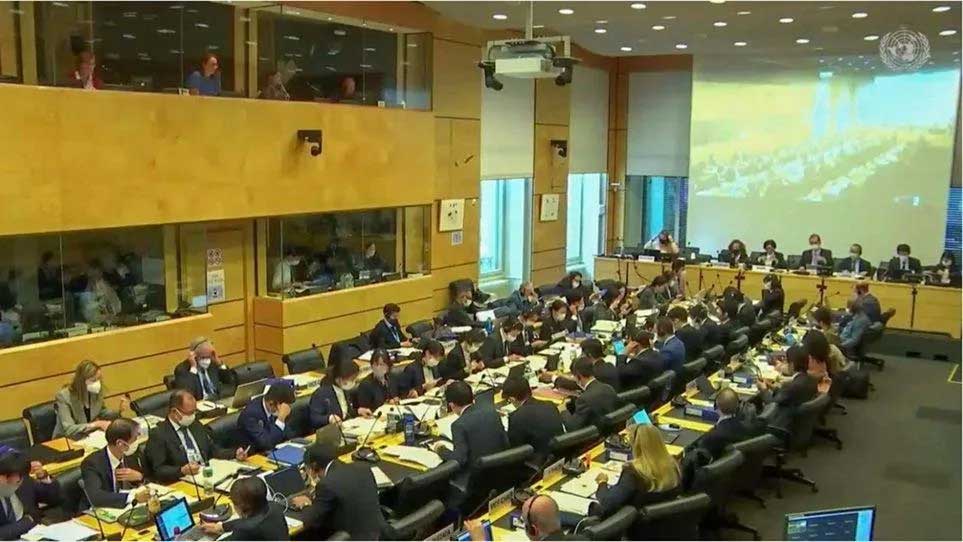
Featured image above: Meeting of the UN Human Rights Committee – October 2022, Geneva, Switzerland. Screenshot from a broadcast video.