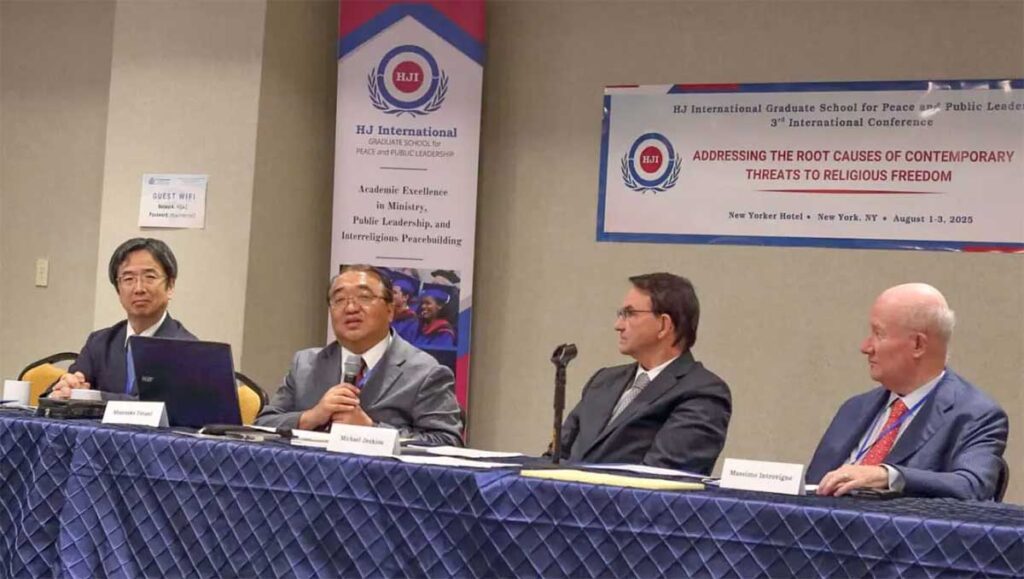
Tokyo 2025 dissolution order against Family Federation criticized at international conference in New York on freedom of religion globally
Tokyo, 4th August 2025 – Published as an article in the Japanese newspaper Sekai Nippo. Republished with permission. Translated from Japanese. Original article.
Closed-Door Hearings and Ambiguous Legal Basis Criticized
International Religious Freedom Conference in New York Raises Concerns over the Dissolution Order Against the Family Federation
by Yosuke Yamazaki (山崎洋介)
Prepared by Knut Holdhus
On 2nd August, the second day of an international conference on religious freedom hosted by the HJ International Graduate School for Peace and Public Leadership (formerly the Unification Theological Seminary), scholars, human rights advocates, and journalists gathered at a hotel in New York City to exchange views. The conference also addressed the Family Federation for World Peace and Unification (formerly the Unification Church), which was ordered to disband by the Tokyo District Court in March.
The theme of the conference was “Addressing the Root Causes of Temporary Threats to Religious Freedom”. In the session focusing on the Family Federation, Shunsuke Uotani (魚谷俊輔), Secretary-General of UPF Japan – a group affiliated with the Federation – remarked that since the Aum Shinrikyo incident in the 1990s, scholars who previously gave favorable evaluations of the Federation came under fire, leading to a lack of academic research on the Family Federation from a neutral standpoint. He emphasized: “The trauma caused by the Aum incident on the study of new religions in Japan is extremely severe and, one could say, has not yet healed.”
Hirohisa Koide (小出浩久), a physician and Family Federation believer, testified about being confined by his parents and relatives, and pressured to renounce his faith by deprogrammers and Christian pastors. He described how he feigned renunciation to escape, but said: “That was the beginning of deep suffering.”
He claimed he was then coerced for about a year into speaking against the religious organization in the media and was forced to sign legal documents suing the Family Federation.
Participating online, international human rights lawyer Patricia Duval criticized the Tokyo District Court’s ruling, which deemed the religious organization’s recruitment and fundraising practices harmful to “public welfare” based on vague concepts like “social appropriateness.” She also raised concerns about the closed nature of the proceedings, suggesting that it could lead to fabricated testimony and a lack of procedural transparency.
In another session examining the historical and social background of threats to religious freedom, Massimo Introvigne, an Italian sociologist of religion, argued that there are five models of anti-cult movements: the “U.S. model,” “China model,” “Russia model,” “France model,” and “Japan–Korea model.” Regarding Japan and Korea, he pointed out: “Strangely, leftists such as socialists and communists are cooperating with Protestants, who are supposed to be theoretically anti-communist.”
The conference will continue until 3rd August. Discussions will include the role of governments and international organizations, with participants such as Jan Figel, former Slovak Deputy Prime Minister and the EU’s first Special Envoy for Freedom of Religion or Belief, and Richard Swett, former U.S. Ambassador to Denmark
Featured image above: Shunsuke Uotani (魚谷俊輔), Secretary-General of UPF Japan (second from left), speaks at an international conference on religious freedom, held at a hotel in New York City on 2nd August 2025. Photo: Yosuke Yamazaki (山崎洋介)