Experts on international human rights shocked by outrageous new anti-religious Japanese law that manufactures “victims” entitled to go to court to obtain large compensation for donations made years, even decades earlier, also it’s outrageous that Japanese authorities for 60 years have ignored gross human rights abuses against members of religious minority the Family Federation
Tokyo, February 4 and 5, 2025 – Published as an article in the Japanese newspaper Sekai Nippo. Republished with permission. Translated from Japanese. Original article 1 and article 2.
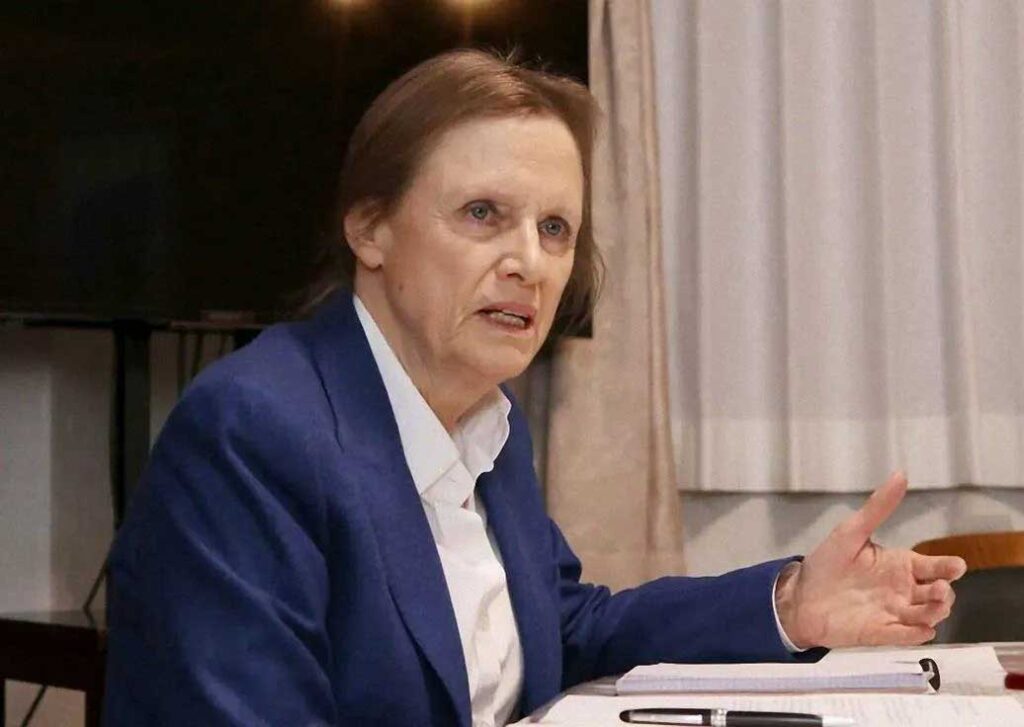
International Human Rights Lawyer Patricia Duval
by the Religious Freedom Investigative Team of the editorial department of Sekai Nippo
Prepared by Knut Holdhus
It has been reported that the statement submitted by Japan’s Ministry of Education, Culture, Sports, Science and Technology (MEXT) to the Tokyo District Court as evidence in its request for a dissolution order against the Family Federation for World Peace and Unification (formerly the Unification Church) contained fabricated testimonies. Amid such reports, French international human rights lawyer Patricia Duval, who is currently visiting Japan, provided her insights.
Duval also directly met with Miyuki Kawaguchi (pseudonym), who was previously interviewed by our newspaper on 21st January. Kawaguchi had spoken with her elderly mother, who had signed the MEXT statement, and the mother denied ever having said what was written in the document.
Q: What was your impression after meeting face-to-face with Miyuki Kawaguchi, who also spoke to our newspaper and Kyodo News?
I heard her testimony directly. As reported, it was the mother who introduced her daughter to the church, and the two had lived a life of faith together for over 30 years.
However, the MEXT statement, which the mother supposedly signed, claimed that she had been coerced by her daughter into making donations long ago, and that she wished for the dissolution of the Family Federation.
Originally, Kawaguchi’s brother did not entirely share the faith of his mother and sister, but he also never actively opposed it. However, following the assassination of former Prime Minister Shinzo Abe, the media became flooded with one-sided criticism of the Family Federation. This drastically changed his stance.
Following MEXT’s request for a dissolution order, a new law called the Special Act on Relief for Victims of Certain Unlawful Acts was enacted at the end of the previous year. This law, effectively targeting the Family Federation, allows individuals to more easily participate in collective negotiations for donation-related damages with government support.
It seems that the brother consulted Houterasu (Japan Legal Support Center), and MEXT later contacted their mother. After a lengthy interview, a statement was prepared.
What a shocking development! This new law has instead caused division within this family. The donations that the mother once made out of her faith were reframed – through MEXT’s intervention – as coerced contributions made under her daughter’s influence.
Furthermore, the suspicion that MEXT fabricated the testimony surfaced when a Kyodo News report was published by Sankei Shimbun. After this, the woman’s sons reportedly visited her and said, “At least read the first page of the statement.” They emphasized that it contained her handwritten signature, seemingly hoping for a selective interpretation of the facts. However, doubts deepened that the statement had been submitted without the mother fully verifying its contents.
As a result, the daughter was forced to submit a “counter-statement” to the Tokyo District Court through the Family Federation, testifying to the true facts. The judge must now compare the two statements and consider the new family conflict caused by the new law.
In reality, the mother, who is over 90 years old, is caught in the middle of a conflict between her sons and her daughter. Should she be forced to abandon her faith? No, the government should remain neutral, respecting both the rights of believers and non-believers. In fact, the mother’s freedom of religion should be protected.
The government likely intended to help victims when it enacted the new law, but in practice, it has become an authority that rewrites the past lives of elderly individuals. Instead of protecting the mother, it has brought her new suffering in her final years.
The New Law Manufactures “Victims”
Q: Isn’t it ironic that the new law, rather than providing relief, is instead creating tragedies in believers’ families?
As seen in the Kawaguchi case, the media’s relentless focus on criticizing the Family Federation has caused significant harm to society. In an environment where there is little tolerance for new religious movements, believers’ past donations – made as religious acts – have now been reframed as cases of “financial fraud”, fostering resentment among their relatives.
With the enactment of the Special Act on Relief for Victims of Certain Unlawful Acts, which covers litigation costs for claimants, Ms. Kawaguchi’s brother decided to pursue a refund claim. This government system has incited families into legal action, transforming past events into “victimization” retroactively. Shockingly, donations made on average 20 years ago – and in some cases up to 60 years ago – are now being reported as “damages”.
During my visit to Japan, I was able to directly confirm how this new law is being applied alongside the Tokyo District Court’s hearings on MEXT’s dissolution order request.
The total amount of claims in the collective lawsuits coordinated by the National Lawyers Network against the Unification Church has now reached 5 billion yen (approximately $33 million). In the future, additional claims could be created at any time. This systematic approach is effectively pushing the Family Federation toward financial collapse.
Q: Before and during World War II, the Japanese government carried out religious persecution. After the war, the Japanese Constitution enshrined freedom of religion. Now, 80 years later, the case of the Family Federation for World Peace and Unification (formerly the Unification Church) has become an opportunity for the entire nation to reflect on religious freedom as a fundamental human right. However, the government’s request for a dissolution order and the parallel legislative moves, such as the Special Law for Victims of Certain Illegal Acts, have raised concerns about various human rights violations against ordinary Family Federation members.
Duval: The government is facilitating a system where believers’ families are encouraged to lodge complaints, leading to the suppression of a religious organization. This is an extremely dangerous mechanism and must not be tolerated. Domestically, it violates the freedom of religion guaranteed by the Constitution. Internationally, it seriously infringes on the freedom of religion protected under international human rights treaties, making the government’s responsibility grave.
Q: In Japan’s legal system, freedom of religion is restricted by the concept of “public welfare”, which contrasts with the perspective of international law.
Duval: The UN Human Rights Committee (HRC) has, for over 15 years, consistently recommended that the Japanese government refrain from restricting freedom of religion based on the ambiguous concept of “public welfare”. This concept is legally vague and can be applied in an unlimited and arbitrary manner.
As an expert in international human rights law, I must emphasize that the core spirit of religious freedom is the protection of religious minorities’ faiths. In democratic states, freedom of religion is rarely discussed in the context of majority religions. The role of the government should be neutral, ensuring that neither the majority nor the minority is favored.
However, the request for the dissolution of the Family Federation by the Ministry of Education (MEXT) contradicts this principle. Under the guise of public welfare, it seeks to eradicate a religious minority. Furthermore, the government’s stance aligns with the majority rather than remaining neutral. These two points make it a violation of international human rights law.
Q: Speaking of human rights violations, over the past 60 years, as many as 4,300 Family Federation believers have been subjected to abduction, confinement, and coercive faith-breaking.
Duval: These victims were physically restrained through violent means, forcibly detained, and deprived of all freedoms until they renounced their faith. This ongoing practice has been called “the worst human rights violation in postwar Japan”. The most extreme case involved Toru Goto, who was confined for 12 years and 5 months. Recently, Asahi Shimbun (31st January 2025) reported that a court ruled his relatives’ actions illegal and ordered them to pay 22 million yen in damages.
Article 18(2) of the International Covenant on Civil and Political Rights (ICCPR) guarantees that individuals have the right not to be forcibly deprived of their religious freedom. It is outrageous that the Japanese government has neglected this issue for nearly 60 years, allowing 4,300 cases of abduction and forced renunciation to persist.
In 2014, the UN Human Rights Committee (HRC) presented concrete evidence and urged the Japanese government to take effective measures to protect this right. I vividly remember that a few months later, the Tokyo High Court finally handed down a ruling in favor of Goto, increasing his compensation in its verdict.
As a signatory (ratifying) nation, Japan must mobilize its law enforcement (police) and judiciary to eradicate these human rights violations. During my recent visit to Japan, I discovered that in just the past two years, two additional cases of abduction and coercive faith-breaking have occurred.
One of my missions is to bring international awareness to the human rights violations against religious minorities in Japan. After my time here, I plan to travel to the United States to advocate for this issue with relevant parties.
Featured image above: Patricia Duval – Member of the Paris Bar Association, specializing in international human rights law. She obtained a degree in public law from the Sorbonne University in France. She has defended the rights of religious minorities and believers both in France and internationally, including in international organizations such as the European Court of Human Rights (ECtHR), the Council of Europe (CoE), the Organization for Security and Co-operation in Europe (OSCE), the European Union (EU), and the United Nations. She has also published numerous academic papers on religion and freedom of belief. Photo: Sekai Nippo