A growing number of religious minority believers have started raising their voices
Tokyo, 19th August 2024 – Published as the 22nd article in a series in the Japanese newspaper Sekai Nippo. Republished with permission. Translated from Japanese. Original article
Believers Speak Out
by the Religious Freedom Investigative Team of the editorial department of Sekai Nippo
prepared by Knut Holdhus
A request for a court order to dissolve the Family Federation for World Peace and Unification (formerly the Unification Church) was issued in October last year. Many of the religious organization’s followers have been waiting to see how the organization would respond, but some have independently taken to the streets and begun to make their opinions known to society.
Kazuya Miseki (a pseudonym), a man in his 30s living in Adachi Ward, Tokyo, joined the religious organization after being approached in Shinjuku [Editor’s note: Tokyo’s major commercial and administrative center] at the age of 20. Since last October, he has been street preaching at JR Matsudo Station in Chiba Prefecture. He had felt since the shooting incident involving former Prime Minister Shinzo Abe, “There are too few voices from people of faith. Can’t someone counter this terrible media coverage?”
He said, “Some church staff members have been hurt by past critical reports. Church staff are not the only believers, so I thought that if I want to do something, I should speak up without hesitation.”
Naturally, he was worried that if he stood on the street, he would be criticized, his private life might be negatively affected, and he might even be harmed. But once he started, more and more believers joined him, and some even began drawing illustrations for the flyers they distributed. Recently, he has also been talking about how he has matured through his faith.
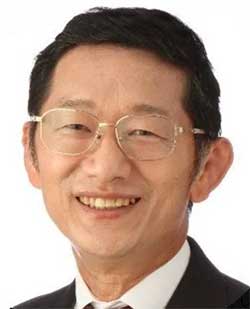
In January this year, the “Chiba Prefecture Citizens’ Association to Protect Freedom of Religion and Human Rights” was established, mainly by believers. Hiroshi Ogasawara (小笠原裕) (61) from Yachiyo City became the representative. He emphasized the social backlash against the religious organization, stating, “The proposition to socially exclude religion is spreading throughout society. The religious community needs to consciously stand up, and for that to happen, we, the people involved, must first raise our voices.”
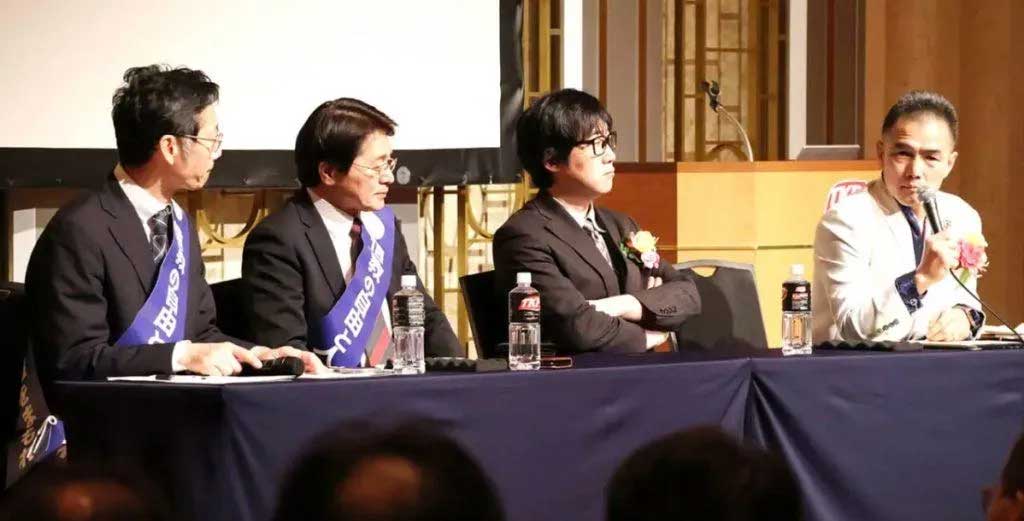
In March, they held a symposium in Chiba City. They invited members of parliament, lawyers, and Christian pastors, but what Ogasawara values most is for the believers themselves to take to the streets and directly express their honest feelings to the public.
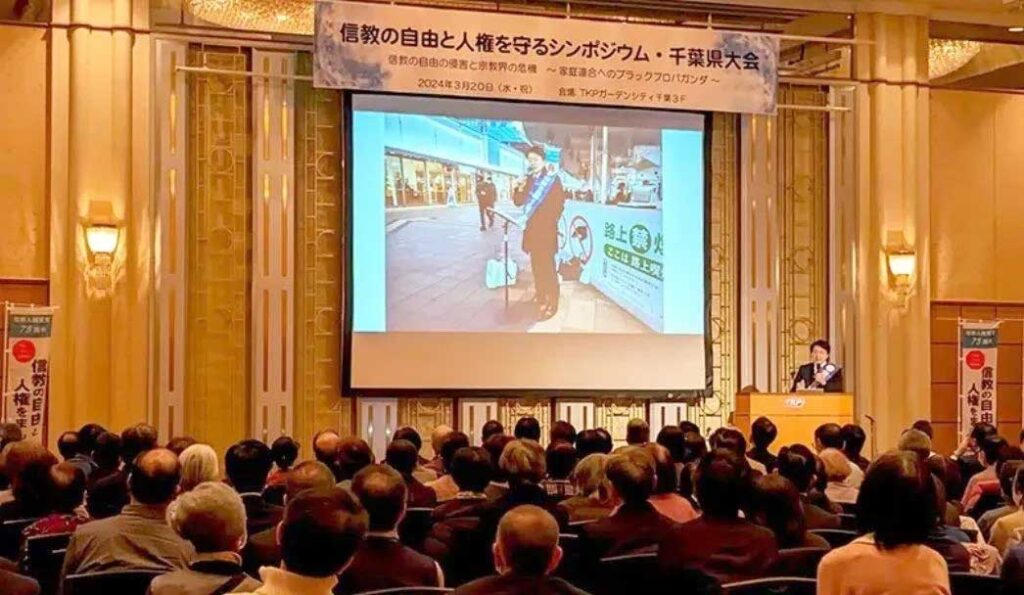
Yoshiaki Kawahara (川原義昭) (63), a board member of the organization living in Chiba City, also began giving speeches on the street in front of JR Chiba Station last autumn. Kawahara has expanded his street preaching efforts nationwide through connections among believers of the Family Federation community. The circle is steadily expanding, with the number of locations holding such speeches exceeding 140 in July.
Being active on the streets, however, often led to disruptions. Around May of this year, a passerby repeatedly hurled insult at him. Even someone who initially stepped in to mediate turned against Kawahara and joined in the verbal abuse after learning he was associated with the former Unification Church. Although Kawahara called the police, the officers didn’t take the incident seriously and eventually left without resolving the issue.
Kawahara says, “It is not easy to correct people’s prejudices, but it is important to sincerely convey the truth and find people who can empathize.”
He also hopes that this street speech activity may bring about internal reforms within the Family Federation.
He explains,“Believers tend to operate in a top-down manner, which leaves little opportunity to express their own words and opinions. By taking to the streets, we hope to foster individual initiatives and open up new possibilities.”
Daichi Ito (伊藤大地) (70) from Fukuoka City shares this sentiment. Feeling the recent media coverage was unjust, he began speaking out about religious freedom through street campaigns after September 2022. When he shared these activities online, he received a flood of responses from believers nationwide, praising his courageous actions. Ito argues, “If the church as an organization isn’t going to act, then the believers must rise up.”
Furthermore, he enthusiastically states, “It’s not just about asserting our own viewpoints, but also about considering what Japan, in its current national crisis, should be like. We need to send out a strong message with the country’s best interests in mind.”
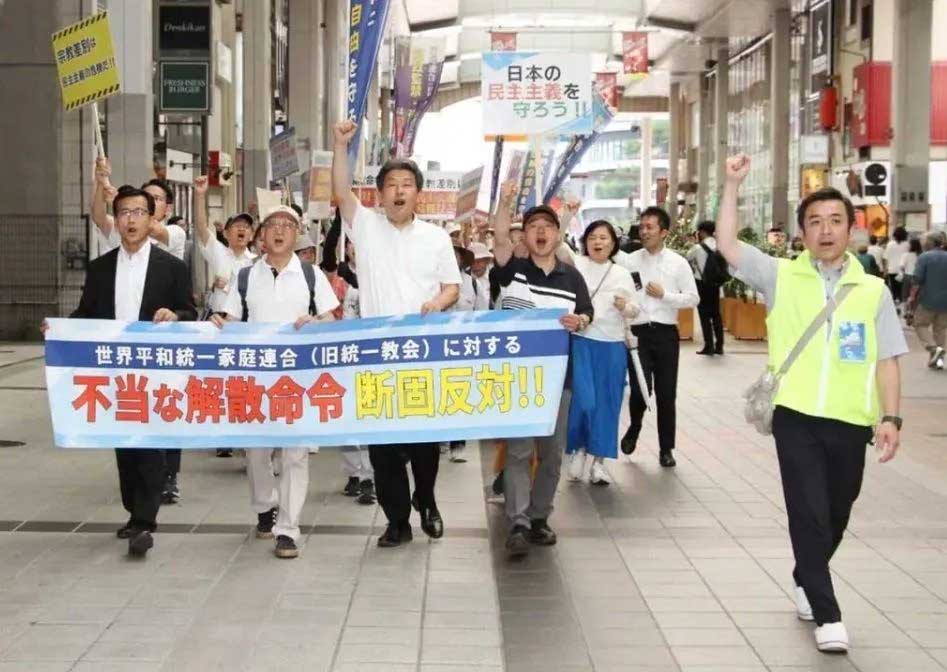
In June this year, believers formed the “Kumamoto Prefecture Citizens’ Association to Protect Basic Human Rights and Freedom of Religion” in Kumamoto City and held a protest march in the city. These efforts to appeal to the general public are spreading across the country.
Click here to read more on Religious Persecution
Featured image above: Yoshiaki Kawahara sharing his experiences of street preaching at a symposium in March in Chiba City, Chiba Prefecture. Photo: Tsuyoshi Toyoda (豊田剛) / Sekai Nippo