How the authorities had to rewrite the rules in order to have a case and then preceded with a mob justice-like trial behind closed doors, with a predetermined outcome in an unjust dissolution case
Tokyo, 29th March 2025 – Published as an article in the Japanese newspaper Sekai Nippo. Republished with permission. Translated from Japanese. Original article.
Court Ruling Tied to Assassin’s “Motive”
Request for Dissolution Order Against Family Federation
by the Religious Freedom Investigative Team of the editorial department of Sekai Nippo
prepared by Knut Holdhus
For the first time, the Ministry of Education, Culture, Sports, Science and Technology (MEXT) has requested the dissolution of a religious corporation based on “wrongdoings according to civil law”. The Tokyo District Court ruled in favor of the request, ordering the dissolution of the Family Federation for World Peace and Unification (formerly known as the Unification Church). However, the developments leading up to this decision, closely linked to the motives of the suspect in the assassination of former Prime Minister Shinzo Abe (安倍晋三), expose the dangers of a people’s trial-like (人民裁判的) [See editor’s note 1 below] approach that could undermine democracy.
A sudden change in legal interpretation – no statute of limitations in civil law [See editor’s note 2 below]
Even as reported damages have drastically declined, the court “presumed” harm.
At a press conference held at 7:00 PM on the 25th March at the Family Federation’s headquarters in Shibuya, Tokyo, Tomihiro Tanaka (田中富広), President of the religious organization, argued that among the factors cited for the dissolution order – organizational involvement in unlawful acts, their malicious nature, and continuity – “it is visibly clear that continuity no longer exists.”
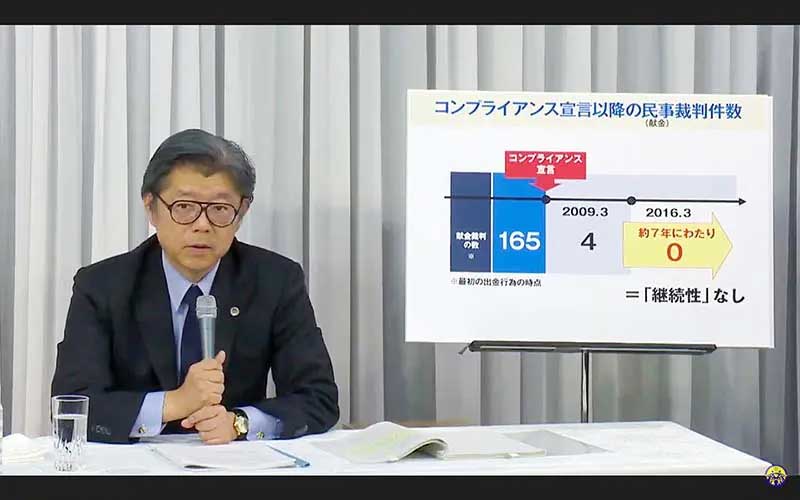
Attorney Nobuya Fukumoto (福本修也), representing the organization, presented a flip chart showing that lawsuits related to financial disputes, including donation-related issues, had sharply declined after the 2009 “compliance declaration”. Before the declaration, 165 cases reached a verdict; afterward, only four. From March 2016 onward, there were no cases for nearly seven years.
The court ruling described the damages before the declaration as “unprecedented in scale”. While acknowledging a decline in damages afterward, it still claimed, “Harm has continued without interruption in recent years and remains at a significant level.”
However, under the so-called “Anti-Unification Church Law” (a law to prevent fraudulent donation solicitations), enacted two years ago, there have been no reported cases in which the Family Federation has committed any of the six prohibited acts, including “using spiritual insights to induce donations”. If such improvements were acknowledged, the argument for continuity would collapse, making it impossible to justify the dissolution order. The court decision, however, rejected the Family Federation’s claims using what appears to be a strained interpretation of the facts.
The trigger: The 2022 assassination
The push for dissolution originated with the July 2022 assassination of former Prime Minister Abe. According to police information leaked to the media, suspect Tetsuya Yamagami (山上徹也) allegedly targeted Abe because he believed the former prime minister was connected to the Family Federation, an organization Yamagami harbored resentment against due to his mother’s involvement. This led to an unprecedented wave of media criticism against the religious organization.
Because the incident occurred during an election campaign, media coverage intensified, focusing on the organization’s political connections. Then-Prime Minister Fumio Kishida (岸田文雄), as head of the ruling Liberal Democratic Party (LDP), publicly distanced the party from the Family Federation. The opposition also pressured LDP members to sever ties with the organization, ultimately leading to the request for dissolution.
However, MEXT had previously stated that the Family Federation was not subject to dissolution since it had not been criminally prosecuted as a corporation. On 14th October 2022, three months after the assassination, the government officially confirmed that the organization did not meet the criteria for dissolution under Article 81, Sections 1 and 2 of the Religious Corporations Act.
Until 18th October, Kishida reaffirmed in parliamentary discussions that “wrongdoings according to civil law do not qualify” as grounds for dissolution. Yet on 19th October, in a sudden reversal, he declared that “wrongdoings according to civil law would be included,” contradicting the prior cabinet decision – effectively changing a crucial legal interpretation overnight behind closed doors. This shift led to the legal battle over whether “organizational involvement in unlawful acts, their malicious nature, and continuity” justified dissolution.
Concerns over arbitrary use of power
At the press conference, Tanaka pointed out that wrongdoings according to civil law “have no statute of limitations” [See editor’s note 2 below]. MEXT, in its dissolution request, cited alleged “damages” going back as far as 1980 – cases over 30 years old. This raises concerns about governmental overreach and abuse of power, as it suggests that MEXT could apply similar retroactive scrutiny to other religious organizations in the future. Public welfare and societal norms evolve over time, and allowing the government to arbitrarily reinterpret laws based on political considerations sets a dangerous precedent.
The court ruling also referenced past legal issues involving businesses run by church members, including “spiritual sales” (where religious beliefs were used to sell goods) and the “Shinsei Incident” (新生事件) [See editor’s note 3 below] (involving arrests for violations of the Act on Specified Commercial Transactions). However, these matters had already been resolved through legal judgments, settlements, or criminal penalties. Since the Compliance Declaration [See editor’s note 4 below], almost no new issues have arisen. Nevertheless, by retroactively expanding the scope of alleged “damages”, the court inferred that past wrongdoing continued even after the reforms and ultimately justified dissolution.
A Precedent for Political Persecution?
Dissolving the organization in response to the assassination case is akin to rearresting a person who has already served his or her sentence – not for a new crime, but simply because past judgments were deemed too lenient or because authorities suspect further wrongdoing.
Moreover, the entire process – from the Religious Affairs Council’s deliberations to MEXT’s questioning of the organization and the court’s hearings – was conducted behind closed doors. Attorney Fukumoto pointed out that during cross-examination, it was revealed that MEXT had fabricated evidence. Yet the court ignored this problem in its ruling.
The excessive backlash [against the Family Federation] seized upon the motive of the suspect who killed the former prime minister out of hatred toward a religious organization. This, coupled with an overnight change in legal interpretation, led to an unprecedented use of civil law as grounds for dissolving a religious corporation. Although it was subject to legal procedures, it was like a people’s trial (人民裁判的) [See editor’s note 1 below], and the request for the dissolution of a religious corporation was carried out arbitrarily and behind closed doors.
[Editor’s note 1: In this context, “like a people’s trial” (人民裁判的 – Jinmin Saiban-teki) refers to a “people’s tribunal-like” or “mob justice-like” process. It implies a trial or legal action that lacks proper judicial fairness, due process, and transparency – where decisions are driven by public sentiment, political pressure, or media influence rather than objective legal standards.
The article uses this term to criticize the dissolution request against the Family Federation, suggesting that it was carried out in a manner resembling a show trial, where the outcome was predetermined and influenced by public backlash rather than impartial legal judgment.]
[Editor’s note 2: In this context, “without statute of limitations” (時効なく) refers to the fact that the acts that are wrongdoings according to civil law (torts) (民法上の不法行為) cited as the basis for dissolving the Family Federation were not restricted by a time limit. Normally, in legal cases, there is a statute of limitations — a set period after which legal action can no longer be taken. However, the Ministry of Education, Culture, Sports, Science and Technology (MEXT) retroactively examined alleged damages as far back as 1980, over 40 years prior, to justify the dissolution request.
The criticism in the article suggests that by disregarding any statute of limitations, the government expanded the scope of past allegations indefinitely, allowing decades-old issues to be used as grounds for present legal action. This raises concerns about legal fairness, as organizations or individuals could be held accountable for actions far beyond the usual legal time limits.]
[Editor’s note 3: The Shinsei Incident (新世事件) refers to a 2009 case in Japan involving the company Shinsei (New Life), which was run by members of the Unification Church. Shinsei was accused of engaging in what lawyers campaigning against the church termed as “spiritual sales” (霊感商法) – a practice where individuals allegedly were persuaded to purchase items by being told that these goods possess supernatural benefits or that not buying them could lead to misfortune.]
[Editor’s note 4: The 2009 compliance declaration of the Unification Church of Japan (now the Family Federation for World Peace and Unification) was a formal commitment by the organization to reform its practices in response to longstanding public criticism and legal challenges.
The Unification Church in Japan had faced numerous allegations related to recruitment tactics and donation solicitation, termed “spiritual sales” (霊感商法) by a hostile network of activist lawyers who had declared the religious organization an enemy. These issues led to multiple lawsuits orchestrated by the activist lawyers and significant media backlash. This prompted the organization to take measures to restore its reputation and demonstrate compliance with legal and ethical standards.
The religious organization pledged to stop possibly unethical donation practices, including what the hostile network of lawyers claimed amounted to “pressuring members into making large financial contributions under spiritual pretexts.”
This was in response to accusations from the same activist lawyers that followers “were being manipulated into giving away substantial amounts of money or property.”
The Unification Church stated it would enhance internal oversight to ensure compliance with ethical and legal standards. Measures included better leadership training and stricter guidelines for evangelization and donation solicitation.
After this compliance declaration, there was a significant decrease in the number of lawsuits against the Unification Church – since 2015 called the Family Federation. The religious organization has used this as evidence that it has improved its practices and should not be subject to dissolution.]
Featured image above: Attorney Nobuya Fukumoto (福本修也), legal representative of the Family Federation, speaks at a press conference at the organization’s headquarters on 25th March 2025. He is here presenting a flip chart showing that lawsuits related to financial disputes, including donation-related issues, had sharply declined after the 2009 “compliance declaration”. Before the declaration, 165 cases reached a verdict, afterward, only four. From March 2016 onward, there were no cases for nearly seven years. Photo: Screenshot from a video distributed by the religious organization.