
Japanese author carrying out an extensive media study concludes that lies told 100 times by the media about religious minorities become truth for the general public
Tokyo, 16th December 2024 – Published as an article in the Japanese newspaper Sekai Nippo. Republished with permission. Translated from Japanese. Original article.
Media That Produces Negative Sentiments
Lecture by Author Fumihiro Kato (加藤文宏) at the Senichi Club (世日クラブ)
by the editorial department of Sekai Nippo
Prepared by Knut Holdhus
The regular lecture meeting of the Senichi Club (世日クラブ), formed by readers of the Sekai Nippo (The World Daily), was held online on 15th December 2024. Author Fumihiro Kato delivered a lecture titled “The Era of Agitation and Media Pollution: Morikake (モリカケ), Slush Funds (Under-the-Table Money), and Reporting on the Former Unification Church.” [Editor’s note: Morikake refers to a scandal where it was claimed that government officials had given preferential treatment to school operators with ties to the prime minister.]
Kato pointed out that the mass media, driven by ideologies or profit motives, often stimulate public sentiments with biased or fabricated information. He noted, “This frequently gives rise to negative sentiments, which, in turn, create waves of public opinion.”
Kato referred to the media’s act of selecting and determining topics from daily events as “agenda-setting”. He expressed concern about the media’s agenda-setting, where the importance of an issue to society is determined by the amount and nature of its coverage. Fumihiro Kato said there is “a fine line between such agenda-setting and the idea that ‘a lie told a hundred times becomes truth’.”
Regarding media coverage of political funding issues within the Liberal Democratic Party factions and the Family Federation for World Peace and Unification (formerly the Unification Church), Kato criticized the tendency to rely on testimony from certain biased parties. He also pointed out how terms like “slush funds” (under-the-table money) and “deeply involved” (cozy relationships) are used to divert the focus of discussions. He analyzed that “actual public opinion is often born by conforming to the false image of public opinion created by the media.”
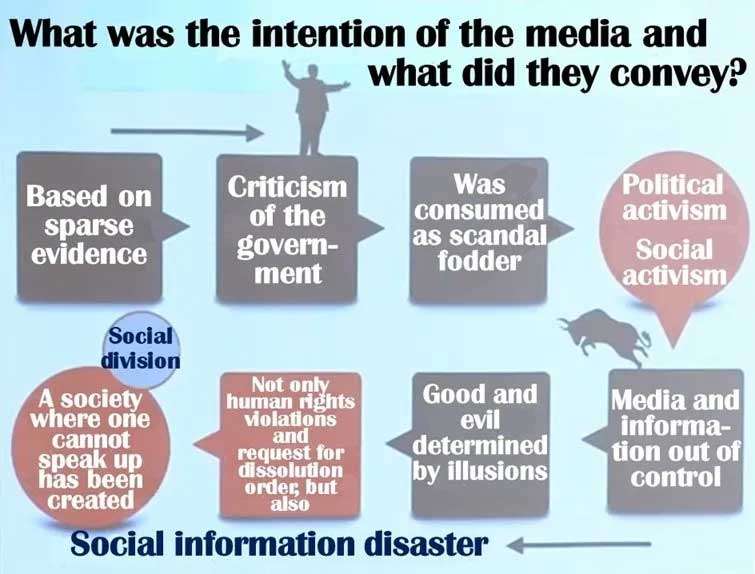
Kato also criticized public opinion polls, stating that they “introduce preconceived ideas and biases to the respondents, making the polls a tool for creating media-driven public opinion. Perhaps calling them ‘media influence surveys’ would be more appropriate.”
As a countermeasure to media pollution, Kato proposed abolishing the “political neutrality” requirement in Japan’s Broadcasting Act to ensure that media outlets are not treated as authoritative or untouchable entities. He also recommended developing legal frameworks, creating archives of broadcasts, and establishing an independent verification body.
[Editor’s note: Fumihiro Kato (加藤文宏) has contributed to various media outlets, including opinion magazines. Under the pen name Fumi Kato (かとう ふみ), he has published works such as “Chushi Ruro” (厨師流浪 – Wandering Chef), “Kakai Fuki” (花開富貴 – Blossoming, Prosperous and Noble), and “Denko no Otoko” (電光の男 – Lightning Man). In 2023, he contributed with an article titled “Can News and Talk Shows Determine Good and Evil?” in the February issue of Monthly Seiron (月刊正論), challenging the approach to reporting on the Unification Church.]
Click here to read more on Religious Persecution
Featured image above: Fumihiro Kato (加藤文宏) delivering his lecture 14th December 2024 in Ichikawa City, Chiba Prefecture. Photo: Tsuyoshi Toyoda (豊田剛).