First case ever of civil-code grounds used to dissolve a religious organization, as its appeal is rejected in what many perceive as an orchestrated campaign undertaken by the state as a whole
Tokyo, 4th March 2026 – Published as an article in the Japanese newspaper Sekai Nippo. Republished with permission. Translated from Japanese. Original article.
Tokyo High Court Upholds Dissolution Order for Family Federation; Religious Corporation Status Revoked, Liquidation Proceedings to Begin
by the editorial staff of Sekai Nippo
prepared by Knut Holdhus
In the immediate appeal proceedings regarding the Ministry of Education, Culture, Sports, Science and Technology’s request for a dissolution order against the Family Federation for World Peace and Unification (formerly the Unification Church), the Tokyo High Court – Presiding Judge Motoko Miki (三木素子) – ruled on 4th March to uphold the dissolution order issued by the Tokyo District Court and dismissed the Family Federation’s immediate appeal. This marks the first case in which a dissolution order has been based on unlawful acts under the Civil Code.
The religious organization plans to file a special appeal with the Supreme Court. However, as a result of the Tokyo High Court’s decision, the organization will lose its status as a religious corporation, and liquidation procedures will commence.
In response to the ruling, the Family Federation issued the following statement: “We are deeply concerned and cannot help but feel profound shame that our believers may be labeled as members of an antisocial group and forced to live in fear of discrimination and prejudice in Japanese society, concealing themselves in order to survive. We will never accept this unjust judicial decision and will continue fighting – including by filing a special appeal – to defend freedom of religion.”
Regarding the request for a dissolution order, the Tokyo District Court ruled in March of last year that the organization had caused “damage on a massive scale” and ordered its dissolution. The religious organization filed an immediate appeal, objecting to the district court’s fact-finding based on presumptions – such as the assumption that “a considerable degree of hidden damage likely exists” – as well as alleging fabrication of evidence by the Ministry of Education.
During the appeal proceedings, the Family Federation argued that damages had sharply declined following its 2009 “Compliance Declaration” [See editor’s note 1 below] and maintained that there was no necessity for a dissolution order. The hearings were conducted behind closed doors and concluded in November of last year.
The full statement released by the Family Federation of Japan is as follows: “Today, the Tokyo High Court issued a decision approving the dissolution order against our religious corporation. This can be said to fulfill, as an undertaking of the state as a whole [See editor’s note 2 below], the desire of the terrorist who assassinated former Prime Minister Shinzo Abe (安倍晋三). The perpetrator is said to hold a grudge against the Family Federation and sought to inflict damage upon it. This judicial decision will not only incite new acts of political terrorism but will also undermine Japan’s credibility in the international community, leaving a stain on our nation’s history.
Our corporation strongly requested that the High Court conduct appropriate proceedings based on facts and evidence. However, this decision constitutes an unjust ruling reached with a predetermined conclusion, lacking factual and evidentiary support and contrary to the principle of adjudication based on evidence.
Furthermore, with the cooperation of independent attorneys, our corporation has been sincerely engaged in providing compensation to those claiming to have suffered ‘damage.’ Now that the corporation is to be dissolved, such compensation efforts can no longer continue, which we find extremely regrettable.
Above all, we are deeply concerned and filled with shame that, as a result of this decision, our believers may be branded as ‘members of an antisocial group’ and forced to live in fear of discrimination and prejudice within Japanese society, concealing themselves in order to survive. We will never accept this unjust judicial decision and will continue to fight – including by filing a special appeal – to defend freedom of religion.”
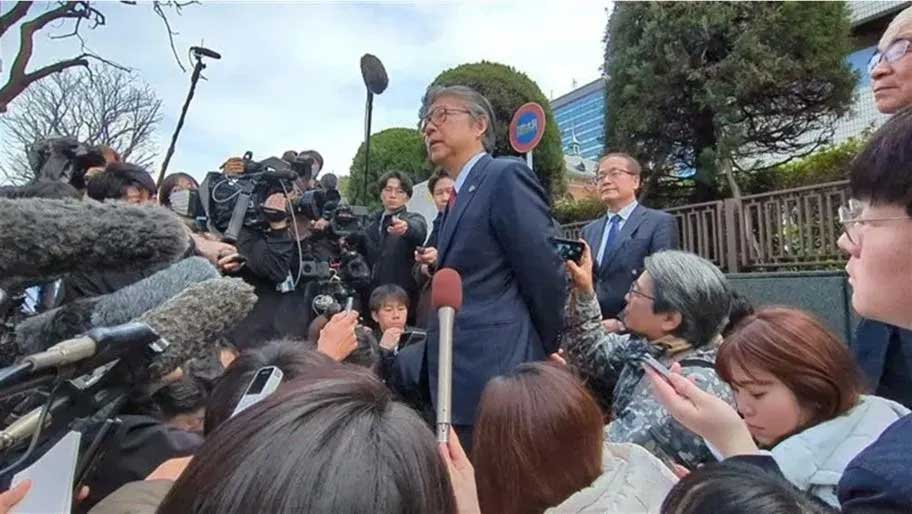
Featured image above: Fukumoto, legal advisor to the Family Federation in Japan, responding to media inquiries following the Tokyo High Court decision on 4th March 2026. Photo: Sekai Nippo
[Editor’s note 1: The 2009 compliance declaration of the Unification Church of Japan (now the Family Federation for World Peace and Unification) was a formal commitment by the organization to reform its practices in response to longstanding public criticism and legal challenges.
The Unification Church in Japan had faced numerous allegations related to recruitment tactics and donation solicitation, termed “spiritual sales” (霊感商法) by a hostile network of activist lawyers who had declared the religious organization an enemy. These issues led to multiple lawsuits orchestrated by the activist lawyers and significant media backlash. This prompted the organization to take measures to restore its reputation and demonstrate compliance with legal and ethical standards.
The religious organization pledged to stop possibly unethical donation practices, including what the hostile network of lawyers claimed amounted to “pressuring members into making large financial contributions under spiritual pretexts.” This was in response to accusations from the same activist lawyers that followers “were being manipulated into giving away substantial amounts of money or property.” The Unification Church stated it would enhance internal oversight to ensure compliance with ethical and legal standards. Measures included better training for leaders and stricter guidelines for evangelization and solicitation of donations.
After this compliance declaration, there was a significant decrease in the number of lawsuits against the Unification Church – since 2015 called the Family Federation. The religious organization has used this as evidence that it has improved its practices and should not be subject to dissolution.]
[Editor’s note 2: In political discourse, the Japanese expression 国家ぐるみ (kokka gurumi) is rarely neutral. It carries strong connotations of institutional coordination and suggests involvement beyond a single agency – implying courts, ministries, police, legislature, etc. The expression implies top-down orchestration and centralized direction or political intent rather than independent bureaucratic or judicial action.
The phrase is often used in accusations of state repression, political persecution, cover-ups, systemic corruption. It frames the act as not just mistaken, but as a structural act of the state itself. In the above text, the writers are asserting that the Tokyo High Court verdict is not merely a judicial ruling. It represents the state acting collectively. The state is therefore portrayed as fulfilling a terrorist’s objective.
This dramatically escalates the accusation. Instead of saying that the court made an unfair decision, it implies that the Japanese state apparatus as a whole is enabling terrorism’s goals.” That framing politicizes the judiciary, undermines claims of judicial independence, and portrays the organization as a victim of systemic persecution.]