Blog of Unification Theological Seminary
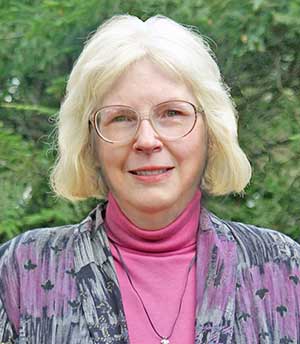
By Jennifer P. Tanabe
A memoir is a treasure trove filled with precious nuggets of information about a person’s life. No matter how well you may think you know someone, reading their memoir illuminates parts of their life that you knew little to nothing about. Dr. Therese Stewart’s memoir, My Life of Faith, does not disappoint.
Therese was born and raised on a farm in rural Minnesota. As a child, she learned and practiced her family’s Catholic faith, and when her older sister became a nun, she told God she would follow in her footsteps. World War II somewhat delayed that plan, diverting her to nursing. This proved a minor delay, however, as she joined the same Franciscan order as her sister in 1948.
Therese spent two decades as a Catholic nun. In the late 1960s came the first crucial turning point in her life of faith. She met a member of the Unification Church, Betsy O’Neill (now Jones), while studying at Columbia University in New York City. After studying Divine Principle for several months, and having a number of significant dreams, she committed herself to a new spiritual course.
Here is how she describes her early response to these new teachings:
I felt that my life had been preparation for this. Divine Principle reinforced much of what I believed as a Catholic but there was striking new content too. I had never thought of Jesus and the Holy Spirit as “spiritual true parents,” nor anticipated the coming of physical True Parents. Also compelling was the idea that the prophecy of the Second Coming was being fulfilled by a couple! The concept of True Parents as opposed to the fallen first ancestors, Adam and Eve, was new to me. (I had no problem accepting the idea that the fall of man was an illicit love relationship even though many considered that an archaic interpretation of the Genesis account). The idea that Jesus was to have married and extended God’s lineage immediately struck me as true. (I had read years before that it was not God’s will for Jesus to die on the cross but that someday we would understand why God had allowed it.)
I did not easily accept that the Second Coming would be fulfilled by anyone other than Jesus but neither could I deny that the allegedly unfulfilled part of his mission—to marry, create a True Family, and develop a loving dominion over the creation—required his having a physical body!
Therese joined the Unification Movement in 1968. She did not just abandon her previous way of life and faith, but spent time and effort to explain her new understanding to the sisters in her religious community. When they found the Divine Principle to be incompatible with the teachings of the Catholic Church, she had to choose, and she chose her new spiritual path and new life. This decision was not made lightly, based on emotion or external factors. She was a serious student of the teachings, and prayed deeply to obtain God’s guidance before making her decision to embrace this new faith.
As many know, Therese served as Academic Dean at Unification Theological Seminary — the first academic dean at the newly founded seminary, interviewing and hiring the original faculty members and working with them to design the curriculum. She describes this early time:
An interview with Professor Josef Hausner, who joined the faculty in its second year, reflects the diversity of applicants. We met for the interview in New York City. He greeted me warmly and after a few minutes getting acquainted, he asked why Rev. Moon was starting a Seminary when so many were closing. He retrieved a copy of the New York Times from his desk with a speech of Rev. Moon’s on the cover page. Many sections were highlighted in red! “These are the parts I agree with,” he commented. Probably he resonated so strongly with Rev. Moon’s vision because of his own experience. Rabbi Hausner and his entire congregation had been exiled to Siberia during World War II.
The professors were excited to be a part of Rev. Moon’s vision for peace through God-centered marriages and families. They prepared courses in their fields and together with the administration developed a program in religious education to provide students with a foundation for teaching Divine Principle and for ecumenical outreach.
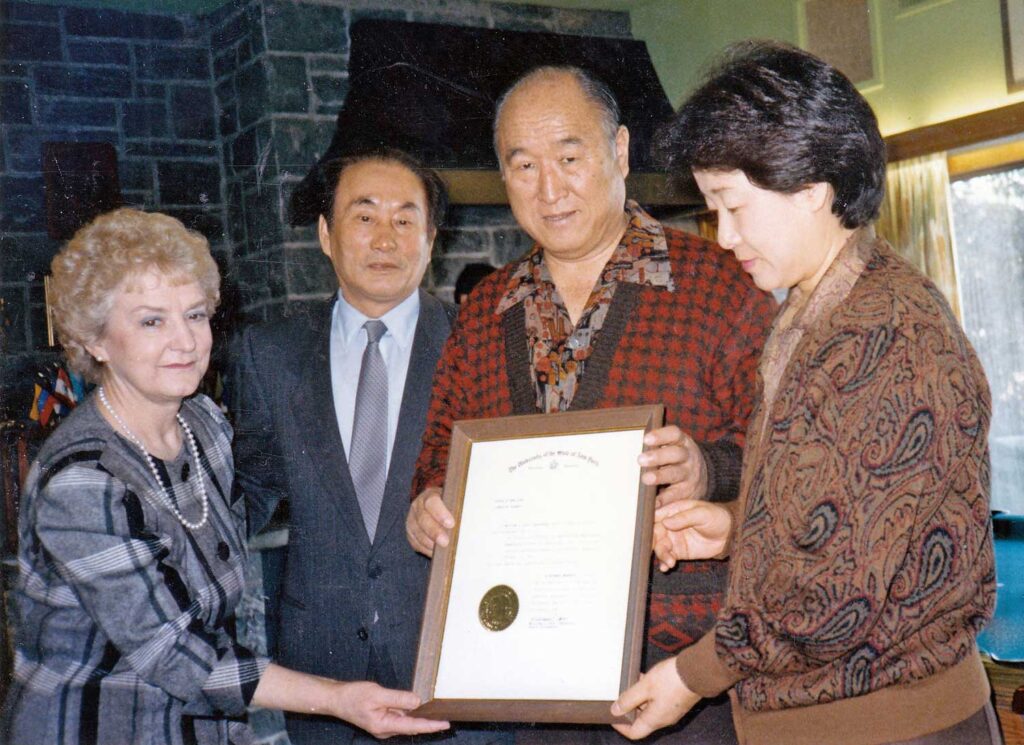
How unusual it was for a woman to be an academic dean in the 1970s. Therese notes that “Dr. Richard Quebedeaux, author and observer of the new religious movements, commented, ‘I don’t think there is another seminary in the United States with a Korean President, a Chinese Vice-President, and an American female Academic Dean’.”
Few Unificationists had theological training, let alone doctorates in a religious field. Combined with the controversy surrounding the Unification Movement, there were many challenges to obtaining approval for granting degrees. It was not until 1986 that a provisional charter was granted by the New York State Education Department; the full charter was not granted until 1990. Thus, the period of Therese’s tenure as Academic Dean was filled with challenges, expected and unexpected, some of which she relates in letters to then-seminary President David S.C. Kim. Life at the seminary reflected the need to balance academic excellence with a life of faith for students, staff, administration, and faculty alike, a challenge Therese took in her stride, supported as always by her faith.
Having set aside her academic studies to pursue her spiritual calling, after many years in academic administration, Therese obtained her doctorate from Teachers College at Columbia University, with her dissertation titled, “Sustaining Unification Faith and the Spiritual Quest after Seminary.” It includes a Unification theory of spiritual growth, which details the theology and practice of fulfilling each of the Three Blessings. It also summarizes the reality of Unification ministry as experienced by the UTS graduates she interviewed for her dissertation research:
What emerges is a profoundly human story of people seeking God and goodness. In so doing, they endeavor to create good and in the creation of goodness, they seek God. They aspire to actualize Divine Heart on the intrapersonal, interpersonal, and universal levels. Their stories tell a flawed and complex tale. Even the Seminary is not a haven—the world is filled with competing forces.
The participants were found to be deeply committed—committed to realizing a vision, committed to their families, to their nation, their world. They put their faith into action. They are caring, responsible people, deeply valuing their relationships. They are active in negotiating the developmental stages of a relational faith. … To use a biblical term, these Seminary graduates reveal themselves to be steadfast, not perfect, but having their feet firmly planted on the road that leads thereto.
Consistent with Unification ideals, they are seen traveling not alone but with spouse and children, with colleagues and elders, as well as a larger family beyond that. Their stories reflect an awareness that their entourage includes contemporary fellow travelers of different races, religions, and cultures, citizens of both this world and the spiritual world. …
In terms of everyday ministry, this translates into nurturing the vision of a world of families indwelt by God; cultivating relationships, especially the relationship with God; cooperating with other individuals, families, and ministers/leaders of different faiths in an effort to restore their own heart and character, nurturing and guiding their family, confronting social problems at every level, and sharing their vision and story/experience with others.
Therese received the Holy Marriage Blessing in 1975 as one of the 1,800 couples. Her husband, Ernest Stewart, had served in the military for two decades and first met Reverend Moon in Korea. A significant turning point in anyone’s life is marriage and the start of family life. For a former nun like Therese, the expectation and actualization of these events naturally involved major changes in her lifestyle and faith. Coupled with the spiritual significance of the Holy Marriage Blessing, and that Rev. Moon acted as matchmaker arranging the marriages of his followers, this stage surely brought her life of faith to a new level.
She and Ernest raised their son, Michael, while living and working at UTS in Barrytown. Therese faced the challenge of making the transition from the single celibate life of a nun to becoming wife and later mother to her own family with humility, grace and determination. Her life of faith broadened from her individual spiritual growth to focus on the development of a God-centered family. After her retirement from the seminary, they joined Michael and his wife and children, living as a three-generation family.
In one of her writings, “Divine Principle from the Perspective of a Former Nun,” Therese explains the Unification view of marriage which prompted her to embark on this stage of her life, with the commitment to make it work, not just in the physical realm but in the eternal realm of spirit:
Genesis iterates that at the time of creation, God said to the angels, “Let us make man in our image. Male and female He created them.” Divine Principle infers from this that in God His/Her self, is the essence of masculinity and femininity. Without marriage, God would not experience physical love or the bearing of children. …
Divine Principle teaches that marriage is not for one’s self but for one’s spouse and children. Many Unificationists enlist or accept the assistance of others in selection of a husband or wife. In that spirit I chose to participate in a Marriage Ceremony in Korea that brought together members from many countries, notably Korea, Japan, several European countries, and America, in 1975. Believing that God worked through Rev. Moon, my husband-to-be and I accepted each other as he recommended. Despite some challenging periods, or perhaps through them, we came to see the wisdom of our being together and learned to love each other. His transition to the spiritual world in 2009 has been less difficult to accept because of the awareness of our eternal union. As I continue to grow spiritually, the veil that separates us becomes less real.
The passing of her beloved husband marked another change for Therese. As always, she took it in stride and continued looking forward. It was only a few years later that Father Moon himself ascended, and for Therese the path of Mother Moon has become central to her own life of faith.
Faith has always been central to Therese Stewart’s life, as evidenced by the title of her memoir, My Life of Faith, edited by Jennifer P. Tanabe. It can be purchased in paperback or as an eBook.♦
Dr. Jennifer P. Tanabe was born in Scotland and earned both her bachelors and doctoral degrees in psychology from the University of Edinburgh. She moved to the United States as a postdoctoral fellow at the University of Minnesota’s Institute of Child Development. She has served on the faculty and in various administrative and consulting capacities at UTS, and currently teaches a Research Methods course in its D.Min. program.