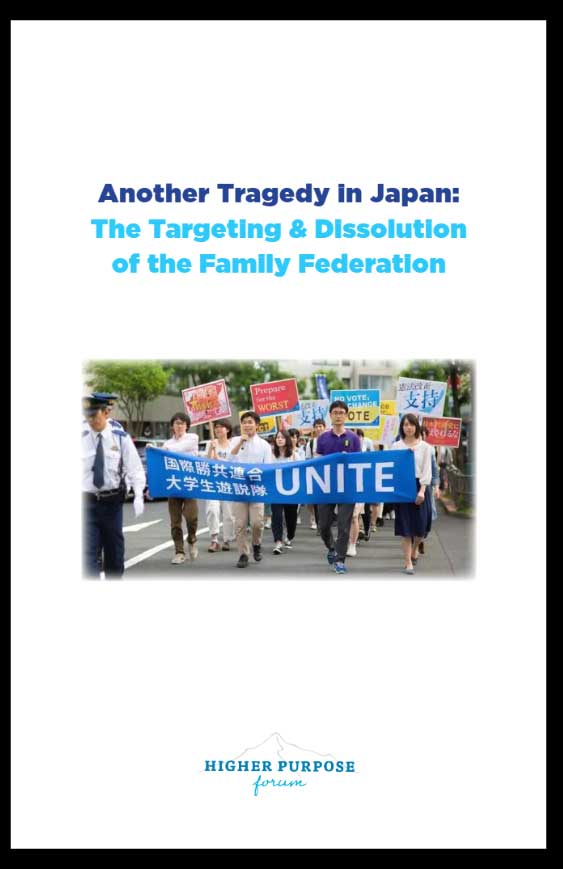
In his new book, James Edgerly delves into religious freedom on trial in Japan and the legal and social aspects of the 2025 dissolution order against the Family Federation
[Review]
Another Tragedy in Japan
Prepared by Knut Holdhus
Another Tragedy in Japan: The Targeting & Dissolution of the Family Federation is the title of a 40-page booklet moderated by James B. Edgerly and published by Higher Purpose Forum as a second edition in July 2025. The publication presents a deeply considered reflection on the legal and social pressures confronting the Family Federation for World Peace and Unification (FFWPU) – formerly the Unification Church – in Japan. Edgerly is the founder and director of the Higher Purpose Forum, which, according to him, is an “independent project of the Unification Movement”.
Edgerly dedicates the booklet to Toru Goto – a Unificationist who twice suffered abduction and forced confinement by his family, the second time for more than 12 years – from 1995 to 2008. After years of legal battle, he achieved a landmark Supreme Court victory in 2015. That court ruling did not end the coercive practices of dehumanizing faith-breaking entirely, but made it much more difficult for the professional deprogrammers to market their shady services. Goto’s story serves as a testament to both the resilience of faith and the broader trajectory of rights for religious minorities in Japan.
Situational Context & Legal Background
Edgerly measures the recent dissolution order issued by a Tokyo court against a broader historical backdrop. In October 2023, Japan’s Ministry of Education, Culture, Sports, Science and Technology (MEXT) filed a request to dissolve the Family Federation of Japan, citing allegations like “manipulative fundraising” and other civil violations. In March 2025, the Tokyo District Court granted that request – an unprecedented legal step against a religious organization that had no criminal convictions on record.
Edgerly contrasts Japan’s legal and cultural response with that of other democracies, particularly the United States, where religious freedom, including for unpopular movements, remains more vigorously safeguarded. He underscores that the civil cases cited by the court in Japan stem largely from decades-old disputes – all predating a 2009 compliance reform [See editor’s note below] – and that many plaintiffs are ex-members whose testimonies originated from “deprogramming” conditions now considered coercive and discredited.
The Media, Law, and Public Sentiment
One of the most striking elements in the booklet is the analysis of two press conferences at the Foreign Correspondents’ Club of Japan (FCCJ), held just two days apart in March 2025. On 26th March, Federation President Tomihiro Tanaka calmly and factually responded to criticism – highlighting, for instance, the disappearance of complaints and civil cases over the past seven years, and the overwhelming origin of plaintiffs from deprogramming scenarios.
In contrast, on 28th March, representatives from anti-Unificationist lawyer networks (e.g., NNLASS) made sweeping claims, calling the Federation‘s activities “fabrications” and labeling its ceremonies as forced mass weddings. Their tone was triumphalist and dismissive of Federation perspectives – but received applause from the press, underlining a broader media bias.
Edgerly argues that this polarized messaging – and the absence of active Unificationist voices in the courtroom or investigative processes – exemplifies a disturbing erosion of due process and fair representation.
Historical Campaign Against the Federation
Edgerly situates the recent legal attack within a five-phase historical arc spanning over five decades:
- Late 1970s – The Federation’s affiliate International Federation for Victory over Communism (IFVOC) played influential roles in conservative politics, prompting backlash from Japan’s left about its anti-communist activities.
- 1980s-2009 – Fundraising methods, notably “spiritual sales,” came under criticism. Meanwhile, the Federation slowly admitted excesses and eventually reformed by 2009.
- 1981-2025 – Anti-Unification legal entities formed early, engaging in deprogramming referrals, lawsuits, and generating “manufactured victims” The so-called “Defection Business” grew into a significant civil litigation mechanism.
- 2009-2022 – The 2009 compliance measures [See editor’s note below] marked a pivotal reform. Meanwhile, the Toru Goto case in 2015 reduced forced deprogramming significantly, setting a precedent for religious freedom protections.
- 2022-Present – The assassination of former Prime Minister Shinzo Abe in July 2022 by Tetsuya Yamagami (who blamed the Federation for his family’s bankruptcy) triggered a national backlash. Anti-Unification lawyers quickly framed the Federation as culpable, shifting public anger towards institutional dissolution rather than focusing on the assassin himself.
Democratic & Human Rights Stakes
Edgerly warns that dissolving a religious organization without criminal violations – primarily based on civil claims and hostility – sets a dangerous precedent for Japan’s democratic ethos and for religious freedom globally. He notes how international bodies like the U.S. State Department, the U.N., and religious freedom advocates have raised alarm, emphasizing that such actions deviate from both Japan’s constitution and international obligations under instruments like the International Covenant on Civil and Political Rights (ICCPR).
He particularly highlights the lack of transparent dialogue, the “herd mentality” of media-fueled public sentiment, and the marginalization of the Family Federation’s narrative – all signaling a broader slide toward ideological conformity and against pluralism.
Analysis
Edgerly’s booklet offers more than documentation; it is a care-filled plea for balance, justice, and empathy. This narrative:
- Humanizes the believers – showcasing their victimization and the trauma of harassment, job loss, evictions, and social ostracism.
- Elevates legal awareness by clearly showing that those bringing suit were beneficiaries of coercive methods, undermining the integrity of evidence.
- Connects modern events to long-standing tradition of pluralistic suppression, reminding us that the tensions predate the Abe assassination.
- Champions democratic resilience, highlighting voices – journalists, international advocates, and faith leaders – who reject the punitive dissolution order and stand for religious liberty.
In doing so, it challenges readers to consider whether a truly democratic society should retaliate against religious minorities through legal means based on prejudice rather than fair adjudication.
Conclusion
In Another Tragedy in Japan, James Edgerly provides a powerful, compassionate account of a religious community caught in the crossfire of decades-long ideological warfare, public outrage, and legal overreach. The booklet goes beyond chronicle – it is a call for empathy, justice, and vigilance. It affirms that democratic values and religious freedoms are fragile, especially when public pressure eclipses critical thinking and fair treatment.
Featured image above: Edited version of “Another Tragedy in Japan: The Targeting & Dissolution of the Family Federation” by James Edgerly, 2nd edition published by the Higher Purpose Forum, July 2025.