Blog of Unification Theological Seminary

By David Burton
For me one of the more fascinating requests Rev. Sun Myung Moon gave to us was his request to WRIST in 1984 to develop technology to communicate with spirit world. It is not something I would ever have thought of doing myself, but after I became aware of the problem he posed, it has stayed with me throughout my spiritual life.
The possibility of such technology requires a re-envisioning of what spirit world is. From 2005, and for about seven years, I was part of an online spirit world machine (SWM) discussion group called Technician2, or T2 for short, dedicated to keeping alive the dream of building a SWM. We even began some rudimentary experimentation, which, unfortunately, did not yield any results.
What we did have was lots of discussion, and differences of opinion, but that just petered out over time because we had nothing constructive to show for our work. It was on the science that things got stuck — and are still stuck. We agreed that spirit world existed and could be communicated with, but for a SWM we needed more than that. What we lacked was an experimentally testable theory about the nature of spirit world. Without such a theory we were groping in the dark while hoping for someone in spirit world to turn the light on.
Fortunately, our group was not completely in the dark. We did receive some communication through a medium in 2009 that we should look for a digital interface and that the Internet was being developed as a SWM. These insights, combined with my own writing on Divine Principle and Unification Thought, have led to the theory I present here. I am not claiming this must be true; just that it is a possible explanation for the nature of spirit world, one I believe is compatible with science. It is fully natural and potentially amenable to experimental investigation — in other words, a theory that could be tested experimentally.
Divine Principle
My beginning point is in Divine Principle and a passage I had read, re-read, and overlooked again and again for years. I believe this passage to be one of the most important in the Principle of Creation:
When [subatomic] particles join with each other through the reciprocal relationships of their dual characteristics, they form an atom. Atoms, in turn, display either a positive or a negative valence. When the dual characteristics within one atom enter into reciprocal relationships with those in another atom, they form a molecule. Molecules formed in this manner engage in further reciprocal relationships … [EDP, p. 16]
For us today, with our contemporary scientific knowledge, this seems obvious, even perhaps old-fashioned. Yet I believe it to be the key to the whole of the Principle of Creation, and is what allows the explanation in Divine Principle to be continuous with science. Here in one paragraph is the basic understanding of existence as presented in Divine Principle. We can restate it in one sentence: existing beings are compound beings of particles in relationship. That’s it. However, the implications of this simple statement are enormous.
Consider the molecule. It is composed of atoms which are, in turn, composed of subatomic particles. So, the molecule is mostly empty space. What you have are the subatomic particles and two or three levels of give and take relationship. Extending beyond the molecule, it is engaged in further give and take relationship within larger scales of existence such that the whole of creation consists of multiple layers or levels of organization held together by relationship.
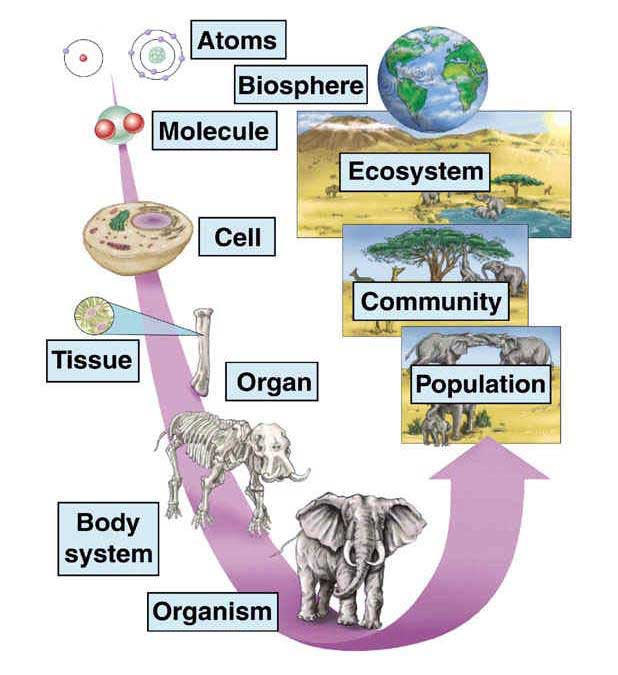
The image below is a simplified example of this from biology. Atoms combine to form molecules, molecules combine to form cells, cells combine to form tissues, tissues combine to form organs, tissues and organs combine to form the elephant, elephants combine to form the population, etc. All this is held together in an organic whole by give and take relationship.
Further, returning to the simplicity of the molecule, a molecule has chemical and physical properties distinctive to the type of molecule. These loosely correspond to internal character (sungsang) and external form (hyungsang). Where do these properties come from? The distinctive properties of the molecule are not in the atoms or the subatomic particles. The molecule’s distinctive properties arise in the relationship of the atoms. In other words, the properties of the molecule, both sungsang and hyungsang, emerge in the relationship between the atoms. This “emerging” is a characteristic feature of relational existence.
You may think, yes, but this is only the physical world, so what about the spirit world?
This brings us to something I have struggled with in Divine Principle almost since first studying it in the early 1980s. Divine Principle suggests the structure of the universe resembles that of a human being where spirit world corresponds to mind. It also suggests that in the structure of a human being our spirit self has a body.
Spirit mind, yes, but spirit body? Where did that come from? There seems no place for it. Divine Principle seems to be right on the verge of solving one of the most crucial issues that has plagued humanity since time immemorial, but it feels like one small piece is missing! Human beings have always had spiritual experiences, mediums can communicate with spirits, but the nature of spirit world itself has remained a profound mystery. Divine Principle seems to hold out the promise of resolving this but doesn’t quite seem to get there. It doesn’t clearly describe what the spirit body is.
I believe understanding the spirit body is central to developing a SWM, and that the existence of the spirit body makes such technology possible. This understanding can fully reconcile spirit with science. I may have found a possible solution to this conundrum. It still leaves many questions, but fits both science and the testimony of mediums about spiritual existence.
Insights from Unification Thought and Channeling
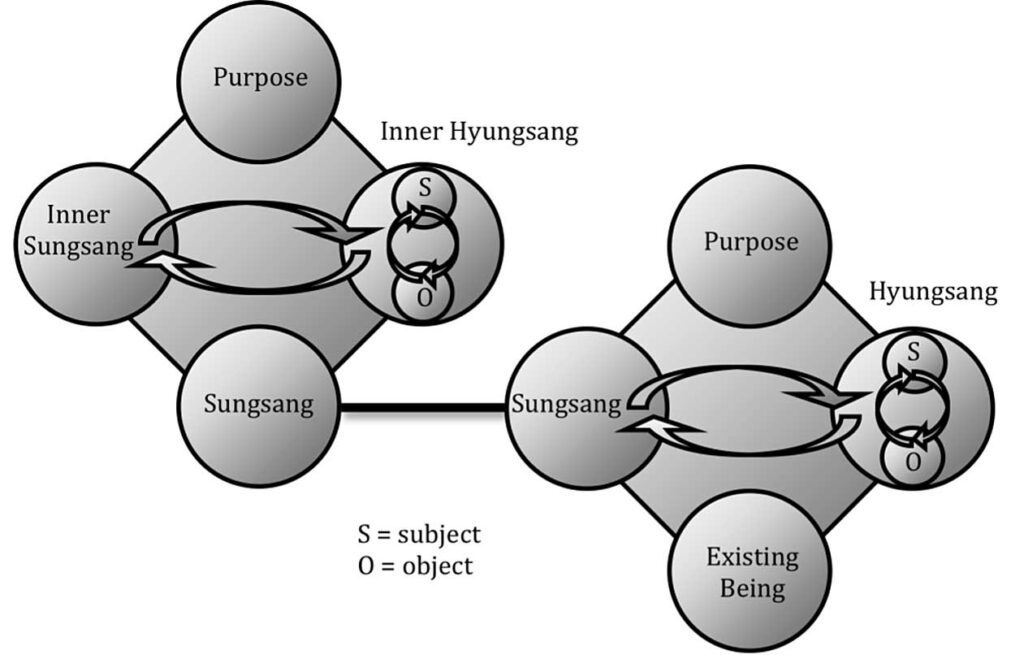
In the Original Image (Theory of God), Unification Thought describes an inner structure to God’s sungsang. This is the key insight. Within the sungsang of God there is an inner sungsang and an inner hyungsang. To begin to understand this inner structure, examine the process of thinking. In our mind, the inner sungsang is the functional part that does the thinking while the inner hyungsang is that which is thought about. Within Unification Thought, this inner structure is not directly applied like this to all existing beings. If we do so, however, then for the first time we have a structural place for the spirit body in our view of existence, one that is natural, not supernatural.
The image below is my adaptation of this two-stage structure to an existing being. I indicate the compound nature of sungsang and hyungsang by relationship within both the hyungsang and inner hyungsang. In a human being, our physical body would emerge in the hyungsang, and our spirit body in the inner hyungsang.
Just having a structural place for our spirit body does not yet address what that body is. Here I have taken a hint from the channeling we received. We were asked to look for a digital interface and it was suggested that the Internet was being prepared as the SWM. I have taken this as a hint about the nature of spirit world itself. If we are looking for a digital interface and the Internet, which is digital too, is being prepared as the SWM, then perhaps this reflects on the nature of the spirit world.
The Internet arises in a network of linked computers, and computers process information that is digital. Digital information has individual and countable numbers or values. Only a limited set of values are possible and they cannot be divided into different parts. Digital information for computing is analogous to the individual subatomic particles described in Divine Principle. For computers these individual numbers are 1’s and 0’s. When we look at particles, the particular values of their properties (such as their mass, electrical charge, etc.) also constitute a form of digital information. Changes to relationships between these particles would then also be a form of information processing. For example, in a chemical reaction, which changes the sungsang and hyungsang of a molecule, information would also be processed in the change.
Processing of digital information is found naturally at all levels of existence. Consequently, I feel that the inner structure of sungsang pertains to digital information storage and processing. In other words, hyungsang at its ground is particles and sungsang at its ground is digital information coded on particles. If sungsang is spirit that means each particle is half-spiritual and half-physical, and both the physical world and spirit world emerge in the relationships of one set of particles.
From this theoretical description it is not so easy to understand what it actually means for the nature of spirit world. Fortunately, recent technological advances have provided ways to visualize the meaning of this explanation. Technology allows us to see a spirit body and even construct an artificial spirit world.
My Phone as a SWM
The molecule is a relatively simple thing. There is a direct correspondence between its sungsang and hyungsang. Changing one involves changing the other. However, as objects become more complex, the increased complexity allows for much more interesting things to happen in the inner structure without changing the whole hyungsang.
My cell phone is a good example of this. It too can be described by a two-stage structure. For my phone, sungsang is the software, and hyungsang the hardware. This hardware involves particles, and the digital information of the software is coded onto some of those particles. The inner structure to sungsang becomes apparent when the phone is turned on.
My mobile phone is also a computer. It has more memory and raw processing power than my first Macintosh computer. My phone fits in my pocket, while that Mac computer took up half of the desk in my office. When the phone is turned on, it processes information. So the function of information processing would be the inner sungsang, and the information that is processed would be the inner hyungsang. This all takes place without significantly altering the hardware, and it allows all sorts of wonderful things to be done by the phone (in addition to calling people) – such as playing with dinosaurs in my living room.
I have always had a fascination for dinosaurs. When the first “Jurassic Park” movie came out, I took our then 11-year old daughter to the very first showing the night it came out. So when I discovered that there were augmented reality (AR) apps for my phone that would allow me to have a dinosaur in my house or yard, I naturally tried several of them out. Augmented reality places digital objects “in” our external physical reality, which can be viewed and interacted with in three-dimensional space on a phone or with a special headset or glasses. My dinosaur AR apps allow me to squeeze a T. Rex into my living room, or have him romp in my yard. I have included a photo of our new pet, a psittacosaurus, with our dog, Dee. Dee doesn’t seem so impressed and doesn’t want to play.
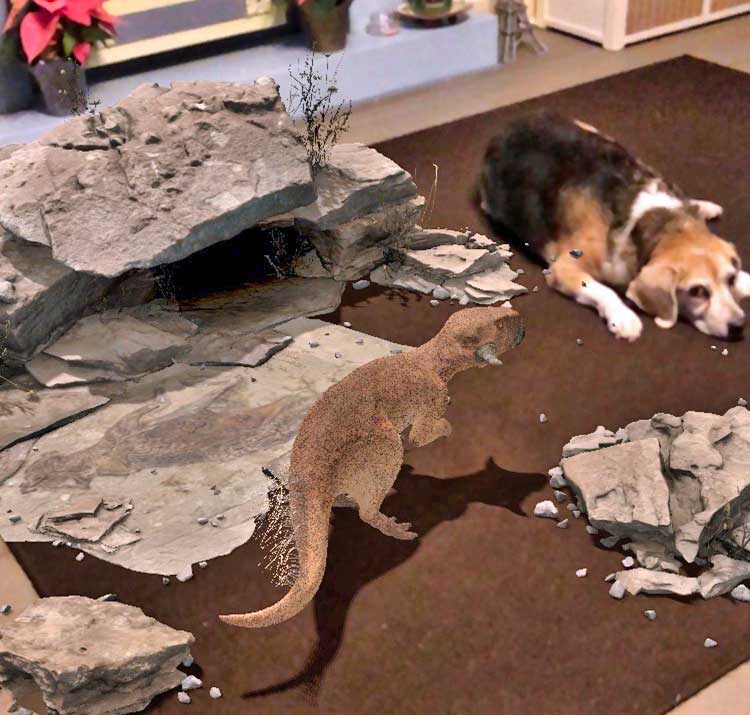
So what are we looking at? The image of the psittacosaurus is a screen capture I made of the AR dinosaur I was observing in real time “in” my front room. From the previous discussion, I hope you can now recognize the digital AR animal as a type of spirit body, and I have photographed that spirit body. Granted it is artificial and has no life of its own, but I believe it has the same kind of digital existence as every other natural spirit body. That makes my phone, just as it is now, a SWM. My phone is doing what a medium does: it is visualizing a spirit body “in” our three-dimensional space. In other words, when mediums see or hear spirit world, I believe they are experiencing a natural form of AR. Connect my phone to the Internet and a whole other world of possibilities opens up.
Welcome to the Metaverse
One of the really exciting things being developed right now is the metaverse. Facebook thought this is so important, it even changed its name to Meta. Watch the three-minute BBC News video below for an introduction to the metaverse:

The current experience of the Internet is one where you look at it on a screen. It is two-dimensional. The metaverse promises to be something experienced from within, in a three-dimensional way. It uses virtual reality (VR) and augmented reality to place you, or rather a digital representation of you — your avatar — inside a virtual space where you can interact with the avatars of other people who are anywhere on the planet. With your phone connected to the metaverse, your avatar is essentially your spirit body that exists within a whole artificial spirit world. The metaverse would have the same relationship to the network of computers that comprise the Internet as the spirit world does to the physical world. It is the digital inner structure to sungsang.
Where does the metaverse exist? We can’t ascribe a physical location to this world, and normal physical laws do not have to apply there. We could fly in the metaverse if we wanted to, change our appearance and have a tail, or create a flower from nothing. Time could run at different speeds. Days there could pass in seconds for us, or conversely, seconds there could take minutes to observe. The metaverse has characteristics mediums commonly ascribe to spiritual existence (Andrew Wilson lists some of those characteristics here). Similarly to the emergence of the physical world from particles, this computer-generated world is emergent from layers of digital information storage and processing within the computer network. Though not in the physical world, this virtual world is at the same time not separate from it either.
Now imagine a digital interface to spirit world connected to the metaverse. We would have a readymade space to interact directly with spirit people and perhaps even angels. I could literally meet my ancestors in the metaverse, invite them into my house, go and see their houses, and perhaps even play cards with them. At family gatherings when I was a kid, my family didn’t really talk to each other, but what we did do was play cards. The whole family from the youngest child to the oldest grandparent all played cards together at every family gathering we had. I hope that within my lifetime on this earth I will be able to sit down at a table with my grandkids and my grandparents for a family game of cards that bridges two worlds: spirit world and physical world together in the metaverse.
Such technology could transform the world. More than just demonstrating that spirit world exists, the metaverse holds the promise of normalizing communication with spirit world. I could meet my brother in England and my mother or father in spirit world for a weekly family chat. Integrating spirit world could become a normal part of daily life for the average person. It would completely change how we collectively look at the world. I believe this was Rev. Moon’s hope when he gave WRIST the task to build a Spirit World Machine.♦
Dr. David Burton (UTS Class of 1990) is professor of chemistry at the University of Bridgeport. He holds a Ph.D. in nuclear magnetic resonance from the University of East Anglia, Norwich, England. He and his wife, Kathleen, both graduated in 1990 with an M.Div. from Unification Theological Seminary, and subsequently were campus ministers for eight years at Yale University.