Japan: Debate grows over unjust dissolution of Family Federation as Buddhist publication points out blatant state violations of more than half a million believers’ freedom of conscience
Tokyo, 20th June 2025 – Published as an article in the Japanese newspaper Sekai Nippo. Republished with permission. Translated from Japanese. Original article.
An Attack on “Freedom of Conscience”
The Issue of the Family Federation’s Dissolution
by Seisaku Morita (森田 清策)
prepared by Knut Holdhus
Nearly three years have passed since the shooting of former Prime Minister Shinzo Abe (安倍晋三) on 8th July 2022. The incident sparked legal proceedings seeking the dissolution of the religious corporation known as the Family Federation for World Peace and Unification (formerly the Unification Church).
This March, the Tokyo District Court issued an order for its dissolution. The religious organization has deemed the ruling unjust and immediately appealed to the Tokyo High Court.
Since the shooting, a wave of criticism against the Family Federation has surged through the mass media. At the same time, some conservative circles have published analyses arguing that the government’s actions amount to unjust intervention in religious freedom, and that the dissolution effort is a leftist attempt by lawyers and journalists to crush a conservative religious group.
Meanwhile, the Komeito party and Soka Gakkai [See editor’s note below] – who should be most sensitive to incorrect interpretations of the principle of separation of religion and state – seemed to respond sluggishly. Perhaps they feared the anti-church “frenzy” might eventually be directed at them.
Possibly due to the decline in media frenzy, the July issue of Ushio (潮), a monthly magazine closely associated with Soka Gakkai and Komeito [See editor’s note below], has published two essays addressing the issue of the Family Federation’s dissolution. The first, by author Masaru Sato (佐藤優), is titled “The Contemporary Mission of Monthly Ushio in an Age of Confusion (Dialogue)”. The second is by Sayuri Saito (齋藤小百合), professor at Keisen University’s Department of Human and Social Studies, titled “Freedom of Religion and the Principle of Church-State Separation as the Foundation of a Harmonious Society.”
Sato, in his reflection on Ushio‘s role on the 65th anniversary of its founding, touches on the dissolution issue. He emphasizes, above all, the principle of separation of religion and state. This principle prohibits the state or public authority from intervening in the activities of religious organizations or the beliefs of individuals. He firmly asserts, “It is entirely constitutional for religious organizations or individuals to engage in political activity – there’s no way that Soka Gakkai’s support of Komeito [See editor’s note below] is unconstitutional.”
Based on this, Sato expresses indignation at what he sees as “extremely aggressive attacks on the Family Federation and assaults on the individual’s freedom of conscience” following the Abe shooting. What he says next is important and worth quoting at length: “From the perspective of Soka Gakkai [See editor’s note below], the former Unification Church, which engaged in ‘spiritual sales’ tactics, is an entirely different religion with nothing in common. Even so, to trample on the sanctity of what members hold dear in their inner world and label the former Unification Church a ‘perverse and heretical cult’ is to violate the freedom of conscience.”
Sato, who is known to be a Christian, is expressing his deep conviction that “freedom of conscience” is inviolable, regardless of religious differences. This underpins his stance: “I cannot sympathize at all with those shouting that the Ministry of Education (MEXT) should issue a dissolution order to the former Unification Church.”
While asserting that freedom of conscience must not be violated, he acknowledges the need to address specific misconduct. He argues that individuals involved should be held socially, morally, and criminally responsible. However, he warns that “mocking not only the individuals who caused problems, but also all believers and even the belief system itself” must not be tolerated.
I (Morita, author of this article) agree. If the Family Federation has committed misconduct, moral and legal responses are necessary to correct it. But considering that the number of civil lawsuits and public consultations has significantly decreased, suggesting a major reduction in such misconduct, is it really necessary to dissolve the organization?
On the other hand, Professor Saito’s essay presents a more ambiguous line of reasoning. She begins by saying that freedom of religion and the principle of separation of religion and state originated as a way to protect minority believers from “oppression by the state intertwined with religion”. However, she also argues that, given the realities of “spiritual sales” and large donations, the Tokyo District Court‘s dissolution order “cannot be seen as an infringement on religious freedom and might even be considered overdue.”
Yet, after stating that, she prefaces her next point with a disclaimer that “up until now I’ve expressed rather harsh opinions,” and adds: “What I still feel compelled to say is that when public authority intervenes in religious freedom on the grounds of ‘seriously harming public welfare’, it must exercise the utmost caution.”
She also notes that the timing of the court’s dissolution order – coinciding with the 30th anniversary of the 1995 Tokyo subway sarin attack by Aum Shinrikyo – left her with “an indescribably eerie feeling”. She further argues that, while the “victims” of “spiritual sales” and large donations have suffered greatly, “trying to equate the problems of the Unification Church with the indiscriminate terrorism of Aum Shinrikyo is completely off the mark.” These statements undercut the “harsh criticisms” she made earlier toward the church.
Unlike Sato, who is a writer free to express his opinions, Saito is an academic within a university. It seems the core of her true message came in the second half of her essay. Her need to include critical remarks toward the religious organization in the beginning may reflect the precarious position of academics today – highlighting the pressures they face to maintain credibility while navigating controversial topics.
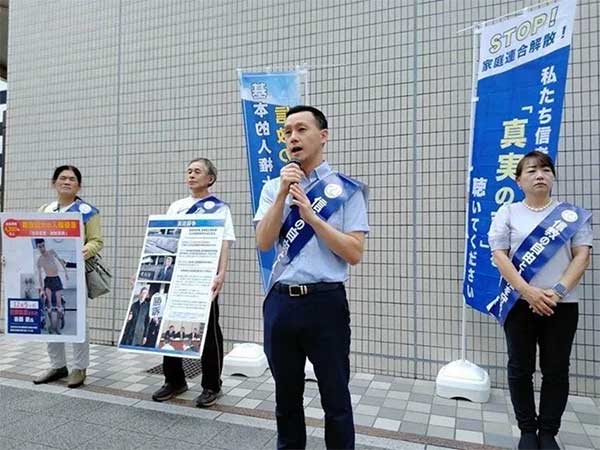
Featured image above: Demonstrators in Takasaki, Japan 22nd June 2025, protesting state violations of their freedom of conscience. Photo: FFWPU
[Editor’s note: Soka Gakkai, a global lay Buddhist organization originating in Japan, aims to create an “ideal world” based on the principles of Nichiren Buddhism, which emphasizes individual empowerment, inner transformation, and societal harmony. Their vision is often framed as kosen-rufu, meaning the widespread propagation of Buddhist values to establish peace and happiness for all.
Soka Gakkai promotes peace, culture, and education through initiatives that focus on personal transformation (human revolution) – the belief that changing oneself positively impacts society; peace ativism – anti-nuclear campaigns, human rights advocacy, and interfaith dialogue; education – institutions like Soka University emphasize value creation and global citizenship; community engagement – social welfare programs, disaster relief, and environmental sustainability efforts.
To actualize these ideals in governance, Soka Gakkai founded the Komeito party in 1964 (now known as New Komeito or simply Komeito). The party’s purpose was to translate Buddhist-based humanistic values into public policy. While legally separate from Soka Gakkai, Komeito has long been backed by members of Soka Gakkai and focuses on peace-oriented diplomacy (e.g., supporting Japan’s pacifist constitution); social welfare policies (benefiting education, healthcare, and the elderly); grassroots democracy (reflecting the voice of ordinary citizens)
Since 1999, Komeito has been a coalition partner with the Liberal Democratic Party (LDP), influencing policies while maintaining a centrist stance.
Despite its contributions, Soka Gakkai’s political role has been controversial, with critics accusing it of blurring the lines between religion and politics. Some also argue that Komeito’s alliance with the conservative LDP compromises its original pacifist ideals.
Soka Gakkai envisions an ideal world through personal empowerment, education, and political engagement. While its approach is rooted in Buddhist ethics, its political involvement remains a complex and debated issue.]