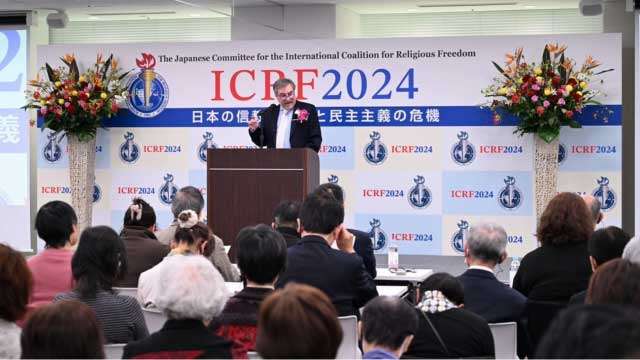
“In light of gross violations in Japan, FoRB—Freedom of Religion or Belief—has been articulated as a vital human right for a healthy society to the audience in Tokyo.”
Religious liberty extends beyond the mere freedom to believe or not believe; it encompasses the right to live according to one’s beliefs or lack thereof. However, Japan continues to restrict religious freedom, as evidenced by the case of the Family Federation for World Peace and Unification.
Prepared by Knut Holdhus
Bitter Winter, the leading international online magazine for religious freedom and human rights, featured on 26th December 2024 the first of four articles by Marco Respinti, the magazine’s Director-in-Charge. The articles were based on a series of lectures he gave in four Japanese cities – Hiroshima, Tokyo, Nagoya, and Fukuoka – from 6th to 10th December 2024, organized by the Japan Committee of the International Coalition for Religious Freedom (ICRF).
The first Bitter Winter article carried the headline “Made in Japan: No FoRB for the Family Federation. 1. Denying the First Political Human Right”
The lecture tour highlighted a pressing issue: the ongoing challenges to religious liberty in Japan. Respinti pointed out that he had gained valuable insights into this critical matter through discussions with esteemed colleagues, lawyers, activists, and specialists. As a foreign guest, he did not claim the authority to judge Japan, but as a global citizen, he advocated for the universal importance of freedom of religion or belief (FoRB). This right is foundational to healthy societies and genuine democracies.
Respinti emphasized, “A pivotal element of a healthy society and a distinctive character of a true democracy is freedom of religion, belief, or creed for everyone. International treaties call it ‘FoRB’: freedom of religion ‘or belief’. This is actually important. Practices that are not technically ‘religion’ are still manifestations of ‘belief’ and are thus protected by FoRB.”
FoRB is recognized as a fundamental human right by international treaties. It encompasses not only traditional religious practices but also non-religious beliefs, ensuring protection for all forms of conscience. In fact, FoRB is the first “political” human right, second only to the right to life. Without life, human rights have no bearer; without FoRB, individuals lack the freedom to explore and express their most profound convictions.
This right involves the freedom to engage with life’s ultimate questions, such as the existence of a higher power or cosmic principle. When people can freely address these existential queries, they achieve true liberty. Moreover, FoRB is not confined to private belief but extends to the public sphere, influencing how individuals organize their lives and contribute to society.
Marco Respinti emphasized that FoRB also underpins other essential rights, such as freedom of expression, association, and education. These freedoms derive from the ability to live authentically according to one’s beliefs. Thus, FoRB is not only the cornerstone of individual dignity but also a crucial element of societal health and democratic integrity.
The far-reaching impact of FoRB
Throughout history, the presence or absence of FoRB has shaped civilizations. According to Respinti, societies rise or fall based on their ability to uphold this right. When even one individual’s FoRB is restricted, the entire society suffers. This demonstrates that religious liberty is not a niche concern but a universal imperative.
Today, FoRB is among the most threatened human rights worldwide. In many countries, authoritarian regimes suppress religious freedom, destabilizing communities with hatred, ideology, and power struggles. However, even democracies are not immune to this problem. When democratic nations fail to safeguard FoRB, they become incomplete democracies in need of reform. These violations can manifest through fiscal policies, administrative actions, cultural biases, and organizational restrictions.
The case of Japan
Unfortunately, Japan is not exempt from these challenges. Bitter Winter, an online magazine dedicated to religious freedom, has documented significant threats to FoRB in Japan, particularly following the assassination of former Prime Minister Shinzo Abe (安倍 晋三, 1954–2022) on 8th July 2022, in Kashihara, Nara Prefecture.
Abe, who served as Japan’s Prime Minister from 2006–2007 and 2012–2020, was tragically killed by Tetsuya Yamagami (山上 徹也), a former member of the Japan Maritime Self-Defense Force. This event ignited a public controversy surrounding the Family Federation.
Respinti mentions how the fallout from Abe’s assassination has brought increased scrutiny to the Family Federation. Activists campaigning against the religious organization accuse it of financial exploitation and unethical practices, leading to government interventions that have had significant implications for FoRB in Japan. While the government’s actions are ostensibly aimed at protecting citizens, the same actions raise concerns about the broader erosion of religious freedom.
A call for vigilance
Japan’s vibrant democracy and remarkable cultural heritage make the current threats to FoRB particularly troubling. A true democracy must protect the rights of all citizens, ensuring that no individual or group is denied the freedom to live according to their beliefs. When FoRB is diminished, it jeopardizes not only individual rights but the very foundation of democratic society.
Marco Respinti emphasizes that religious liberty should concern everyone. It is not merely an abstract principle but a tangible safeguard of human dignity and societal harmony. As Japan grapples with these challenges, it is imperative for policymakers, civil society, and the international community to uphold FoRB as a universal and inviolable right.
Conclusion
FoRB is the bedrock of all human rights and the hallmark of a thriving democracy. Its preservation requires vigilance and commitment from individuals and institutions alike. As we reflect on the situation in Japan, let us reaffirm our dedication to ensuring that religious liberty is not just an ideal but a lived reality for all. The stakes are high, but the rewards – peace, justice, and freedom – are immeasurable.
Featured image above: Marco Respinti speaking in Tokyo 8th December 2024. Photo: Japan Committee of ICRF