Claim of religious freedom violation raised in Supreme Court appeal over dissolution as Family Federation believers pursue final avenue in the Japanese legal system
Prepared By Knut Holdhus
The Japanese daily Sekai Nippo reported on 10th March on the latest development in the dissolution order against the Family Federation for World Peace and Unification (formerly the Unification Church). The paper writes, “The religious organization filed a special appeal with the Supreme Court on 9th March, challenging the Tokyo High Court’s decision that ordered its dissolution.
The liquidation process – such as compensation to victims of donation-related “damages” – being carried out by a liquidator appointed by the Tokyo District Court will continue.
Because of the High Court’s ruling, the dissolution order has already taken effect, and the religious organization has already lost its legal status as a religious corporation. However, if the Supreme Court overturns the dissolution decision, the effect of the dissolution would be suspended, and the liquidation procedures would stop.
As of 10th March, the religious organization has not issued a comment. In the statement of reasons for the special appeal to be submitted to the Supreme Court, it is expected to argue that the ‘violation of laws and regulations’ – a requirement for dissolution under the Religious Corporations Act – does not include torts under civil law, and that the dissolution order infringes upon the constitutionally guaranteed ‘freedom of religion’.”
In Japanese procedure, a special appeal (特別抗告 – tokubetsu kōkoku) is a very limited appeal to the Supreme Court used when a party claims that a lower court decision violates the Constitution or involves a serious legal error. It is not a normal appeal about facts or evidence.
In many procedural matters (including certain civil rulings and non-trial decisions), once the High Court has ruled, there is normally no ordinary appeal left. The only remaining route is a special appeal to the Supreme Court.
The Supreme Court will usually consider it only if the appellant claims a violation of the Japanese Constitution or a serious procedural/legal defect in the decision.
The Supreme Court generally does not re-evaluate evidence or factual findings. It reviews constitutional or legal interpretation issues only. The Supreme Court rejects most special appeals quickly, often without detailed reasoning.
According to the Sekai Nippo article, the religious organization plans to argue that the dissolution order violates “freedom of religion”. This may be seen as strategic because freedom of religion is protected by Article 20 of the Constitution of Japan. Constitutional claims are one of the few valid grounds for a special appeal.
So the argument the Japanese daily describes is essentially that the dissolution order violates constitutional protections for religious freedom. That gives the many believers of the Family Federation a procedural doorway to the Supreme Court.
Such a special appeal is not unusual procedurally, but rarely successful. Parties frequently file a special appeal after losing in the High Court when no ordinary appeal remains. However, the Supreme Court accepts only a very small fraction. Most are dismissed summarily.
Even though the legal mechanism of this case is common, the subject matter is highly unusual. The dissolution of a religious corporation in Japan is extremely rare. It raises constitutional questions about religion and state authority.
The case is connected to the political and social fallout after the 2022 assassination of former Prime Minister Shinzo Abe (安倍晋三). That context is why the appeal has drawn substantial attention.
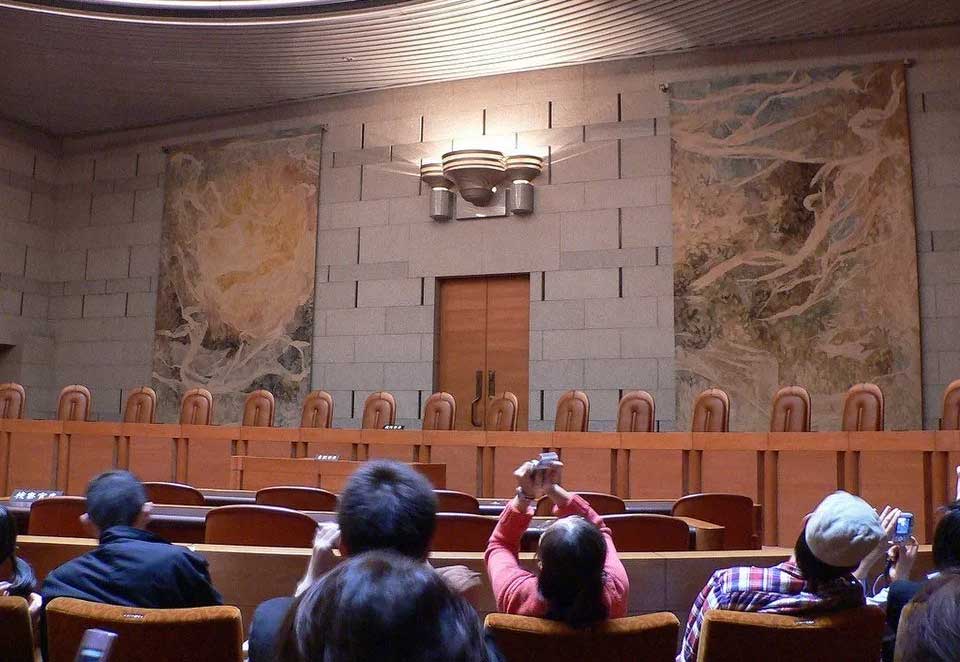
Featured image above: the Grand Bench of the Japanese Supreme Court, the highest judicial panel, consisting of all 15 justices, which handles critical constitutional issues, landmark cases, and changes to legal precedent. It sits at the top of the Japanese judicial system to ensure consistent interpretation of the law. Photo: Tetsu2266 / Wikimedia Commons. Public domain image