Left-wingers Viewed Abe’s Assassination as a “Once-in-a-Lifetime” Chance to Eliminate the Anti-Communism Movement
Large Conservative Monthly Magazine Exposes Political Vendetta Behind Dissolution Case Against Movement That Helped Safeguard Japan During Critical Cold War Period
Prepared by Knut Holdhus
In their thought-provoking dialogue featured in the September 2025 issue of Hanada, Attorney Nobuya Fukumoto (福本修也) and Professor Emeritus Seishiro Sugihara (杉原 誠四郎) offer a compelling defense of the International Federation for Victory Over Communism (IFVOC, or 勝共連合 (Shōkyō Rengō) in Japanese). Their insights are part of a larger article headlined, “The Former Unification Church – the Irregularities of the Dissolution Order”.
This conversation unfolds against the backdrop of renewed national debates concerning the role of the Unification Church (now the Family Federation) in Japanese political life and the current legal proceedings concerning its dissolution. With clarity, historical context, and strong conviction, the two men argue that IFVOC made a significant and underappreciated contribution to postwar Japanese society – particularly in its effort to resist the tide of global communism and to safeguard Japan’s democratic structure.
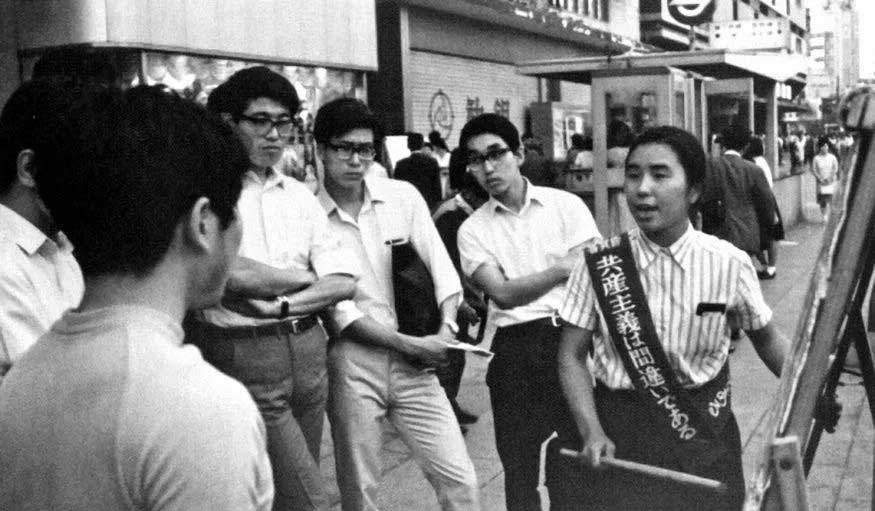
The conversation on this topic begins with Sugihara, a legal scholar, recalling the Vietnam War era, when Japan, though not a direct combatant, was deeply affected by the ideological struggle raging between capitalism and communism. He paints a vivid picture of members of the anti-communism federation engaging in grassroots activism, standing on street corners with blackboards to explain the dangers of communism. This anecdote not only humanizes the movement but also underscores its educational and civic-minded aspirations.
Sugihara emphasizes that during this era, communism was not an abstract ideological threat – it was a force sweeping through the developing world and influencing Japan’s own leftist student and labor movements. The IFVOC, he argues, stepped in to provide the intellectual and organizational counterbalance that Japan’s liberal democratic mainstream had been lacking.
Fukumoto builds on this by situating IFVOC within the broader geopolitical context of the Cold War. He reminds readers that the organization was founded in 1968 by Sun Myung Moon, the founder of the Unification Church, at a time when communism was spreading rapidly through Asia. Japan, though allied with the United States, was under constant ideological pressure.
In this environment, IFVOC provided an infrastructure through which conservative and center-right forces – including politicians, business leaders, public safety officials, and retired Self-Defense Forces officers – could coordinate their efforts to challenge the progressive (and at times pro-communist) opposition. The Federation, they argue, was not merely reactive but proactive, helping to influence local governance, public policy, and national security measures.
One of the most powerful elements of the article is its exploration of the Levchenko Incident, in which a former Soviet KGB agent defected to the United States and exposed a network of alleged Soviet collaborators in Japan, including members of the Japan Socialist Party. Sugihara and Fukumoto point out that the fallout from this scandal shook Japan’s political establishment and validated many of the anti-communist concerns that IFVOC had raised for years.
However, instead of fostering national unity against foreign subversion, the left responded by accusing IFVOC – and by extension, the Unification Church – of conspiring with the CIA to fabricate the entire incident. This, they argue, set the stage for decades of hostility toward the Federation and its religious affiliates.
The legal and political ramifications of this animosity are traced in detail. IFVOC successfully sued the Socialist Party for defamation, resulting in a settlement in 1994. However, as Fukumoto and Sugihara explain, the legal counsel for the Socialist Party, Hiroshi Yamaguchi (山口広), had by then formed the National Network of Lawyers Against Spiritual Sales (Zenkoku Benren).
According to them, this organization’s founding purpose was not merely to protect consumers from predatory religious practices – but to systematically dismantle the Unification Church and IFVOC itself, both of which were seen as ideological enemies of the left. Fukumoto asserts that the root cause of the ongoing dissolution case against the Family Federation lies not in allegations of misconduct alone, but in this long-standing political vendetta.
The interview concludes with a sobering reflection on the assassination of former Prime Minister Shinzo Abe (安倍晋三) by Tetsuya Yamagami (山上徹也), whose family’s alleged exploitation by the Unification Church triggered renewed scrutiny of the religious organization.
Sugihara and Fukumoto argue that Zenkoku Benren and its allies in the media seized on this moment as a political opportunity – an event they viewed as a “once-in-a-lifetime” chance to accomplish what decades of litigation and campaigning had not: the formal dissolution of the Family Federation. In their view, the general public has been kept unaware of these historical and political undercurrents, which, if more broadly understood, might shift the tone of public discourse and the trajectory of legal action.
In sum, this conversation offers a robust and unapologetic defense of the International Federation for Victory Over Communism. It seeks to reframe the narrative around the Family Federation by focusing on its historical contributions to anti-communism, national defense, and democratic preservation. While critics may question the ideological bias of the IFVOC or its religious roots, Fukumoto and Sugihara remind readers that history is rarely black and white – and that institutions like IFVOC played an indispensable role in shaping modern Japan.
Featured image above: From a Victory over Communism (IFVOC) campaign in Japan in 1969. Photo: IFVOC