Legal spokesperson points out the total absence of justice and fairness in Japan’s dissolution case against Family Federation based on outdated civil harm claims and fabricated victims
Problems of the Tokyo District Court Decision on the Dissolution of the Family Federation
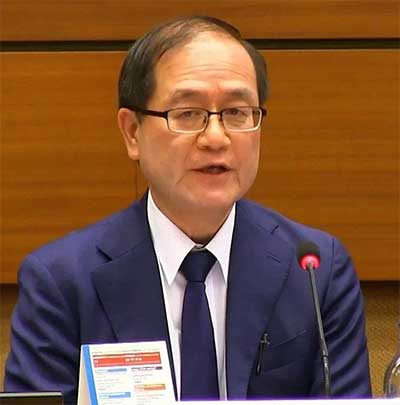
A speech by Norishige Kondo (近藤徳茂), Deputy Director of the Legal Affairs Office of the Family Federation in Japan, at a side event organized by the Universal Peace Federation (UPF) at the 59th session of the Human Rights Council, in hall 25 of the United Nations Office in Geneva, Switzerland 16th June 2025.
Prepared by Knut Holdhus
The title of my presentation is “Problems of the Tokyo District Court Decision on the Dissolution of the Family Federation”.
As was explained, our official name is Family Federation for World Peace and Unification, but I believe that you are familiar with our former name, Unification Church. So in my presentation, I use the abbreviation UC to indicate our church.
After the former Prime Minister Shinzo Abe was assassinated on 8th July 2022, the lawyers’ network against the UC created the false impression that serious and widespread harm caused by the UC occurred across the country. It is because the suspect quoted his grudge against the Unification Church as the motive for the murder.
However, later we found that the major lawyer [Hiroshi Yamaguchi] of the network stated in the July 2022 issue of a periodical [Consumer Law News] that the number of complaints [to the Consumer Affairs Agency] related to the UC has declined.
It was the same month as the Abe incident, and therefore, the claims by the network appear to be merely propaganda.
However, in those days, the media pressured the government. As a result, an unnecessary new law to control donations was enacted. The government even changed the legal interpretation for dissolving the UC. And finally, it filed a lawsuit seeking the dissolution of the UC.
The government tried to dissolve the UC based on the Religious Corporations Act, article 81, paragraph 3, item 1, [which says that the requirements for dissolution] are “violation of law” and “harming public welfare seriously and clearly”.
Prime Minister Kishida changed the legal interpretation overnight and included civil torts [civil wrongs causing alleged harm] in the concept of “violation of law” to dissolve the UC.
However, civil torts are too vague a concept to be grounds for dissolution, and such an interpretation violates ICCPR [International Covenant on Civil and Political Rights] article 18, paragraph 3.
As for “public welfare”, the UN Human Rights Committee recommended Japan three times not to restrict religious freedom by [concerns for] public welfare.
The government ignored them. Surprisingly enough, the court accepted the change of legal interpretation and ignored the recommendation by the [UN Human Rights] Committee as well.
However, recently, there were only a few tort [civil wrong causing alleged harm] cases related to the UC.
As a result, the government submitted fabricated written statements under the names of alleged “victims”. Yet the UC exposed the fabrications in the court.
Finally, the court found grounds for dissolution based on speculations, saying there must be unknown cases of victims, and it issued a decision to dissolve the UC.
Regarding the civil cases, the UC instructed its members not to accept large amounts of donations in 2009, and the number of cases declined.
The Tokyo District Court found tortuous acts [civil wrongs causing alleged harm] based not only on civil judgments but also on settlements. Even so, the total amount declined to 5% after 2009.
For dissolving a religious cooperation, there must be a presently existing motive. So the court found torts [civil wrongs causing alleged harm] based on speculation, violating the principle of judgment based on evidence.
Regarding the past tort cases, the majority of the plaintiffs were victims of deprogramming [See editor’s note 1 below].
The court relied only on deprogrammed apostates [See editor’s note 2 below] for facts dating back from 20 to 40 years before. In violation of international law, the court found what they according to social norms considered to be “illegalities”.
In this graph, the red line shows the number of believers who suffered deprogramming [See editor’s note 1 below], and the blue line shows the believers who sued the UC. These two lines show similarity. It means that even the past cases were intentionally created cases.
From every perspective, the decision to dissolve the UC can be deemed unjust.
We sincerely request the international community’s attention and monitoring regarding this issue.
Thank you for your attention.
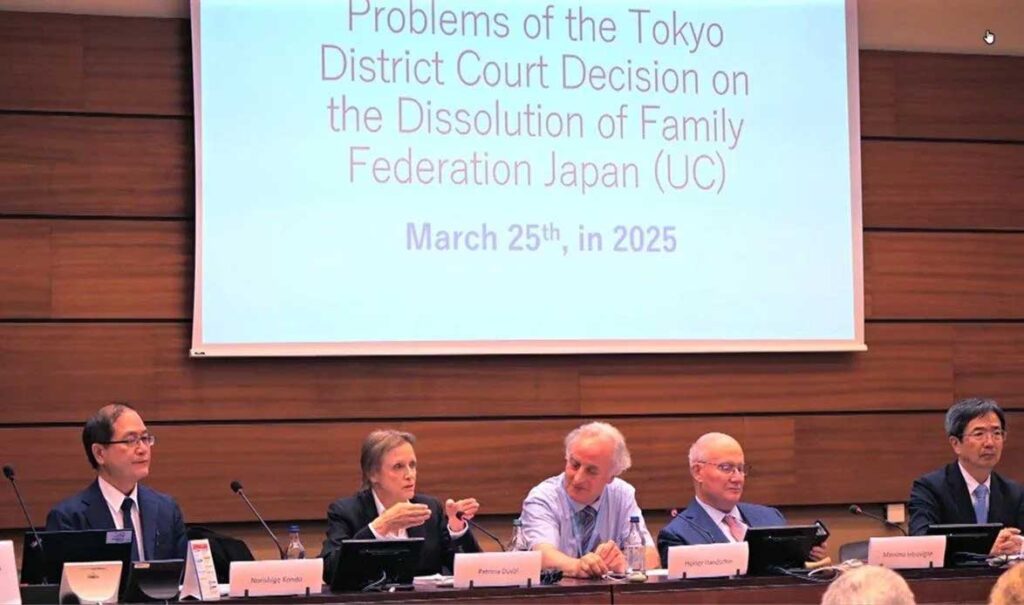
Featured image above: Norishige Kondo (left) and the panel of speakers at the side event to the 59th session of the Human Rights Council in Geneva, Switzerland on 16th June 2025. From left: Kondo, Attorney Patricia Duval, Heiner Handschin, Dr. Massimo Introvigne, Dr. Hirohisa Koide.
[Editor’s note 1: Coercive faith-breaking (“deprogramming”) in Japan refers to the practice of coercively attempting to separate individuals from their religious affiliations or beliefs, typically through intervention by family members, professional faith-breakers (deprogrammers) or organizations hostile to new religious movements (NRMs). This phenomenon often targets members of such movements, e.g., relatively large faiths like the Family Federation or Jehovah’s Witnesses, but also smaller groups like Happy Science (Kōfuku no Kagaku) and other newer religious movements.
However, Soka Gakkai, a Buddhist-based lay organization with more than 8 million Japanese members and affiliated with Nichiren Buddhism, has occasionally been subject to faith-breaking attempts.
The practice gained attention in the latter half of the 20th century, particularly in the 1980s and 1990s. Parents or concerned family members often hired faith-breakers who taught them how to abduct and forcibly detain believers. Almost all such cases involved confining the individual believer and cutting him or her off from the religious community. During the confinement, the believer was subjected to intense questioning or indoctrination designed to break his or her faith. The aim was to “rescue” the person from what the family often had been tricked by faith-breakers or lawyers to regard as a harmful influence from the religious organization.
Critics of forced de-conversion argue that it violates fundamental human rights, including freedom of thought, religion, and association. Reports of psychological trauma and accusations of unlawful detention have sparked debates over their ethical and legal implications. In response, some religious groups, particularly NRMs, have lobbied for greater protections against such practices.
Japanese courts have been inconsistent in addressing cases of coercive faith-breaking. While some verdicts have condemned the practice as illegal detention, others have been more lenient, citing family concerns about “mental health” or alleged “exploitation” as mitigating factors.]
[Editor’s note 2: Apostates here refer not just to someone who has left the religion, but who are now being used to undermine the group. The apostates in the text above are being used by hostile and cynical lawyers for malicious reasons to cause harm to the faith they were forced out of, when they had their faith broken coercively by so-called faith-breakers (deprogrammers), working in league with activist lawyers.]