By Juraj Lajda, October 4, 2024
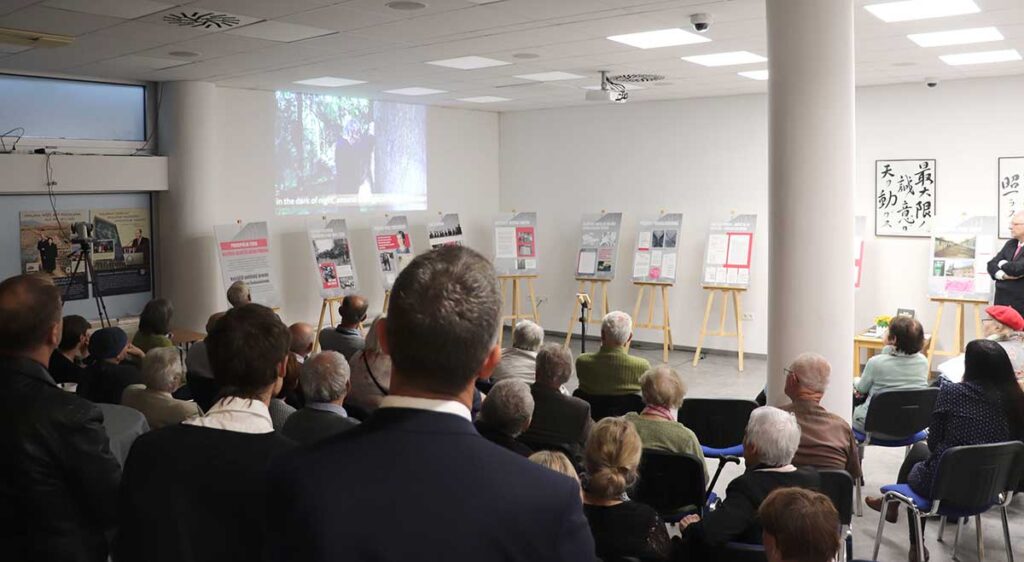
“PRINCIPLE PEOPLE—HISTORY OF AN UNCOMMON STORY” was the title of the vernissage and exhibition held at the Peace Embassy of Bratislava on October 2, 2024. The exhibition commemorated the 50th anniversary of the persecution and conviction of the first members of the Unification Movement in what was then Czechoslovakia.
The “Principle People” movement arrived in Czechoslovakia from Austria following the occupation in 1968. Its ideas rapidly spread throughout the country, especially inspiring the youth. Due to the anti-Marxist orientation of their teachings, members quickly attracted the attention of State Security.
In 1973, State Security launched an unprecedented action resulting in the prosecution and sentencing of over 30 young individuals to prison terms ranging from one to nearly five years. It was the largest political trial in Czechoslovakia at the time. The vernissage featured authentic testimonies from the first members and their prison experiences.
The exhibition opened with a performance by a female trio consisting of Ernestína Lajdová, Marcela Magušinová, and Dorota Šimeková, who sang songs from that era. Betka Danišková, the national leader at the time, served 4 years and 4 months in prison. During her speech, she recalled her time in pre-trial detention and her last meeting in the prison corridor with Marie Živná, who died a few days later in her cell under unexplained circumstances. She recounted how she was devastated by the news of Živná’s death and often cried into her towels, with her prison roommate cautioning her against crying too much to avoid headaches.
Anton Uhnák, another group member sentenced to 3 years and 8 months, remarked that the Principle People followed certain rules and laws differing from those of Marxism-Leninism. It was a struggle between absolute materialism and theological idealism. “We did not want struggle, but cooperation,” he stated. The Marxists planned to establish a communist society by 2000, but they failed to consider that there was also a divine plan. The regime tried to silence us. Our main distinction from other groups was our status as an international movement.
Juraj Lajda, who also acted as the MC, spent 3 years and 2 months in prison. He described the story as one of incredible faith, hope, and determination among young people searching for life’s meaning and possessing ideals to improve society. Unfortunately, they lived under a totalitarian regime that suppressed divergent views during a period of emerging normalization. Their faith and conviction, coupled with their determination, made totalitarianism seem like an insignificant obstacle compared to the ideals they championed.
Miroslav Rybár, the current president of the Family Federation in Slovakia, expressed gratitude to the group’s first members for their dedication. “Without their foundation, we would not be here today,” he said. He also mentioned Emi Steberl, the first missionary who brought these ideas to former Czechoslovakia, despite the dangers, when it would have been easier to stay in Austria. The strength of the Principle People’s ideas endured beyond the fall of communism. “Creating a world of peace centered on God and good families is not easy,” Rybár concluded.
The last speaker, Dr. Jerguš Sivoš, Chairman of the Board of the Nation’s Memory Institute, said that it was the greatest repression of a religious group at that time. Yet, the Principle People stood up to this arduous test, defending their religious convictions and inner freedom. The investigation file is over 3,000 pages long. He then read out the names of 18 convicted individuals.
Dorota Šimeková recited her own poem, written on the day the Supreme Court in Slovakia announced the final verdict. The MC then introduced the 15 exhibition panels and lectures prepared for the following days of the exhibition. Barbara Grabner presented the trailer for the documentary video “The Struggle for Truth and Justice.”
The vernissage concluded with a citation from President Václav Havel on the last panel of the exhibition: “Hope is not the conviction that something will turn out well, but the certainty that something is worthwhile, no matter how it turns out.”
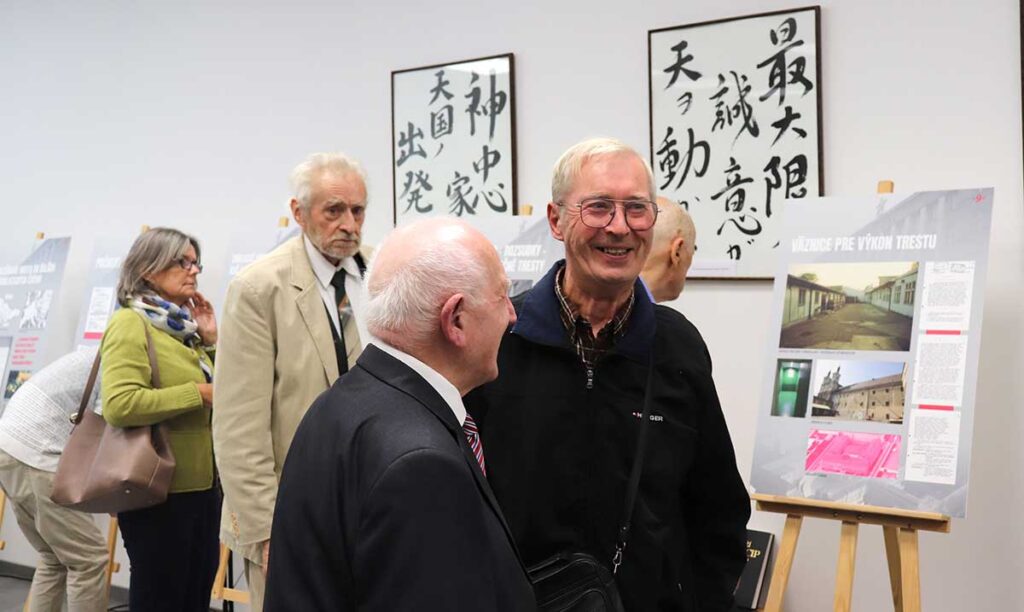
Afterward, approximately 70 participants had the opportunity to view the exhibition.