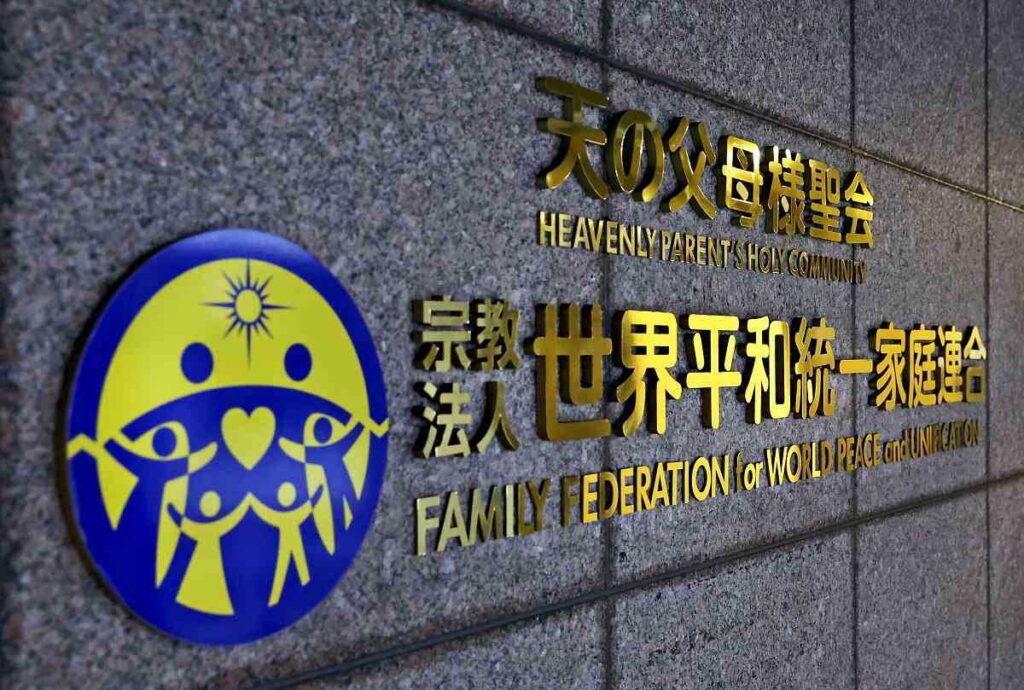
No dissenting voices in mainstream media, but they warn of religious suppression and dangerous legal precedents set by unjust dissolution order
Tokyo, 4th April 2025 – Published as an article in the Japanese newspaper Sekai Nippo. Republished with permission. Translated from Japanese. Original article.
Media Unified in Support While Critics Decry “State Oppression”
Tokyo Court’s Decision to Dissolve Family Federation
by the editorial department of Sekai Nippo
prepared by Knut Holdhus
Following the Tokyo District Court’s decision to order the dissolution of the Family Federation for World Peace and Unification (formerly the Unification Church), mainstream media broadly supported the ruling, with “expert commentary” overwhelmingly in favor. For example, Susumu Shimazono (島薗進), Professor Emeritus at the University of Tokyo, said in the Asahi Shimbun (March 26), “The court’s decision is appropriate,” and Hajime Ajika (田近肇), Professor at Kinki University, commented, “From the standpoint of the Constitution and the Religious Corporations Act, the decision was anticipated and not surprising.”
However, dissenting voices have also emerged. This is the first case in which “wrongdoings according to civil law” have been used as grounds for dissolving a religious corporation, raising questions about the media’s near-total lack of caution or scrutiny.
Masaru Sato (佐藤優), a former senior analyst at the Ministry of Foreign Affairs and a writer, stated at a study session called “Tokyo Daichi Juku” (東京大地塾) held at the House of Councilors office building on 26th March, “Even if the dissolution order is issued under civil law, I don’t see this as any kind of triumph. It gives me chills. It’s not unthinkable that they could go after Christianity next.”
Referring to past cases like the Japan Holiness Church [See editor’s note 1 below] and the Omotokyo [See editor’s note 2 below] being forcibly dissolved, Sato warned, “The state’s posture toward religious suppression is frightening.”
Regarding the inclusion of “wrongdoings according to civil law” as grounds for dissolution, he questioned, “It should be the individuals who committed the unlawful acts who are held criminally or socially responsible – not a net being cast over the entire religious organization.”
He added that if the government is going to ban practices conducted by this organization, it would be unfair not to apply the same standards to other religious organizations like the United Church of Christ in Japan or the Association of Shinto Shrines. He also strongly asserted, “It’s absolutely wrong to mock people for what they believe or for being believers.”
Tsutomu Nishioka (西岡力), a special-appointed professor at Reitaku University, contributed an article titled “The Dissolution Order Violates Freedom of Religion” on 31st March from the perspective of a Protestant believer. He wrote, “With this ruling, our country’s freedom of religion has been significantly restricted. […] It is terrifying that a religious group, which for decades has been legally recognized and operating under religious corporation status, can suddenly be subjected to retroactive changes in dissolution requirements and have its status revoked.”
He also expressed serious doubts over the court’s decision to treat even donation refunds settled out of court as legal violations, using these as grounds for declaring that the group’s actions “clearly and significantly harm public welfare.”
Nishioka also addressed the issue of Family Federation members allegedly being abducted and confined to force them to renounce their faith. He criticized the court for issuing a dissolution order without even mentioning the government’s claim that these cases involved mere “supervision” rather than abduction. He further argued that using the testimonies of ex-members who were forcibly de-converted as evidence for dissolution goes against international norms.
Freelance journalist Masumi Fukuda (福田ますみ), who has extensively reported on the religious organization, told this newspaper that the dissolution order is a “state-orchestrated trial” aimed squarely at the Family Federation, with a pre-decided conclusion. She accused the Ministry of Education, Culture, Sports, Science and Technology (MEXT) of digging up very old cases of settlement or reconciliation and criticized the court’s logic as “layering conjecture upon conjecture, speculating that illegal acts are likely to have occurred.” She said this betrays the fundamental judicial principle of establishing facts through evidence and advised the religious organization to appeal to international audiences, especially in the U.S.
Even politicians are speaking out. Senator Satoshi Hamada (浜田聡参) stated on his YouTube channel, “The court’s ruling essentially means that the violent actions of suspect Yamagami (山上) succeeded. Celebrating this decision is tantamount to endorsing acts of terrorism.”
[Editor’s note 1: The Japanese authorities banned the Japan Holiness Church (日本ホーリネス教会) in the past.
During World War II, the Japanese government suppressed many Christian denominations that were not part of the state-approved United Church of Christ in Japan (日本基督教団, Nihon Kirisuto Kyōdan). The Japan Holiness Church, which was an independent Protestant movement, was banned in 1943 under the pretext of violating the wartime government’s policies. Several of its leaders were arrested and imprisoned, and the church’s activities were forcibly halted.
After the war, the church was re-established in 1949, and it continues to exist today as multiple branches, including the Immanuel General Mission and the Japan Holiness Church.]
[Editor’s note 2: Omotokyo (大本教) is a Japanese new religious movement that originated in the late 19th and early 20th centuries. It was founded by Nao Deguchi (1836–1918), a peasant woman who claimed to have received divine revelations, and her successor Onisaburo Deguchi (1871–1948), who played a significant role in shaping the religion’s teachings and structure.
Omotokyo emphasizes universal salvation, spiritual purification, and the ultimate unity of all religions. The religion stresses the importance of living in harmony with divine will and nature.
Today, Omotokyo remains a small but active religious group in Japan. It has also inspired the foundation of Aikido, the martial art developed by Morihei Ueshiba, who was a follower of Omotokyo.
Omotokyo holds a significant place in the history of Japanese religion, not only as a spiritual movement but also as a symbol of resistance to religious persecution during Japan’s militaristic period.]