
Growing international criticism as Japan’s judiciary exhibits alarming trends in handling of civil cases involving religious minority Family Federation
Prepared by Knut Holdhus
See also Judges Clearly Swayed by Media
See also Civil Case Ruling Shows Partiality of Judiciary
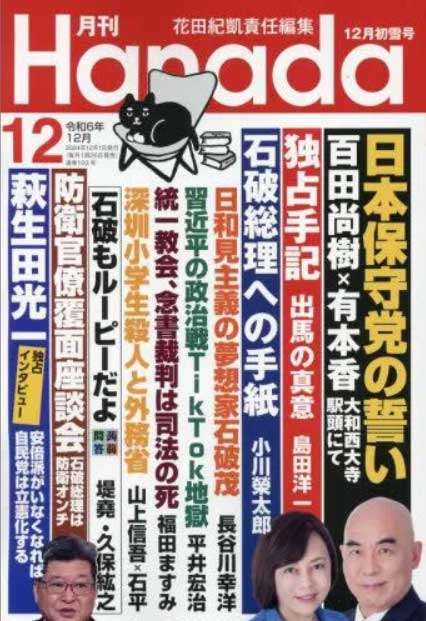
Investigative journalist and award-winning author Masumi Fukuda (福田ますみ) has authored a new extensive report titled “The Day Japan’s Judiciary Died – The Full Truth Behind the Former Unification Church Memorandum (念書) Trial”. Her findings were published in the December 2024 Japanese magazine Monthly Hanada issue. Towards the end of the 10-page report, Fukuda brings attention to strong international criticism of serious violations of religious freedom in the Japanese government’s campaign against a religious minority.
The investigative journalist also points out how the Japanese judiciary systematically issues verdicts that favor allegations from a hostile network of activist lawyers who have been campaigning against the Family Federation for decades. At the same time, judges as a rule turn a deaf ear to solid evidence presented by religious organization members.
The Japanese government’s actions against religious organizations, despite constitutional guarantees of freedom of religion, have drawn significant criticism from the international community. At the IRF (International Religious Freedom) Summit Asia held in Tokyo on 22nd July this year, former U.S. Secretary of State Mike Pompeo directly condemned Japan’s efforts to dissolve the Family Federation. He remarked, “This is wrong. It is harmful to Japan. It must be corrected.”
His statement reflects a broader consensus among human rights advocates and religious scholars in Europe and the United States, who share deep concerns about these developments.
French human rights attorney Patricia Duval has also weighed in on the issue, conducting an in-depth analysis of numerous civil court cases involving the Family Federation. Her findings indicate that Japan breaches the International Covenant on Civil and Political Rights, to which it is a signatory, and that this represents a form of religious suppression within a capitalist framework.
In a report submitted to the United Nations, Duval highlighted several alarming trends in Japan’s judicial approach:
- Blind acceptance of anti-Family Federation arguments: Japanese courts have uncritically adopted the legal reasoning of the National Network of Lawyers Against Spiritual Sales, an organization dedicated to dismantling the Family Federation under the guise of consumer protection. This has led to courts disregarding the faith and intentions of Family Federation members who offered donations. Instead, the courts presumed that the sole motive of the religious organization was financial gain.
- Use of the “mind control” theory: Despite the discrediting of the “mind control” theory, it has been used by the courts to dismiss the evidence presented by the Family Federation, which demonstrated that former members donated voluntarily.
- Ambiguity and presumption of guilt: Courts have arbitrarily deemed certain donations as inconsistent with “social reasonableness” or “social norms” and have applied a presumption of guilt without concrete evidence.
- Condemnation of religious doctrines: Courts have criticized the use of religious teachings – such as beliefs in karma, hell, and salvation – to encourage donations. This contradicts the fundamental right of religious organizations to solicit support based on their doctrines, a necessity for their existence and activities.
According to Duval, the Japanese judiciary’s bias against the Family Federation is so entrenched that even when defendants explain their donations were faith-based, their testimonies are routinely dismissed. Judges claim such donations stem from the federation‘s “undue influence”, effectively invalidating any evidence provided by members of the religious organization. Consequently, the Family Federation and its members are systematically denied the opportunity to seek justice in domestic courts.
This bias was particularly evident in a written memorandum (pledge) trial, where the principles of fairness and justice that should underpin the legal system were glaringly absent. In cases involving the Family Federation, a pattern of misreading a religion, prejudice, disregard for evidence, distortion of facts, predetermined conclusions, and populist pandering has emerged. This systemic failure has left observers deeply disillusioned with Japan’s judiciary.
Adding to the controversy, all lawsuits filed by the Family Federation – including defamation suits – have been summarily dismissed. For example, no legal action was taken against attorney Masaki Kito (紀藤正樹) of the National Network of Lawyers Against Spiritual Sales, who alleged, “There was even a case where members were forced into prostitution because they had no money.”
Similarly, journalist Yoshifu Arita (有田芳生) faced no consequences for claiming, “The police recognize the group as an antisocial organization involved in spiritual sales.” Both statements are baseless. Furthermore, attorneys from the same network have actively sought to block venues from hosting events organized by the Women’s Federation for World Peace, an affiliate of the Family Federation, branding it a “dummy organization”.
In any other context, defamatory statements of this nature would likely have been recognized and punished. Yet, in the case of the Family Federation, such claims have gone unchallenged, exposing a double standard in Japan’s legal system.
Patricia Duval has extensively analyzed lawsuits concerning high-value donations and religious proselytism, revealing how Japan’s judiciary has veered away from the principles of justice and religious freedom. She warns that democracy cannot flourish in the absence of religious liberty, a cornerstone of human rights.
As the ongoing trial concerning the dissolution of the Family Federation progresses, there is an urgent need for Japan’s judiciary to deliver judgments that are fair, impartial, and grounded in sound legal reasoning. Only through such actions can the nation address the growing concerns of its international critics and reaffirm its commitment to upholding religious freedom.