Legal expert says it is unconstitutional to hold closed proceedings in dissolution case against a large religious minority, Family Federation
Tokyo, 5th March 2026 – Published as an article in the Japanese newspaper Sekai Nippo. Republished with permission. Translated from Japanese. Original article.
[High Court Decision – Expert Commentary]
Ignoring the Right to a Public Trial, Procedures that Violate the Constitution Commentary by Seishiro Sugihara, Former Professor at Musashino Women’s University
by Seishiro Sugihara (杉原誠四郎)
Prepared by Knut Holdhus
Just as with the Tokyo District Court’s decision last March, the biggest problem with the Tokyo High Court’s recent dissolution order against the Family Federation is that it was issued without granting the right to a public trial based on Articles 32 and 82 of the Constitution, and instead was handled as a closed, non-contentious case [See editor’s note below]. The dissolution of a religious corporation – an action equivalent to a death penalty for an individual – was carried out without the public trial required by the Constitution. This clearly constitutes a constitutional violation and is a matter of grave concern.
The Religious Corporations Act indeed stipulates that court proceedings regarding dissolution orders requested by the executive branch are to be treated as non-public, non-contentious cases [See editor’s note below]. However, the original intent of this provision in the Religious Corporations Act was to prevent the executive branch from recklessly issuing dissolution orders against religious corporations. For that reason, the law requires the executive branch to request a dissolution order from the court and obtain the court’s judgment before such an order can be issued.
In other words, this system assumes circumstances in which a religious corporation has engaged in actions violating the criminal law and the criminal penalties have already been finalized, or when acts have repeatedly been recognized as unlawful in court judgments. Only when such situations have occurred, and the organization still fails to correct its conduct despite administrative guidance – when the grounds for dissolution are already clearly evident to anyone – does the government then petition the court, after which the court issues a dissolution order. Because the grounds are already obvious in such cases, the proceedings may be handled as a non-contentious case [See editor’s note below].
In the present case, however, the Minister of Education, Culture, Sports, Science and Technology requested the dissolution order merely by collecting reports from individuals claiming to be victims. No verification was conducted as to whether the reported harm actually existed as fact, nor whether – although it might subjectively be perceived as harm – it could legally be recognized as an unlawful act. Without examining any of these issues, the matter was treated as a closed, non-contentious case [See editor’s note below] based solely on victim reports collected by the Ministry from people identifying themselves as victims, and a dissolution order was then issued. This decision clearly ignored the right to a public trial and is plainly unconstitutional in terms of procedural fairness.
Furthermore, regarding this dissolution order, reports about alleged damages have been circulating that are difficult to accept unless one assumes that all donations made to the Family Federation should be interpreted as harm. Many related parties have also made comments readily affirming such claims as damage. However, the principle that donations made based on religious faith cannot be treated as harm should be included in the discussion.
What is currently being described as “damage” represents an expansive interpretation of harm. If such reasoning is allowed, then other religious organizations should also be criticized under the same standards. Yet in reporting on this dissolution order, references to other religious groups have not been permitted, and the mass media have shown a clear tendency to direct attention exclusively toward the Family Federation. This too runs counter to the principle of fairness in a state governed by the rule of law, and one could say that with the Tokyo High Court’s decision to issue the dissolution order, a kind of “darkness at high noon” has occurred.
If the type of criticism now being directed at the Family Federation – premised on the assumption that dissolution must occur – were applied to other religious corporations, a very large number of them would likely become targets. Nevertheless, no mention whatsoever is made of other religious corporations, while severe criticism is directed solely at the Family Federation. This contradicts the fairness of the law, and it would not be unreasonable to say that this decision was based on the arbitrary judgment of the presiding judges.
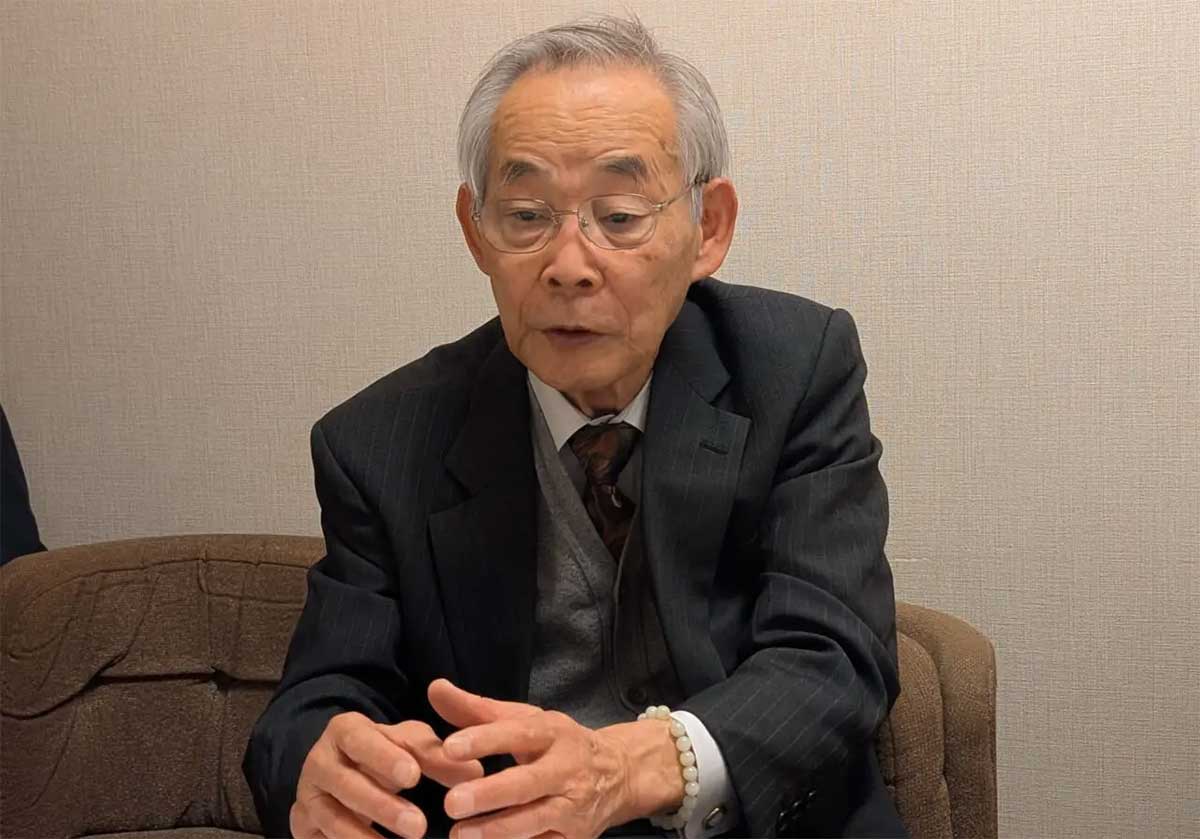
Featured image above: Seishiro Sugihara (杉原誠四郎), former professor at Musashino Women’s University and expert on issues of freedom of religion and constitutional law. Photo: Sekai Nippo
[Editor’s note: A non-contentious case refers to a legal matter where there is no dispute between parties. These cases typically involve administrative, procedural, or uncontested legal actions, such as probate (handling a deceased person’s estate), uncontested divorces, adoption, or registering a trademark. Since there are no opposing parties or legal conflicts, these cases usually proceed smoothly through the legal system without litigation.]