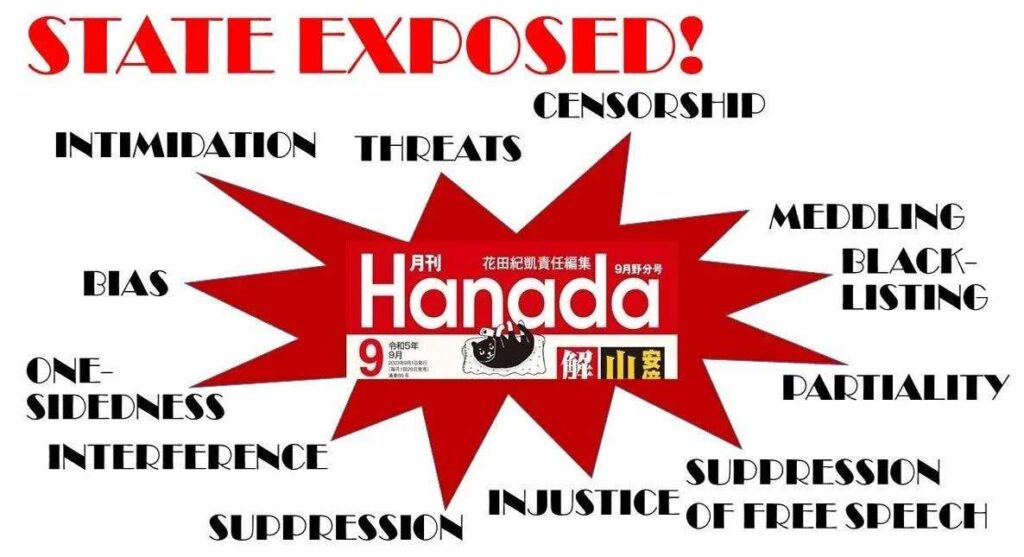
Japanese magazine publishes findings of investigative journalists about the use of threats and state meddling in the work of reporters and editors
Prepared by Knut Holdhus
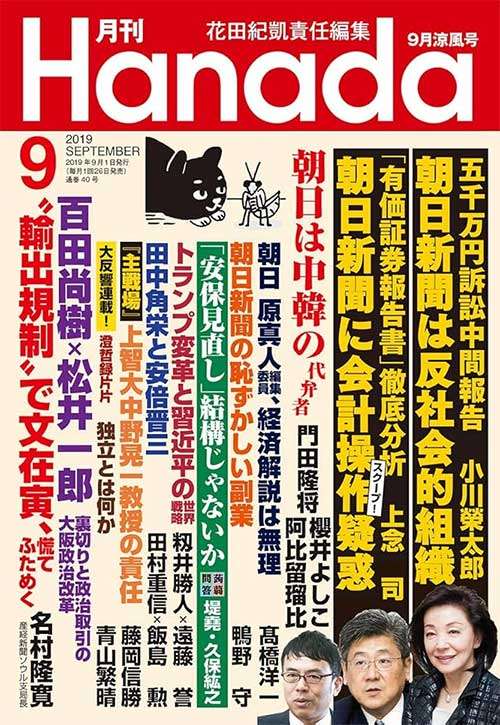
The September 2023 issue of the Japanese magazine Monthly Hanada featured a report by award-winning investigative journalist Masumi Fukuda (福田ますみ). Fukuda highlights a stark media bias and aggressive censorship enforced by authorities, specifically exposing how the Agency for Cultural Affairs reprimanded and threatened media outlets that dared to publish perspectives from the Family Federation amid a government campaign targeting the religious minority.
Her in-depth report, titled “Dissolution Request Push – Censorship of Speech by Tetsuo Goda (合田哲雄), Deputy Director-General of the Agency for Cultural Affairs,” sheds light on the suppression of free speech. It is particularly relevant given the ongoing persecution of the Family Federation in Japan. This marks the first time these findings published by Monthly Hanada are being shared outside Japan, bringing international attention to the issue.
Yomiuri Shimbun reporter prohibited from access to the Ministry of Health, Labor, and Welfare (MHLW)
One case Masumi Fukuda mentions, involves a reporter from Yomiuri Shimbun which highlights tensions between journalistic reporting and government institutions. This case, which centers on reporting related to the Family Federation (formerly known as the Unification Church), diverges from previous controversies involving the Ministry of Education, Culture, Sports, Science, and Technology (MEXT).
The Yomiuri Article
On 1st February 2023, Yomiuri Shimbun published an article titled, “Adoption Brokerage by Former Unification Church: Criminal Complaint Likely to Be Dropped – Unable to Secure Testimonies from Involved Parties.”
The article detailed that the Ministry of Health, Labour, and Welfare (MHLW) had found it difficult to file a criminal complaint against the Family Federation for World Peace and Unification (formerly the Unification Church) for violations of the Adoption Brokerage Act. As a result, it seems the complaint will not proceed. Some cases have surpassed the statute of limitations (three years), and testimonies from individuals involved in adoptions during the relevant period remain unavailable. Additionally, the ministry considered the church’s response to administrative guidance.
The Yomiuri Shimbun article mentioned that the Adoption Brokerage Act, implemented in April 2018, prohibits unlicensed intermediary activities. While the Family Federation lacks a license, numerous adoptions have taken place within its community. In November of 2022, the ministry began investigating suspected unauthorized brokerage activities by the federation, which disclosed that 31 adoptions had occurred since the law’s enactment.
The newspaper also explained that the ministry requested personal information, such as the names and birthdates of the 31 adoptive parents, but the religious organization declined to provide these details. Although the federation admitted to requesting “adoption application forms” from its members, it denied involvement in organized brokerage activities.
The Yomiuri piece claimed that some adoptees submitted statements alleging they were “used as tools for religious doctrine”. However, the ministry was unable to secure testimony from adoptive or biological parents involved during the relevant period. With little chance of obtaining further evidence, pursuing a criminal complaint seems unfeasible.
Although the ministry sought guidance from investigative authorities, concerns were raised, according to the large newspaper, including the inability to identify parties involved and the absence of concrete evidence of brokerage activities. Authorities also questioned the severity of the alleged misconduct.
The reporter’s defense
The article was a collaborative effort by several reporters, including Reporter B, who had been conducting in-depth investigations with lawyer Nobuya Fukumoto (福本修也) and began engaging with the Family Federation’s public relations office around April.
Masumi Fukuda writes that shortly after the article’s release, B was summoned by a section chief of the Ministry of Health, Labour, and Welfare (MHLW). He challenged the article’s claim that “the criminal complaint will be dropped,” asserting that no such decision had been made.
However, B had uncovered evidence suggesting the ministry had submitted a draft complaint to the Tokyo Metropolitan Police Department, which rejected it on the grounds that prosecution was not viable. This informed the article’s conclusion regarding the ministry’s unwillingness to proceed.
According to Fukuda, B retorted, “You can’t prosecute in this case, can you? That would be nothing but a dishonest scheme.” The official then responded by barring B from entering the ministry.
(Note: The Japanese expression translated as “nothing but a dishonest scheme” is often used to describe scenarios in which an entity repeatedly claims it will take action but fails to follow through, fostering a perception of dishonesty.)
The aftermath
Investigative journalist Fukuda explains that frustrated by the restriction, B reportedly told the Family Federation’s public relations officer, “That’s why I’m still pursuing stories about the Family Federation.”
Subsequently, the ministry issued a statement emphasizing that it had not ruled out the possibility of filing a criminal complaint and that investigations were ongoing.
Government influence on media
Fukuda concludes that the broader implications of this incident touch on concerns about government interference in journalistic activities, particularly regarding reporting on the Family Federation for World Peace and Unification. These developments raise questions about press freedom and the state’s role in influencing media narratives.
The reporter’s perspective
Pressuring media outlets not to publish viewpoints of the Family Federation: Agency for Cultural Affairs. Public domain image
When contacted regarding the alleged prohibition from the MHLW, Reporter B responded cautiously: “The article was a team effort, and the content speaks for itself – there is nothing to add or subtract. I’ve heard rumors about similar issues involving the Agency for Cultural Affairs, but it seems these cases may be getting conflated. As for the claim that I was banned, I deny it.”
This denial contradicts statements from the Family Federation’s public relations officer, who asserts that B explicitly acknowledged being banned. The reporter’s reserved remarks suggest heightened sensitivity surrounding the matter.
Featured image above: Japanese state meddling in the work of journalists and editors. Illustration: Knut Holdhus