“Anti-cult” activists may have played a key role in influencing assassin Yamagami before the assassination and portraying him as a victim afterward
Prepared by Knut Holdhus
Bitter Winter, the leading international online magazine dedicated to human rights and religious freedom, published on 27 December 2024, the second installment in a four-part series authored by its director-in-charge, Marco Respinti. The articles were based on a lecture series he presented in the four Japanese cities of Hiroshima, Tokyo, Nagoya, and Fukuoka between 6 and 10 December 2024. These events were organized by the Japanese Committee of the International Coalition for Religious Freedom (ICRF).
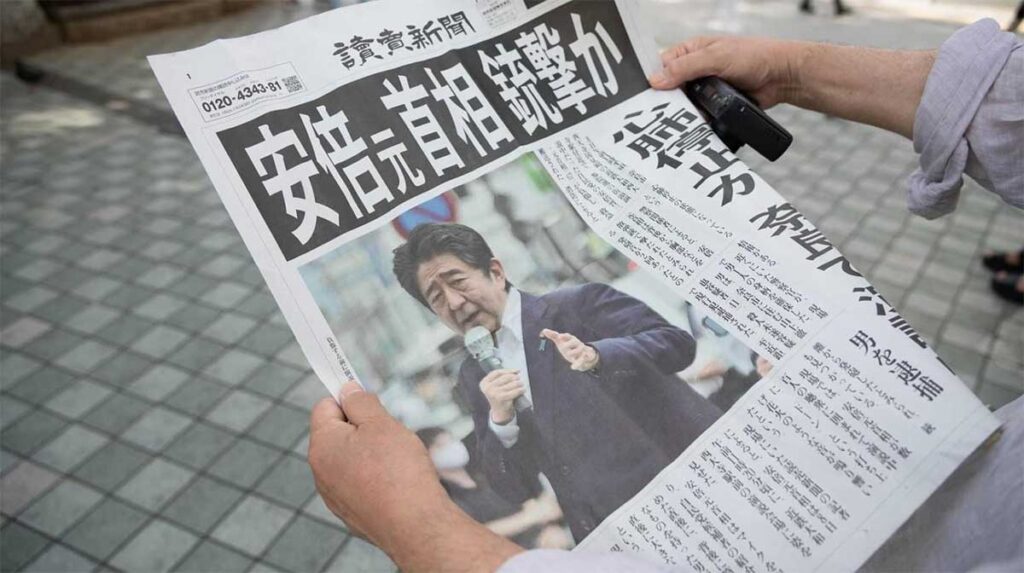
In the second article, titled “Made in Japan: No FoRB for the Family Federation. 2. Revamping the Debunked Notion of ‘Cult’”, Respinti mentions the tragic assassination of former Prime Minister Shinzo Abe (安倍 晋三, 1954–2022). The assassin, Tetsuya Yamagami (山上 徹也), was immediately apprehended at the scene and soon openly confessed to the murder during questioning by local police. Once Abe’s death was officially confirmed, Yamagami faced formal murder charges. Over the subsequent months, additional accusations were brought against him, and as of 30th March 2023, the self-confessed assassin faced a total of four charges. He also risks the death penalty, although in similar cases in the past, such sentences have been commuted to life imprisonment.
Respinti explains that one particularly notable aspect of this case is Yamagami’s claim that his act was not motivated by Abe’s political affiliations, policies, or party. According to Yamagami, the assassination was in no way connected, directly or indirectly, to politics. Instead, he admitted to killing an innocent man and a prominent national leader purely out of deep resentment and hatred toward the Unification Church (now called the Family Federation for World Peace and Unification).
Yamagami revealed that he initially intended to assassinate Dr. Hak Ja Han, the widow of Reverend Sun Myung Moon and co-founder of the Family Federation. However, he abandoned this plan due to the logistical challenges of getting close to her.
He instead targeted Abe, who was known to have expressed sympathy toward the Family Federation. Yamagami himself was never a member of the religious organization, but his mother was, and he claimed that her excessive donations to the organization drove her into bankruptcy. This financial ruin, he alleged, left him and his siblings in dire poverty, with one of his brothers eventually taking his own life and Yamagami himself attempting suicide.
In his Bitter Winter article, Respinti claims that now, more than two years after the assassination, several aspects of the case remain unclear. However, a significant issue is that while Yamagami has yet to stand trial or receive a sentence, the Family Federation has faced a barrage of accusations, as though it were responsible for the crime rather than being a victim. The organization is being targeted and penalized, while the true perpetrator was Yamagami alone. Abe paid the ultimate price with his life, the Family Federation is paying a steep price through public backlash, yet accountability for the heinous crime lies solely with the assassin. Despite this, the opposite seems to be unfolding.
The situation is marked by a troubling logic, which Marco Respinti summarizes in four key points:
- Yamagami was never a member of the Unification Church or the Family Federation.
- His mother declared bankruptcy in 2002. In response to complaints from her brother-in-law, two members of the religious organization returned 50% of her donations in installments.
- Abe himself was neither a member of the Unification Church nor the Family Federation, though he did receive support from members during elections. He participated virtually in a 2021 event and sent a message to a 2022 event hosted by the Universal Peace Federation, an NGO founded by Family Federation leaders. Notably, prominent figures such as U.S. President Donald Trump and former European Commission presidents José Manuel Barroso and Romano Prodi have also participated in such events, alongside many other politicians across the ideological spectrum.
- The timing of the assassination raises questions. Yamagami targeted Abe in 2022, even though his mother’s financial difficulties stemmed from her bankruptcy two decades earlier, in 2002. While this does not implicate the so-called anti-cult movement directly, The Journal of CESNUR has documented Yamagami’s participation in “anti-cult” online forums in recent years, which may have influenced his already unstable mind.
Given these factors, it is evident that the situation remains complex and murky. Some Western scholars have even suggested that Yamagami may be one of the most “successful” political assassins in modern history. His stated goal was to damage or even destroy the Family Federation, and, unlike many political assassinations that fail to achieve their intended objectives, his actions have caused significant harm to the organization. However, this success is built on a foundation of lies.
Marco Respinti emphasizes that he is not a prosecutor and does not wish to preempt the findings of any court of law in Japan. His role here is that of an observer and reporter. The Italian religious freedom authority describes Yamagami’s claims as “lies” because his accusations against the Family Federation are demonstrably false in many ways. For the sake of truth and clarity, Respinti believes it is essential to examine the flawed reasoning that led the assassin to such a misguided conclusion.
Yamagami’s crime was rooted in the belief that the former Unification Church – and by extension, politicians who showed sympathy toward it – deserved punishment for his mother’s financial decisions. He considered the church an “evil cult”. While the former Unification Church has long been labeled a stereotypical “cult” by the international anti-cult movement, this definition does not hold up under scrutiny. Even so, this rhetoric has influenced public perception, particularly in Japan, where the anti-cult movement has gained significant traction.
Respinti describes how in Western academia, courts, and some quality media, the use of discriminatory terms like “cult” has largely been abandoned. This shift is reflected in a landmark ruling by the European Court of Human Rights on 13th December 2022, in the case Tonchev and Others v. Bulgaria. The court ruled that governments and local authorities cannot use stigmatizing terms like “cult” in official documents or campaigns, as this constitutes discrimination and may incite violence. Unfortunately, this progressive perspective has yet to gain traction in Japan. There, authorities continue to use such terminology, perpetuating the stigmatization of religious minorities.
In light of these considerations, the fallout from Abe’s assassination highlights not only the tragedy of his death but also the broader issues surrounding the treatment of religious minorities in Japan. The continued targeting of the Family Federation underscores the dangerous consequences of stigmatization and the need for a more nuanced and balanced approach to such matters.
Featured image above: Shinzo Abe in March 2022, a few months before he was assassinated. Photo: United States Ambassador to Japan Rahm Emanuel / Wikimedia Commons. Public domain image. Cropped