Blog of Unification Theological Seminary

Societies have become very complex since early nation-states formed in the 17th century.
Corporations, central banks, political parties, government bureaucracies, and many other social institutions have arisen to assert great control over individual citizens. These institutions can be of great service or harm to individuals, depending on their purpose and how well they are managed.
Will a way be found to keep them in the service of the people, or will they create a dystopian future in which people have little value except as serfs to those who control these institutions?
Much of the strife in our societies results from the loss of freedom and personal sovereignty as social institutions expand, taking control of governments, land, food, money, health, and energy.
Self-sufficient individuals, small businesses, and small towns are threatened by wealthy elites, global financial conglomerates, and the financial, ideological and political hijacking of institutions. Inflation, the fear of rigged elections, and energy shortages are causing populist uprisings as those who control governments, banks and resources threaten them with indignity.
We have reached a critical point in the evolution of human society. The array of highly developed social institutions in our complex post-modern world can either be put to the service of individual sovereignty and happiness or, left unchecked, put to the service of elites who use these institutions for their own power and wealth as sovereign citizens become a new type of feudal serf.
The Divine Principle refers to this time as the “Last Days,” when the Messiah will appear with a higher truth that can usher in the Completed Testament Era. Rev. Sun Myung Moon spoke about headwing thought that would transcend both the right and the left centered on Godism.
In a Journal of Unification Studies article, “Toward a Headwing Society: The Harmony of Three Social Spheres,” I explained how important elements in Unification Thought fit with a developing school of integral thought: stages of growth to perfection in both individuals and society, internal and external aspects of human life, and the preparation for the ideal world with developments in the last 400 years in which feudalism gives way to individual sovereignty.
An integral society can be viewed as Completed Testament society.
This book intends to show the way forward and stimulate discussion on how to achieve an integral society. In an integral society, social institutions exist for specific purposes that serve human beings. Integral society is created by an integral consciousness. That consciousness is rooted in a view of the whole that respects the value of each individual.
Integral consciousness is developing in our world as reflection on the nature and purpose of our post-modern life accelerates. The most popular pioneer in the field of integral studies is Ken Wilber, whose A Theory of Everything: An Integral Vision for Business, Politics, Science and Spirituality was a bestseller.
The California Institute for Integral Studies (CIIS), a graduate institution, “strives to embody spirit, intellect, and wisdom in service to individuals, communities, and the earth.” CIIS describes integral studies as “a response to the growing need to synthesize the fragmentary aspects of contemporary thought and culture into a meaningful whole.”
Allan Combs, who teaches at CIIS, describes the developing integral vision in The Radiance of Being: Understanding the Grand Integral Vision; Living the Integral Life. The foreword is by Ken Wilber. Steve McIntosh applied this vision to widen our understanding of modern philosophy in his book Integral Consciousness and the Future of Evolution. Paul Smith applied integral theory to the evolution of Christianity in Integral Christianity: The Spirit’s Call to Evolve.
The articulation of the integral vision is not this book’s purpose, but a brief diagrammatic overview is provided in the Appendix and on the Integral Society website. I apply integral theory to the study of society and social institutions to address critical social problems of our time, the relationship between sovereign individuals and social institutions.

Social institutions exist at different levels, spheres and stages of consciousness. They are not “conscious” the way human beings are, but have purposes and values that form the institutional culture. The family is the most basic human institution, a combination of biological necessity and organized human cooperation. Societal levels advance from family to community, town, city, county, state, regional federations of states, and the world. The three basic spheres of society are culture, economy and governance.
An integral society is based on a principled relationship between culture, economy and governance. Each social sphere and its institutions are rooted in different principles that must be differentiated, understood and integrated into complex postmodern societies.
The three primary spheres of society are based on three spontaneous orders that evolve in any human community — language, money and law. Language, money and law refer to culture, economy and governance, respectively. Frederick A. Hayek, developing the thought of Bernard Mandeville, David Hume, Adam Smith, and Carl Menger, discussed how three social orders develop naturally and spontaneously in all types of human society and all stages of human social evolution.
The cultural sphere is primary. It shapes human consciousness by transmitting values, goals and knowledge that enable individuals to pursue relationships, economic necessities and a good life. The sphere of culture is based on the pursuit of love, truth, beauty, and goodness. The family, schools, arts, sports, and other social institutions enable the individual’s pursuit of happiness.
The economic sphere is necessary to support our biological life and is often where we serve others. Money and markets arise spontaneously due to the desire to produce, exchange, and share things that enable us to live and pursue other goals. Economic institutions like factories, stores, banks, and services arise to serve these needs.
The sphere of governance is necessary to referee disputes in relationships and competition for the use of resources. The sphere of governance involves rules like “thou shall not steal” and “thou shall not kill” that enable people to pursue happiness in a secure and harmonious society. Police, governors, judges, courts, legislatures, and other institutions of governance arise to maintain social order so that individuals can pursue happiness in the cultural and economic spheres.
In an integral society, the social institutions in all three spheres perform different and complementary roles to serve all human beings in pursuing a good life that does not infringe on others’ rights to pursue happiness. An individual human being has many organs of the body that serve necessary and complementary functions. A healthy individual is an integral biological system. Social institutions are the organs of society. They must each perform their function in a way that serves both the individual and society. In an integral society, each social organ performs its function.
The Evolution of Human Society
Human society has evolved from hunter-gatherer societies to large complex civilizations with many social institutions in each sphere. Human consciousness has developed with this evolution of society. The evolution of this consciousness is the centerpiece of Wilber’s Theory of Everything. While this evolution has an overall development we can trace over the last 12,000 years, it is not determinate or guaranteed. Civilizations have risen and fallen based on social consciousness, motivations of leaders, and the nature of social institutions.
Hunter-gatherer consciousness is closer to animals that graze and hunt for food. Warfare and tribalism are byproducts of human societies subsisting on natural resources in competition with others.
Civilization is rooted in the production of goods and services adequate for everyone. There is no need to fight over goods, but cooperation in their production and distribution is necessary.
Civilization requires governing a social order where killing and stealing are forbidden. The role of government shifts from organizing military conquests to securing borders and protecting private property. Cultural institutions transmit the rules and skills necessary to live peacefully and prosperously. The socialization process involves the suppression and control of animal instinct. Problems of shortages are not solved by theft and violence but with inventiveness and skills aimed at the production and delivery of more goods and services.
The origins of civilization are generally traced to agriculture and the domestication of animals in ancient Mesopotamia and Turkey. Yet, the animal instincts to plunder and kill remain submerged, appearing in random personal acts of violence, conquest, theft, and slavery. Cultural institutions remain challenged to adapt as new technologies, financial and governance institutions are created in increasingly complex societies. People can use new developments for good or evil purposes if they are not understood and restrained by society. Institutional actors increasingly influence social behavior.
Knowledge has advanced from superstitious beliefs to sophisticated science and philosophy embedded in corporations and universities. Economic institutions have evolved from personal businesses to the mergers and acquisitions controlled by investment firms. Governance institutions have expanded from tribes to states, federations, and global institutions with agencies created to regulate all kinds of human activity.

This book discusses the evolution from simple nation-states to federations of states and what Wilber labels “integral commons.” The founding of the United States represents the first modern effort of social evolution from a system of simple states run by kings or governors to constitutional republics in which sovereign individuals are free to pursue happiness through a more sophisticated interplay of social institutions. The security of states and their relations is governed by a federal system of checks and balances on power designed to allow individuals to pursue happiness freely.
Individual Sovereignty in a World of Institutions
Individual sovereignty lies at the foundation of an integral society. Social institutions have more power, wealth or knowledge than individuals. But they are composed of individuals who have individual consciousness. This consciousness is limited to sense experience and instinct at birth and shaped by socialization and the desire to pursue well-being, family life, truth, beauty, and goodness. Individuals create social institutions to facilitate this pursuit.
Individual sovereignty is at the basis of spontaneous social orders. We create language to communicate, exchange goods and services for mutual benefit, and create rules to live with each other. People at all times and places do these things. Good rules and social institutions will serve the natural pursuits of sovereign individuals. “Do not kill” is a social rule that enables everyone to live their life. “Do not steal” enables personal economic sovereignty by allowing people to control the property they will need to live or exchange with others. “Do not lie” promotes the natural role of language communication. These basic rules support personal sovereignty and the spontaneous orders at the base of the three spheres of society. They are necessary for an integral society.
Social organizations are mostly planned institutions rather than spontaneous natural orders. These two types of social phenomena, planned and unplanned, contribute to social evolution and an integral society. However, planned institutions that create rules impeding personal sovereignty cause human suffering and eventually fail. Such institutions would be considered evil.
The story of the Tower of Babel illustrates social organization is not possible if people cannot communicate. Centrally-planned economies fail because individuals are not free to produce and exchange desired products. States fail when elites use power to serve their own ends rather than enabling people’s pursuit of happiness. These social institutions fail when they try to suppress the spontaneous social orders that spring from human nature.
In an integral society, planned social institutions have natural limits imposed by the requirements of society’s spontaneous evolutionary nature. Integral social consciousness understands this. When a lower level of consciousness attempts to manage social institutions, they get hijacked for personal ends, misdirected for ideological purposes, or acquired by other institutions. Hijacked institutions fail to serve individuals and the whole of society.
The great religions and modern psychology have laid down guidelines for personal self-control and rules for interaction with other individuals. Similar advice and regulations have not been adequately developed for social institutions. This is the nature of the manifesto embedded in this book.
A declaration of integral society and a proposed constitution for an integral society are presented to develop the integral consciousness required to govern modern social institutions. Existing social institutions in all three spheres can be made more effective when focused on their mission, kept in their place, and appropriately limited by law.
Outline of this Book
Part 1 presents a Declaration and Constitution of an integral society. The Declaration begins with a statement of individual sovereignty and human rights and responsibilities. The second section contains a list of ways social institutions have deprived individuals of these rights and caused human suffering. Particularly banks and political parties must be better governed.

This is followed by a proposed Constitution designed to check the abuses and corruption of both individuals and social institutions, enabling people to pursue happiness. This Constitution updates the United States Constitution, but is designed to stimulate discussion on the updating of any constitution for a regional-level federation of states. Many of the proposed articles apply to states also. A Constitution is the legal operating system of a society and requires the type of vigilance found in computer software updates when hackers and viruses exploit weaknesses.
Parts 2 and 3 serve the same purpose for the Constitution of an Integral Society as did the Federalist Papers in explaining the articles of the U.S. Constitution. It draws on successes and failure of the past, showing glimpses of an integral society in previous societies and the nature of abuses of power and money.
Part 2 discusses the evolution of civilization from the world of survival instincts described by Thomas Hobbes as “the state of nature” through the rise of civilization and evolution of individuals with the possibility of autonomy in all three social spheres. Individual sovereignty in Ancient Babylon and Rome is explained and show how that sovereignty was lost in the collapse of the Roman Empire into feudalism and the Dark Ages.
Part 3 examines the rebirth of individual sovereignty in city-states, widespread education, and the Protestant Reformation, and lays the foundations of self-responsibility. Widespread individual sovereignty existed in the 18th century when the U.S. Founders created a governance system for free people. This was followed by the rise of science, technologies, and new social institutions. However, an anarchic “state of nature” developed among social institutions that often hunt, prey on, and devour the sovereign individuals they initially rose to serve. New types of institutional tribalism and warfare in culture, economy and government are a result.
The rise of modern banking and government/bank cabals has deprived individuals of their economic autonomy, concentrating capital in the hands of a few. Laws that give everyone an equal opportunity to own and profit from new capital are the most needed development in the 21st century. The concentrations of power and wealth in social institutions must be limited and under the control of the people those social institutions should serve.
In the legislative arena, it is important to remove the role of political parties as vehicles for social institutions and wealth in lawmaking, and return political power to the citizens. There are other more debatable suggestions made for getting qualified and politically neutral government administrators. Civil service exams, lotteries, and other methods of avoiding the appointment of unqualified political cronies are suggested.
Finally, the Appendix contains diagrams by Wilber and Anderson that help illustrate the nature, evolution, and complexity of an integral society.
A Great Awakening in the 1730s and 1740s prepared sovereign individuals to live in a democratic society in which all people were treated equally. The 2020s represent a Second Great Awakening that prepares social institutions in an integral society to serve the Purpose of Creation that Unificationists desire to fulfill.♦
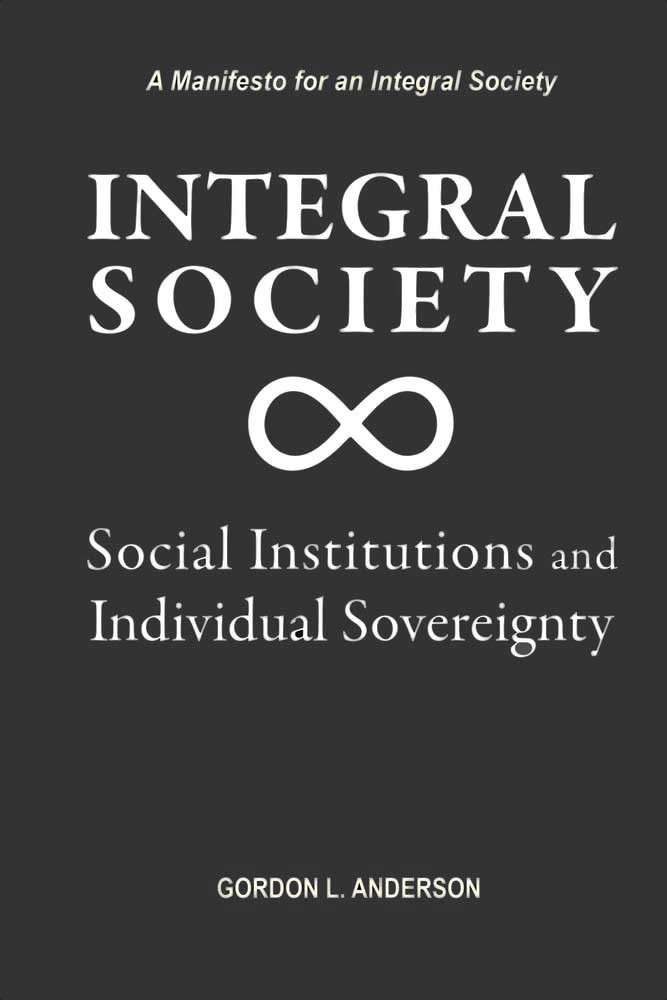
The above is excerpted (with additional material) from the Introduction to Integral Society: Social Institutions and Individual Sovereignty, by Gordon L. Anderson. It is currently available as an e-book, and a paperback version will be available in March 2023.
Dr. Gordon L. Anderson (UTS Class of 1978) is the President of Paragon House, Editor-in-Chief Emeritus of the International Journal on World Peace, and Adjunct Professor at the California Institute of Integral Studies. He earned an M.Div. in Christian Ethics at Union Theological Seminary and a Ph.D. in Philosophy of Religion from Claremont Graduate University.