[Communism That Erased God—Sang Hun Lee’s Philosophical Journey and the Path to Human Liberation] ② The Love That Materialism Missed
By Jung Sung-soo (Specialist in Religion)
This article was originally published in Korean in Segye Times, a major South Korean daily newspaper, under the column series “The Great Epic of the Korean People.” [Click here to view the original article.]
Click to read the previous installment.
Searching for the Source of Love Beyond Materialism
Looking back from the first half of the 21st century, the 20th century was an era when communism exerted the strongest fascination over humanity. Communism promised an ideal society where exploitation and inequality would be eliminated, and everyone would live freely and affluents. In reality, however, it suppressed human freedom and concentrated power in the state and the party. In North Korea, it reached the point of elevating a single leader (Suryeong) to the position of an absolute being and idolizing him.|
Sang Hun Lee (1914–1997), a medical doctor and philosopher who systematized Unification Thought, traced the deeper roots of this failure to its philosophical starting point: the denial of God. To him, God was not merely an object of religious faith. God was the ultimate Source that brought humanity and nature into existence, the starting point of love and conscience, and the foundation of human dignity that neither state nor party could violate. Communism promised human liberation, but by explaining human beings purely through matter and class, it missed that fundamental Source. His critique was that an ideology that erased God ultimately stripped away human freedom and dignity as well.
Consequently, in 1989, communist regimes across Eastern Europe collapsed in succession, and in 1991, the Soviet Union dissolved. However, communism has not completely disappeared from the face of the Earth. One-party ruling systems under communist influence persist in nations such as China, Vietnam, Laos, North Korea, and Cuba, representing nearly one-fifth of the world’s population. Even in free democratic societies, issues of inequality and alienation remain. While these problems must not be ignored, solutions should not be sought by turning the entire wealthy class into enemies or by using state power to suppress individual freedom. South Korea, too, must carefully examine whether state power excessively restricts individual liberties under the pretexts of public interest and reform. Re-examining the history of an ideology that promised human liberation yet ended up oppressing humanity serves to ensure that no ideology or power can ever lord itself over human beings. To find a path toward resolving inequality and alienation while safeguarding both freedom and equality, it is necessary at this moment to re-evaluate the promises and failures of communism.
“Communism That Erased God” is a serialized series based on Sang Hun Lee’s lectures, writings, academic papers, and testimonies. This series goes beyond criticizing past failures; it is an endeavor to seek a future human society where freedom and dignity are guaranteed, and where people live together in love and responsibility. It retraces how communism emerged, fascinated humanity, and transformed through specific processes into a system of oppression. Furthermore, it examines Unification Thought, which Sang Hun Lee presented as the alternative to communism, and seeks a path to restore human freedom, dignity, responsibility, and love based on Godism. Reclaiming God means refusing to treat human beings as mere means for power and profit, interacting with people and nature according to love and conscience, and establishing a social order that upholds human dignity. <Editor’s Note>
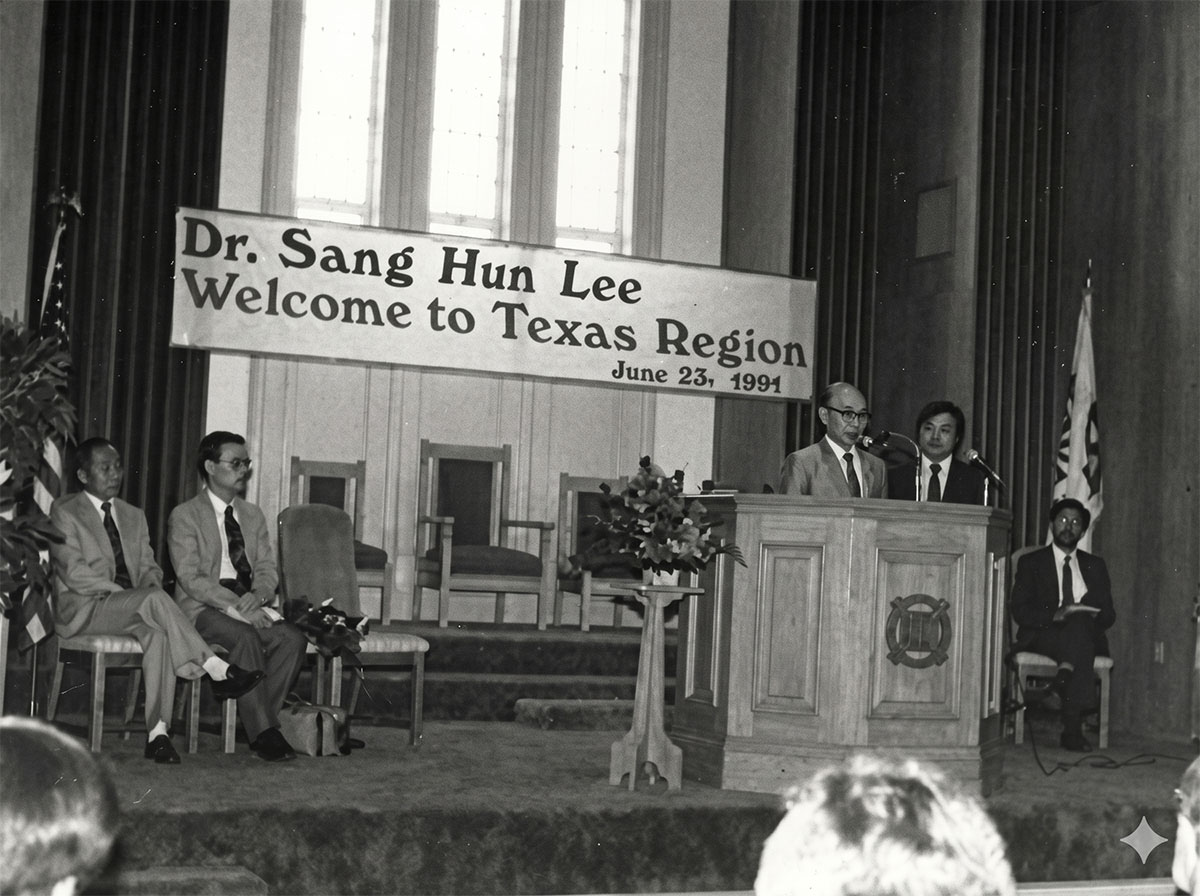
Courtesy of Unification Thought Institute
Searching for the Source of Love Beyond Materialism
Sang Hun Lee once believed that communism was the ultimate ideology to achieve national liberation and human liberation. Neither imprisonment nor torture could break his conviction. However, the deeper he delved into his ideological research, the more he was beset by one fundamental question: What is the true source of the love for nation and humanity that has driven me, and the love that impelled me to risk everything for my comrades? Was not the independence movement, as well as the communist movement, rooted in this love from the very beginning?
Materialism, the philosophical foundation of communism, holds that the fundamental reality of the universe and humanity is not spirit or a divine existence, but matter—and that human consciousness and thought originate from matter. Yet, this explanation alone could not fully clarify the true source of love and sacrifice; it only added to his doubts.
Materialism: Seeking Humanity in Matter
Of course, communists also possess a strong sense of comradeship and solidarity. Karl Marx’s scathing critique of capitalism was likewise rooted in a deep awareness of the problem of human alienation. Did capitalism not reduce human labor to a mere commodity and transform even interpersonal relationships into monetary transactions? However, what Sang Hun Lee sought to question was not the mere existence of love, but its ultimate source.
If human beings are nothing more than material entities and the mind is merely a secondary phenomenon arising from matter, then conscience and love must ultimately be products of material conditions. If so, does the value of love change when conditions change? How can we explain the impulse to choose goodness and sacrifice oneself for others even in moments when no one is watching and one’s own life is in jeopardy?
Class solidarity alone could not resolve these questions. Cooperation among members of the same class can be understood through shared interest. Workers uniting to resist capitalists serves the practical goal of class interest. However, a parent sacrificing their life for a child, a person risking their own body to save someone in danger, or a love that forgives even an enemy—these cannot easily be explained by class interests alone.
Furthermore, when the boundary of love is defined along class lines, love easily becomes accompanied by hatred. Love for the working class can readily combine with hostility toward the capitalist class. It can even justify eliminating opponents for the sake of the revolution. Sang Hun Lee took note of this contradiction: an ideology that championed the liberation of all people ended up dividing humanity into allies and enemies. He became convinced that class-based love could never encompass all of humanity.
It is true that communism pointed its weapon at the external structures that produce human suffering, seeking to uncover how exploitation arises and why workers become alienated. Yet, it ultimately failed to answer why human beings cannot abandon selfishness, or why the lust for power and dominance resurfaces even after unequal structures are eliminated. Communism believed that abolishing private property and changing the relations of production would give birth to a new human being, but it failed to fully reckon with the fact that the desire for power and control can re-emerge in human beings at any time.
Turning Toward Religion in Search of the Source of Sacrifice
To Sang Hun Lee, this was not merely a theoretical flaw. If an ideology seeking to transform society cannot fully explain human nature, the society built upon that ideology can never truly save humanity. No matter how equal the system may be, as long as greed and hatred remain in the hearts of the people who operate it, new forms of oppression are bound to arise. Exploitation merely changes hands, repeating itself in another form.
As a medical doctor, Sang Hun Lee was someone who observed the human body closer than most. While he knew that physical illness affects the mind, he also realized that human thoughts and emotions could not be explained solely through the functions of the physical body. A doctor’s sense of responsibility to save a patient, the compassion that cannot ignore a suffering person, and the conscience that places doing what is right above one’s own safety—these cannot be measured purely by material gains and losses.
In his view, every human being possessed not only the desire to protect one’s own life, but also a heart that seeks to go beyond oneself toward others. People find true joy in giving rather than receiving, and discover the true meaning of life precisely when sacrificing themselves first for the ones they love. Such love was a power welling up from the deepest depths of human existence—a power that could never be explained merely by survival instincts or class consciousness.
If so, the essence of a human being could not consist of matter alone. If love and conscience are human nature, there had to be a Source for that nature. It was at this juncture that Sang Hun Lee’s inquiry turned toward religion. If human beings are created in the image of God, could not the love within humanity be explained as originating from God? The heart that gives itself up for others is not an exceptional behavior that contradicts material self-interest; rather, it is the manifestation of the original nature inherent in humanity.
The Source of Love That Transcends Class
The starting point of Sang Hun Lee’s critique of communism was not animosity or hatred. On the contrary, it lay in his desire to fully realize the aspiration for human liberation that communism originally held. Furthermore, while refusing to ignore the problems of poverty and exploitation that communism had identified, he sought to overcome the limitation of viewing human beings solely through the lens of matter and class relations. Sang Hun Lee required a new ideology capable of explaining not only the transformation of social structures, but also the transformation of the human heart.
Materialism focuses on material conditions when explaining human life. However, what Sang Hun Lee sought was an answer to why human beings live and why they love others even to the point of self-sacrifice. In his view, love was not an accidental emotion that happened to arise from matter. Love itself was the power residing at the very origin of human existence. Materialism, having erased God, inherently possessed limits in explaining the true starting point of this love.
To Be Continued …