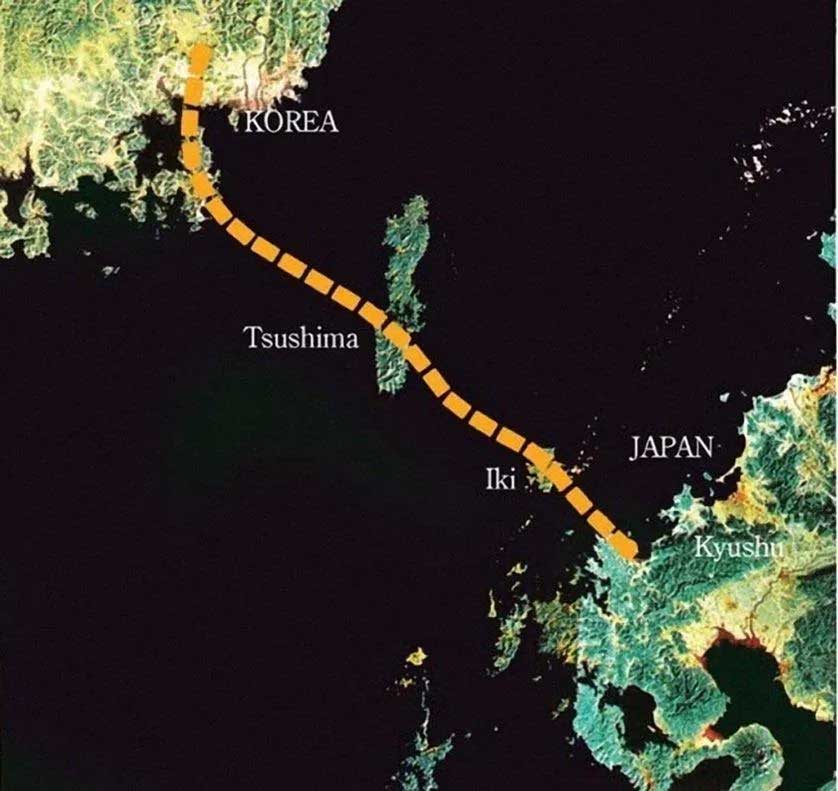
A far broader vision behind the tunnel linking South Korea and Japan, beyond media claims of religion-politics collusion in the current polarized climate
Prepared by Knut Holdhus
“Are They Even Trying to Frame the Push for the Korea-Japan Tunnel as Collusion Between Politics and Religion? [Religion Column]” was the headline in English of an article published on November 27th by the South Korean daily Segye Ilbo – an opinion piece by religious affairs reporter Jeong Seong-su (정성수).
The article addresses the growing public debate surrounding the Korea-Japan Undersea Tunnel and the recent coverage of the issue in the investigative program PD Notebook (PD수첩) by MBC (Munhwa Broadcasting Corporation), one of South Korea’s major national broadcasting networks.
According to Jeong, PD Notebook – known for exposing political and corporate scandals – framed the Family Federation’s involvement in the long-standing tunnel initiative as an example of “collusion between politics and religion” (정교유착), implying that the megaproject exists primarily as a tool to expand the political power of the religious organization. The article strongly disputes this interpretation, arguing that such a portrayal both narrows the historical context of the tunnel initiative and misrepresents the institutional realities of cross-border infrastructure development.
PD NotebookCountering the narrative presented by PD Notebook, the author offers a multi-layered defense of the Korea-Japan Tunnel project, drawing on historical records, academic analyses, prior political discussions between South Korea and Japan, and the inherent nature of ultra-large infrastructure projects. The article situates the tunnel concept within a broader vision of international connectivity and peace originally articulated by Family Federation co-founder Sun Myung Moon – also called Father Moon – in the early 1980s, depicting the project not as a sectarian agenda but as a long-term strategic proposal that has periodically attracted interest from governments, scholars, and localities.
The Segye Ilbo article mentions that Father Moon did not stop at visionary rhetoric. He moved directly into action to realize the ambitious undersea tunnel concept. A site for the prospective entrance was obtained in Karatsu, located in Japan’s Saga Prefecture. With privately raised funds, engineers excavated an exploratory shaft reaching roughly 600 meters beneath the ocean floor. For a private organization to undertake a project of such scale was virtually unheard of, marking the initiative as an exceptional experiment in mega-infrastructure development.
According to religious reporter Jeong, Hak Ja Han – by many called Mother Han – designated the tunnel initiative as a “founder’s legacy project” after Father Moon’s passing in 2012. She emphasized how it was meant to be part of a far larger transnational vision – the World Peace Highway. Under this expanded framework, the idea extended from the Bering Strait across the Eurasian landmass, oriented toward fostering international connectivity. Central to this vision were aims such as promoting cross-border interaction, encouraging peaceful cooperation, and establishing broader economic zones – objectives that emphasized global exchange rather than any religious profit.
Jeong’s article also mentions that academic evaluations further underscore this framing. Heo Jae-wan (허재완), an emeritus professor at Chung-Ang University, identifies the Korea-Japan Tunnel as a pivotal segment of the proposed “BeSeTo Highway”, a transportation corridor linking Beijing, Seoul, and Tokyo. He interprets it as an essential piece of strategic infrastructure capable of integrating Northeast Asian logistics networks and enhancing South Korea’s position as a regional economic hub.
Former Environment Minister Gwak Gyeol-ho (곽결호) – also a past president of the Korean Society of Civil Engineers – similarly characterizes the project as “the greatest creative endeavor of the century”. In his view, it could initiate Busan and the broader southeastern region’s transformation into an international metropolis, facilitate the expansion of environmentally friendly rail systems, and anchor an expansive economic corridor running through the Korean Peninsula, China, Russia, and eventually Europe. These analyses reflect professional assessments in urban planning, economics, and environmental policy rather than advocacy on behalf of any religious body.
Discussions surrounding the tunnel have also persisted at the highest political levels. President Roh Tae-woo (노태우) publicly expressed support for joint exploration of the project during an address to Japan’s Diet, a sentiment echoed by Prime Minister Toshiki Kaifu (海部 俊樹). Comparable conversations occurred between President Kim Dae-jung (김대중) and Prime Minister Yoshiro Mori (森 喜朗), as well as between President Roh Moo-hyun (노무현) and Prime Minister Junichiro Koizumi (小泉 純一郎).
In Japan, a bipartisan parliamentary association was even established to study the proposal, while Busan Metropolitan City and various national research institutes have repeatedly carried out technical and economic analyses. Such sustained governmental and academic attention shows that the Korea-Japan Tunnel should be understood as a long-range strategic undertaking rather than an initiative confined to a religious organization.
At its core, the Segye Ilbo piece argues that PD Notebook’s conclusion – that political outreach on the part of the Family Federation constitutes evidence of improper religious-political entanglement – is based on a misunderstanding of how cross-border megaprojects function. The author insists that because such projects can only proceed with interstate agreements and governmental participation, private actors must inevitably seek political collaboration. Therefore, political engagement around the tunnel should not automatically be interpreted as religious interference in state affairs.
The article ultimately calls for a more mature, long-term, and national-interest-oriented public discourse about the Korea-Japan Tunnel, warning against emotional or ideologically driven interpretations that reduce complex geopolitical and infrastructural considerations to simplistic narratives of religious overreach.
A key point of Jeong’s article is reframing the Korea-Japan Tunnel not as a religious or political controversy but as a visionary infrastructure proposal with far-reaching implications. The author criticizes PD Notebook for positioning the tunnel project as an extension of Family Federation political ambitions, arguing instead that its origins lie in a public, global vision introduced over four decades ago. The piece highlights Sun Myung Moon’s 1981 presentation at an international scientific conference, emphasizing that the audience and context were global and academic, not sectarian.
By showing that the tunnel was first presented in an international forum and supported by studies and discussions over several decades, the author aims to detach the concept from the Family Federation’s internal religious narrative.
By comparing the Korea-Japan Tunnel to other cross-border megaprojects, such as the Channel Tunnel between the U.K. and France, the article situates the initiative within the realm of national strategy rather than religious propagation.
The author uses this reframing to argue that even if the Family Federation has been a prominent private advocate for the tunnel, the project’s significance extends beyond any single organization.
One of the article’s strong points is its appeal to external authorities. It cites prominent scholars, including a well-known emeritus professor of urban planning and a former environment minister. Their evaluations of the tunnel as a strategically beneficial infrastructure project help bolster the claim that the initiative is widely recognized outside the Family Federation’s circle.
Likewise, the mention of discussions at the presidential and prime ministerial levels across multiple administrations further illustrates that the Korea-Japan Tunnel has periodically been a legitimate diplomatic consideration. By invoking bipartisan and multiparty interest in both countries, the author argues that it is simply inaccurate to reduce the project to religious advocacy.
A particularly important analytical point in the opinion piece concerns the institutional requirements of cross-border megaprojects. The author argues that PD Notebook misunderstood or ignored the structural nature of such projects, which require government cooperation by definition. Projects that span sovereign borders need legal frameworks, environmental studies, diplomatic agreements, jurisdictional arrangements, and financing structures that only states can provide.
Thus, the author contends, it is neither unusual nor suspicious that the Family Federation – or any private entity seeking to advance such a project – would request cooperation from government officials or members of parliament. The argument here is that political engagement is a functional necessity, not proof of religious-political misconduct.
This is arguably the most substantial point in the article, and it challenges a broader social trend in South Korea: heightened sensitivity to the political involvement of religious groups, due in part to historical precedents and contemporary scandals. Yet the author pushes back on what he views as an overly simplistic tendency to interpret any political contact by a religious organization as inherently problematic.
The latter part of the Jeong’s opinion piece shifts from critique to a positive argument for why the Korea-Japan Tunnel is in South Korea’s national interest. The author emphasizes potential benefits such as positioning Korea as a logistics hub in Northeast Asia, expanding rail-based green transportation, stimulating balanced national development centered on Busan and the southeastern region, creating a gateway to a trans-Eurasian economic corridor.
By framing the tunnel as a transformative infrastructure project with environmental, economic, and geopolitical advantages, the author again widens the scope of the conversation beyond the religious dimension. The tunnel is portrayed as part of a broader peace and integration strategy for Northeast Asia – an outlook that resonates with long-standing academic and diplomatic discussions about regional community-building.
Featured image above: A proposed tunnel project between the Japanese island of Kyushu and South Korea. Illustration: The International Highway Foundation (IHF)