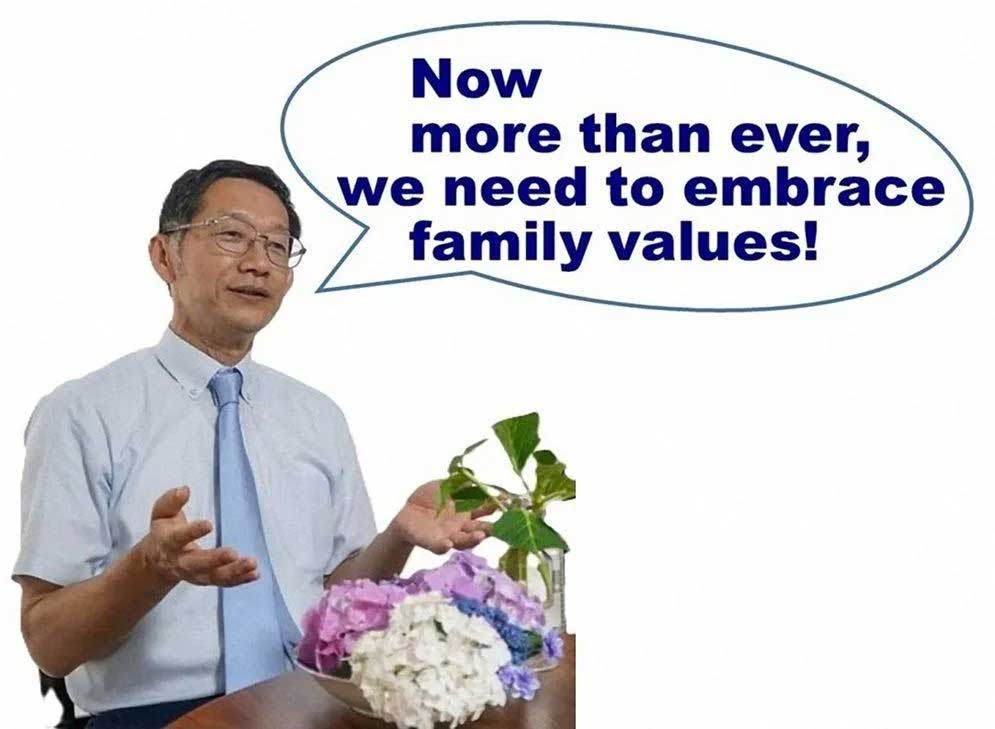
When family values decline, society follows: Four decades of drastic change in Japan’s family structure strain the social system
Tokyo, 21st November 2025 – Published as an article in the Japanese newspaper Sekai Nippo. Republished with permission. Translated from Japanese. Original article.
Opinion Column
Now More Than Ever, We Need to Embrace Family Values
by Hiroshi Ogasawara (小笠原裕) representing the Association for Protecting Japanese Families
Prepared by Knut Holdhus
Over the past forty years, household structures in Japan have changed dramatically. Large households have rapidly disappeared, while single-person households have increased.
According to a Cabinet Office survey, three-generation households accounted for 50.1% of all households in 1980, but by 2022 this figure had plummeted to 7.1%. Conversely, single-person households grew from 10.7% to 31.8% during the same period (from the 2024 White Paper on the Aging Society).
Why has the composition of Japanese households changed so drastically? I believe it stems from the fact that Japan’s traditional family values have changed significantly in the postwar era. Of course, the increase in elderly people living alone due to population aging is one factor. But the more fundamental shift is the change in the very nature of the family, including rising divorce and separation.
The Japanese Constitution proclaims the value of respecting fundamental human rights, but it lacks any values that emphasize the importance of the family. Article 24, Paragraph 2 concerns marriage, but it is written as “matters relating to divorce, marriage, and the family.” When we look at the order of these terms, it can almost be read as prioritizing divorce over marriage, and marriage over family. The Constitution’s basic principle of placing the individual first is reflected here.
As a result, however, the losses to Japanese society are great, to the point that one could say the nation now faces a crisis that threatens its very continuity. As the term “ohitorisama” (the solitary person) suggests, the growth of single-person households has led to rising social security costs needed to support them.
For example, since welfare benefits are paid on a per-household basis, an increase in single-person households leads directly to higher total payments. There are even cases in which people intentionally separate or divorce in order to increase the benefit amount. I heard from the director of a facility for the elderly that although some residents receive welfare, their family members come only to place them in the facility and then never visit again.
A safety net to protect those in economic hardship is important. But if such systems encourage the fragmentation of families, isn’t that a complete reversal of their purpose?
And when individuals become isolated, the state must take responsibility for supporting their lives, resulting in even greater social security expenditures. It seems that Japanese society has fallen into this kind of vicious cycle.
What is important is the value – once taken for granted in Japan – of families supporting one another. In a three-generation household, even if both parents work, children can be cared for at home by their grandparents rather than being sent to daycare. For the children, this also becomes a place for acquiring the basic social education they need. And when grandparents grow old and become physically limited, they can still enjoy a rich old age, watched over by family, without necessarily depending on care facilities.
A society emerges in which children and the elderly alike can live securely even without building more daycare centers or nursing homes. And such a society is extremely efficient from a socioeconomic standpoint.
The values Japan once held – valuing and cherishing the family – are precisely what we must reassess today.
Featured image above: Hiroshi Ogasawara (小笠原裕). In summer 2024, he established the political group “Association for Protecting Japanese Families”. Photo (June 2025): Takahide Ishii (石井 孝秀) / Sekai Nippo