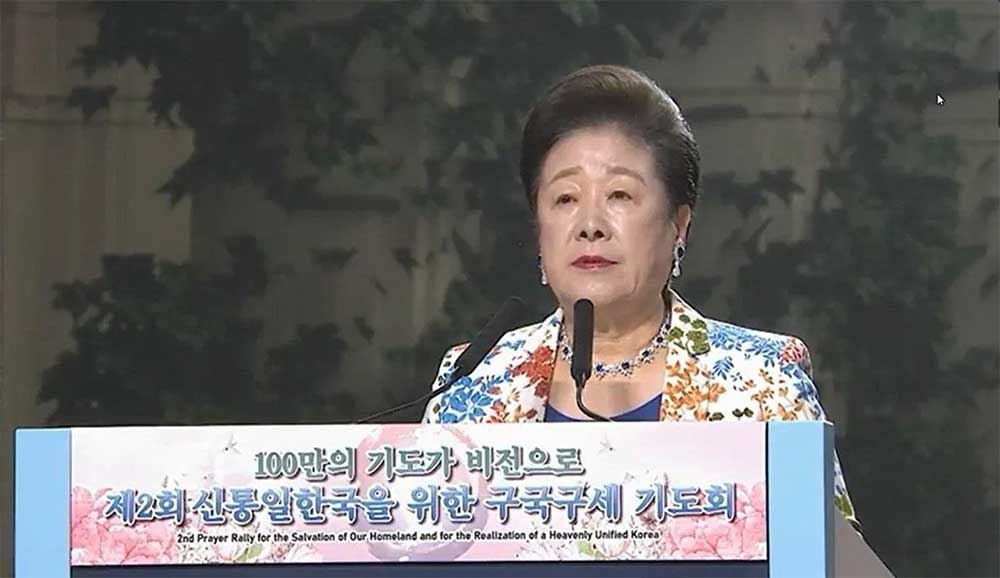
Amid South Korea’s political polarization, media and authorities often view Mother Han through partisan lenses, despite her public mission extending far beyond politics
Prepared by Knut Holdhus
The South Korean daily Segye Ilbo published 25th November an opinion piece which in English would be titled “President Hak Ja Han’s path beyond political factions [Religion Column]”. The article written by religious affairs reporter Jeong Seong-su (정성수) examines how political polarization in South Korea shapes public perceptions of religious figures – specifically Hak Ja Han (한학자) – by many referred to as Mother Han – the current leader and Co-Founder of the Family Federation for World Peace and Unification, also known as the Unification Church.
The author argues that contemporary debates about Mother Han’s political position, motives, and alleged misconduct risk collapsing a complex historical record into simplistic partisan narratives. For Western readers unfamiliar with South Korean political culture and the institutions referenced in the article, several contextual elements are important to fully understand the author’s point.
One of the central examples the article uses is the “Jeong Yun-hoe (정윤회) document” scandal of 2014. To appreciate its significance, one must recognize the institutional environment of South Korea at that time. South Korea’s executive branch operates from the Blue House (Cheong Wa Dae), the former presidential office and residence analogous to the White House in the United States. Under then-President Park Geun-hye (박근혜), a conservative leader whose administration would later collapse amid a major corruption scandal, internal discipline and control within the Blue House were notoriously tight, and accusations of behind-the-scenes influence carried heavy political weight.
Against this backdrop, Segye Ilbo – a newspaper affiliated with the Family Federation – published a leaked internal government document alleging that Jeong Yun-hoe (정윤회), a former aide to Park, was improperly exerting influence over state affairs through an informal network. In Western terms, this was akin to a major newspaper revealing that a personal friend of the president was secretly shaping governmental decision-making without holding any official position. The report ignited a political firestorm and placed the newspaper in direct confrontation with the highest levels of the sitting conservative government.
The significance of this episode in the article’s argument cannot be overstated. For critics who today portray Mother Han as having consistently aligned with or supported certain political factions, the 2014 report represents a counterexample that defies easy categorization. Rather than serving the interests of the ruling party, the Family Federation-aligned newspaper published an exposé that embarrassed and provoked the conservative administration, raising questions about internal power struggles and the abuse of state authority. According to contemporaneous reporting, Mother Han herself endorsed the newspaper’s decision on the grounds that “the media must fulfill its public responsibility.”
The Segye Ilbo article uses this history to challenge the notion that Hak Ja Han or the Family Federation’s institutions have operated merely as extensions of any political camp. The author suggests that Mother Han’s leadership has been motivated more by religious, ethical, and peace-oriented principles than by partisan objectives. Journalist Jeong Seong-su points to decades of initiatives pursued by the Family Federation – interfaith dialogue, North-South Korean engagement, and international peace projects – to argue that such activities are not readily reducible to conventional left-right political metrics.
For Western readers, it is important to recognize that South Korea’s political polarization is intense and often deeply personal. Allegations of political favoritism or ideological allegiance can become powerful rhetorical weapons. Religious movements, especially those as publicly visible as the Family Federation, often find themselves scrutinized through the lens of political loyalty rather than through their broader civic or spiritual missions. The article therefore positions itself as a corrective to these tendencies, contending that one cannot fairly assess Mother Han’s past without situating it within the full complexity of South Korea’s shifting political landscape.
The article also touches on the legal charges currently facing Hak Ja Han, noting that any judgment on their validity should be determined through judicial processes rather than public speculation. While it refrains from discussing the specifics of the case, the author warns against reducing a leader’s decades-long public activities to the narrow frame of contemporary legal disputes. This argument rests on a broader theme: that historical context and long-term patterns of action must be evaluated alongside present controversies.
From a Western analytical standpoint, the article exemplifies a common tension in societies marked by deep partisan divides. Leaders – whether political, religious, or civic – are frequently assessed not on the full arc of their actions but on how they appear to align with the immediate concerns of the moment. The author pushes back against such reductionism, urging readers to examine the documentary record, to acknowledge episodes like the 2014 exposé that complicate easy narratives, and to judge Mother Han’s leadership in light of stated values such as public responsibility, interfaith collaboration, and peacebuilding.
Ultimately, the article is less a defense of Mother Han in a narrow sense and more an argument about how public memory and perception should operate in a polarized society. It urges a more nuanced and historically grounded approach – one that considers not only accusations or political climates, but also evidence, consistency of values, and the broader public impact of a leader’s actions.
Featured image above: Mother Han addressing a large prayer rally for the salvation of Korea and a unified Korean peninsula, 9th January 2022 in Cheonshim Peace World Center, Gapyeong, South Korea.