Placing large ads in South Korean media, Gingrich warns Seoul its values are at stake and urges Lee administration to free 82-year-old religious leader
Prepared by Knut Holdhus
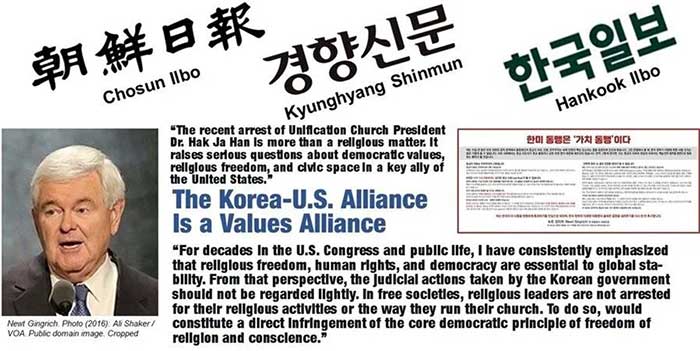
In a paid print advertisement in major Korean outlets – the Chosun Ilbo, Kyunghyang Shinmun, and Hankook Ilbo – on 24th November, Newt Gingrich, former U.S. House Speaker, strongly urged the Korean government to release Hak Ja Han, by many called Mother Han, the 82-year-old leader of the Family Federation, formerly the Unification Church. The ad is titled “The Korea-U.S. Alliance Is a Values Alliance”, and Gingrich frames his call in terms of religious freedom, democratic principles, and shared U.S.-Korea values.
Gingrich argues that Mother Han’s detention is not just a religious matter, but a serious test of Korean democracy: in free societies, he says, religious leaders are not arrested for their religious activities or how they run their church. He describes the South Korean government’s legal actions as a “direct infringement” on freedom of religion and conscience.
Newt Gingrich warns that state intervention into religious affairs risks shaking the foundations of Korean democracy and raises a “red flag” to U.S. leaders. He also contends that “selective justice” and the politicization of law enforcement threaten democratic legitimacy.
The former U.S. House Speaker emphasizes Mother Han’s role in peacebuilding, noting her decades-long leadership, her global work to promote interfaith dialogue, and the Family Federation’s public-interest initiatives: peace advocacy, cultural exchange, volunteer programs, and inter-Korean reconciliation efforts. While acknowledging that the Federation has faced controversy, he argues that “hastily labeling” it as a criminal group would be a “grave misjudgment”.
Gingrich points out practical concerns: Mother Han’s age (82) and the proportionality of detaining such an elderly religious figure. He urges that pre-trial detention should be a last resort, stressing humanitarian and societal consequences.
Newt Gingrich calls on Korean judicial authorities to withdraw excessive detention measures and release Hak Ja Han immediately, as she has not been convicted. He frames the issue as more than legal: it’s a moral test of Korea’s commitment to democratic values, religious liberty, and national dignity. He appeals directly to President Lee Jae-myung to “make the right decision”.
Finally, Gingrich casts this as a matter of shared values: the U.S.-Korea alliance is not just strategic but bound by freedom. If South Korea sets a precedent of curbing religious freedom, he warns, it risks undermining those shared democratic ideals.
The economic newspaper Chosun Biz (조선비즈) reported on the ad extensively, summarizing Gingrich’s key arguments: religious freedom, non-interference, the risk of politicized justice, and calls for Mother Han’s release.
Other Korean outlets also covered the ad, highlighting Gingrich’s concerns about state overreach and his framing of the case as more than a criminal investigation.
The popular weekly newspaper Ilyo Shinmun (일요신문) published commentary from political pundits. Professor Shin Yul (Myeongji University) described Gingrich’s ad as part of an “aftershock” following Hak Ja Han’s detention. He noted that the Family Federation has many foreign followers and significant international influence, but argued that strong foreign backlash (especially from U.S. conservative figures) could complicate the legal process.
Shin also warned of a “hot spot” in U.S.-Korea relations: the Family Federation’s political connections and backing by high-profile U.S. conservatives could make the case a diplomatic vulnerability.
A column in the major economic daily Aju News argues that while American conservatives (like Gingrich and Trump) are raising the alarm about religious freedom, Korean media and civic society should also reflect on the legitimacy of the investigations. The column suggests that these global conservative interventions might not just be about liberty – but also about political alliances and power.
According to the Korea JoongAng Daily on 5th September, Mike Pompeo, another high-profile U.S. conservative and former Secretary of State, previously condemned the special prosecutor’s plans to summon Mother Han, calling such moves a betrayal of democratic principles.
On the conservative commentary front, prominent media personalities and lawyers with conservative audiences for example, attorney Kang – Kang Shin-eop (강신업) – on his YouTube/live channel – discussed the ad and the legal/political questions surrounding the case; these segments generally echoed concerns about proportionality, the treatment of an elderly religious leader, and the international optics for Korea.
In U.S.-based commentary (e.g., The Washington Times), Gingrich’s stance is framed as part of a broader campaign: that protecting Mother Han is not only defending religious freedom but safeguarding an international movement for peace.
Some South Korean analysts express unease about foreign political involvement: that a U.S. politician publicly pressuring South Korea’s judiciary could be perceived as interference in domestic affairs.
Others point to the possibility that this is not purely about religious rights, but also about power networks: the Family Federation’s global reach, its ties to U.S. conservative politics, and potentially the use of Western political capital to defend its leader.
Gingrich’s ad raises the stakes for U.S.-Korea relations by framing Mother Han’s case as a values issue, not just a legal case. It suggests that religious freedom is part of the alliance, not separate from it.
For the South Korean government, responding to such public pressure from a prominent U.S. conservative could be tricky: pushing back may risk accusations of undermining religious liberty, while capitulating could be seen as yielding sovereignty to external actors.
The debate is reigniting broader discussions in Korea about the line between regular law enforcement and politicized justice. Gingrich’s “selective justice” warning taps into domestic anxieties about whether legal processes are being used for political ends.
For the Family Federation and Hak Ja Han, the ad is not just a defense – it’s a reaffirmation of their global legitimacy and mission. Support from figures like Gingrich and Pompeo bolsters their narrative of being persecuted for their beliefs and public good work.
Featured image above: The logos of the papers that carried the ad on 24th Nov. 2025. Besides the photo, the Korean ad and English translation of parts of it.