Some who got away speak out: Pure evil manipulation by professional faith-breakers in league with activist leftwing lawyers allowed to break thousands of families and individuals
Tokyo, 18th June 2025 – Published as an article in the Japanese newspaper Sekai Nippo. Republished with permission. Translated from Japanese. Original article.
“Loyalty Tests” to Identify True Defectors
Encouraged to Betray Friends and View the Church as the Enemy
by the Religious Freedom Investigative Team of the editorial department of Sekai Nippo
Prepared by Knut Holdhus
Deprogramming [See editor’s note below], involving abduction, confinement, and forced renunciation of faith, mainly targeting believers of the Family Federation for World Peace and Unification (formerly the Unification Church), does not end even after the believers declare they have abandoned their faith.
To determine whether a defection is genuine, individuals are often subjected to “loyalty tests”, such as being forced to provide information about fellow believers or even assist in their abduction and confinement. This practice is well-documented.
Such information, once gathered, is then used by lawyers and others cooperating with deprogrammers to encourage the parents of believers to engage in further abduction and confinement. This cascading effect is one reason why deprogramming [See editor’s note below] often spreads in chain-reaction fashion. It is also not uncommon for former members who have left the faith to approach the parents of their former peers.
Saruhiko (pseudonym), a co-representative of the “Yachimata-no-Kai”, a private organization that works to mend relationships between parents and children damaged by abduction and confinement – and himself a victim of such treatment – describes the loyalty test as a form of “rehabilitation” meant to prevent return to the religious organization. He says, “They’re made to steal member lists and church info, or act as spies, to forcibly change their way of thinking.”
These loyalty tests not only weed out false defectors but also fracture relationships between believers. In one case, a confinement victim who pretended to defect was later coerced into cooperating in the abduction of another believer, incurring the wrath of members of the religious organization and causing emotional scars. Some ex-members have even become pastors engaged in anti-Unification Church activities. Saruhiko reflects, “Maybe it’s time we calmly reflect on what really happened through open dialogue.”
Deprogrammer groups refer to this process as a “rescue” and encourage carrying it out not just on one person but in a chain-like manner. Tamiya Taguchi (田口民也), a former Unification Church believer and now a Christian, co-authored the 1992 book “Rescue from the Unification Church”, in which he harshly criticizes the group as one that tries to “turn people’s eyes away from the Bible and Jesus Christ, the true Savior”, emphasizing the need for “rescue”. He states, “Only through the cooperation of many people can the rescue from the Unification Church be truly complete.”
There is ample testimony from believers who say they have seen former comrades, once devout followers, become active opponents after defecting. A male believer in his 50s from Sendai City, Miyagi Prefecture, recalls that during the 1980s in Hokkaido, “I often received calls from former members who had left after being confined. It seemed they even held study sessions among themselves.”
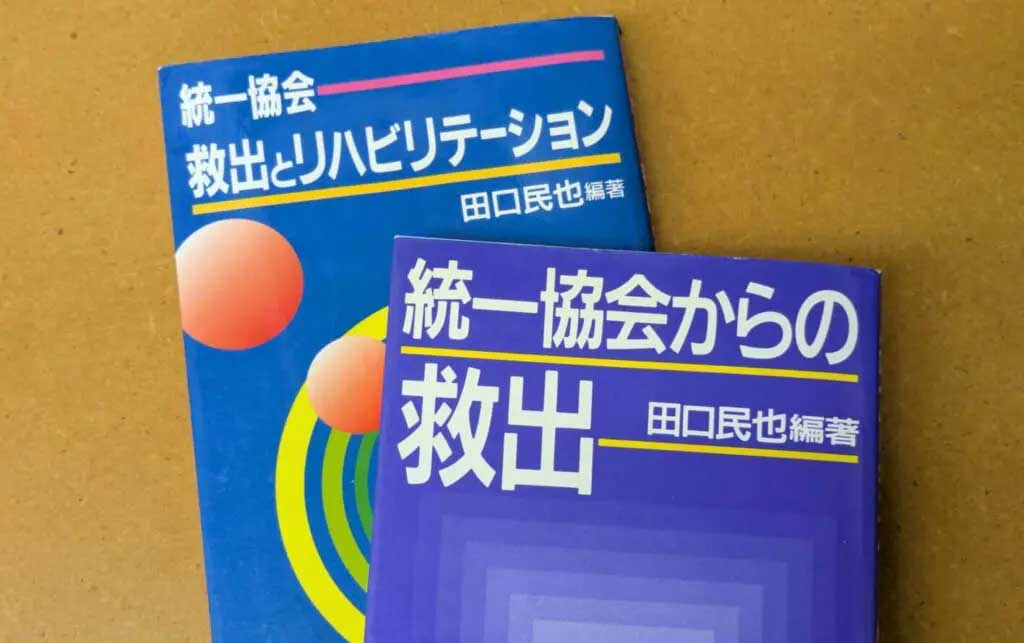
However, in his 1994 co-authored work “Rescue and Rehabilitation from the Unification Church”, Taguchi also acknowledges the prevalence of PTSD among many former members, describing it as a common aftereffect. He refers to this as “flashing”, where a sudden, flash-like fear of the church overwhelms the mind. He gives an example of a former member becoming ill just from passing a church member on the street. Still, he confesses, “I don’t know why this happens.”
Taguchi does not address the psychological trauma caused by forced confinement and coercion, instead claiming that these “flashing” symptoms are a sign of healing, a process by which “the heart is being restored.” He promotes conversion to Christianity through church worship and Bible study, asserting that it’s necessary to confront the Family Federation “head-on,” and guides former members to adopt a hostile stance.
Parents of PTSD-affected children often receive no adequate care from the deprogrammers’ side. Some are left with lingering guilt over confining their child, lamenting, “I can’t die before my child.”
Amenouzume (pseudonym), a female co-representative of Yachimata-no-Kai and a fellow survivor of deprogramming [See editor’s note below], describes her harrowing experience: “Abduction and confinement are unimaginably painful. Even if it lasted just a day, if your heart is deeply wounded, PTSD can develop.”
She strongly calls for the eradication of such practices.
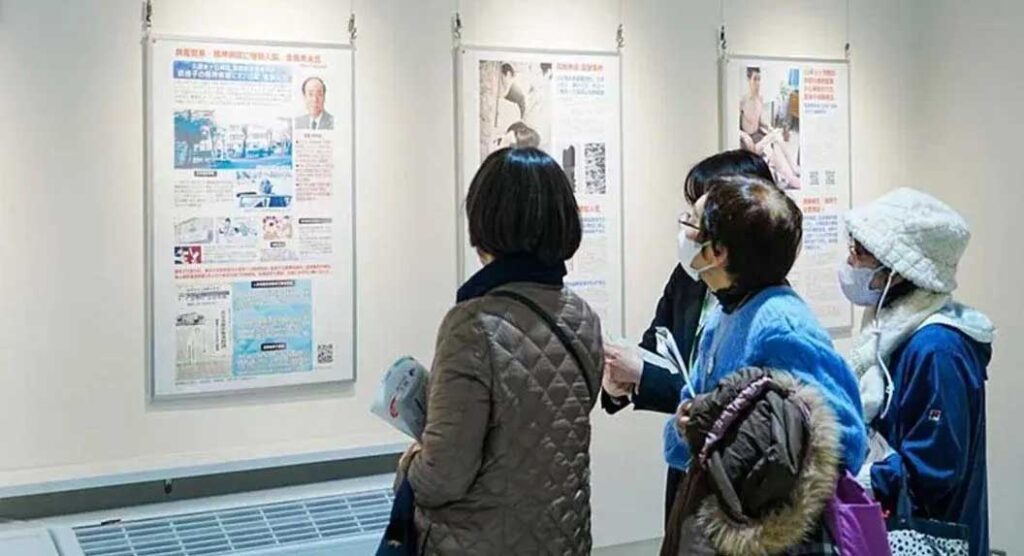
Featured image above: Panel exhibition denouncing deprogramming through abduction and confinement – 19th March 2025, Yokohama City, Kanagawa Prefecture. Photo: Yasuhiro Uno (宇野泰弘)
[Editor’s note: Coercive faith-breaking (“deprogramming”) in Japan refers to the practice of coercively attempting to separate individuals from their religious affiliations or beliefs, typically through intervention by family members, professional faith-breakers (deprogrammers) or organizations hostile to new religious movements (NRMs). This phenomenon often targets members of such movements, e.g. relatively large faiths like the Family Federation or Jehovah’s Witnesses, but also smaller groups like Happy Science (Kōfuku no Kagaku) and other newer religious movements.
However, also Soka Gakkai, a Buddhist-based lay organization with more than 8 million Japanese members, and affiliated with Nichiren Buddhism, has occasionally been subject to faith-breaking attempts.
The practice gained attention in the latter half of the 20th century, particularly in the 1980s and 1990s. Parents or concerned family members often hired faith-breakers who taught them how to abduct and forcibly detain believers. Almost all such cases involved confining the individual believer and cutting him or her off from the religious community. During the confinement, the believer was subjected to intense questioning or indoctrination designed to break his or her faith. The aim was to “rescue” the person from what the family often had been tricked by faith-breakers or lawyers to regard as harmful influence from the religious organization.
Critics of forced de-conversion argue that it violates fundamental human rights, including freedom of thought, religion, and association. Reports of psychological trauma and accusations of unlawful detention have sparked debates over its ethical and legal implications. In response, some religious groups, particularly NRMs, have lobbied for greater protections against such practices.
Japanese courts have been inconsistent in addressing cases of coercive faith-breaking. While some verdicts have condemned the practice as illegal detention, others have been more lenient, citing family concerns about “mental health” or alleged “exploitation” as mitigating factors.]