
State Persecution in Japan, Iran, and Pakistan
Where even peaceful faith is a crime: Japan copying Iran and Pakistan – A democracy adopting the same dehumanizing policies as found in authoritarian states
Freedom of Religion Under Pressure – Experiences from 3 Religious Communities
Prepared by Knut Holdhus
On 12th June, three faith communities in Norway joined forces to highlight the dehumanizing state persecution they face in Iran, Pakistan, and Japan. The joint event was held in the House of Literature in Oslo and titled “Freedom of Religion Under Pressure – Experiences from Three Religious Communities.” It was organized by the Baha’i community, the Ahmadiyya Muslim community, and the Family Federation for World Peace and Unification.
The estimated 300,000 Baha’is in Iran are socially excluded and treated as non-citizens. 600,000, possibly as many as 2 million, Ahmadis face a very similar situation in Pakistan. And maybe even more shocking is the fact that 600,000 members of the Family Federation in Japan are rapidly heading for the same social exclusion and treatment as non-citizens as the other two above-mentioned religious minorities experience in their more authoritarian countries.
The event was chaired by Kristine Tveit Jordet, a human rights advisor at the Stefanus Alliance, a Christian mission and human rights organization. Tveit Jordet is a social anthropologist working with human rights internationally, especially the right to freedom of religion or belief.

Freedom of Religion or Belief
In her opening remarks, she said, “Freedom of religion is fully named ‘freedom of thought, conscience, religion, and belief’. It is a fundamental right enshrined in, among others, the UN’s Universal Declaration of Human Rights and the International Covenant on Civil and Political Rights. We read from Article 18 of the Universal Declaration of Human Rights:
‘Everyone has the right to freedom of thought, conscience, and religion; this right includes freedom to change his religion or belief, and freedom, either alone or in community with others and in public or private, to manifest his religion or belief in teaching, practice, worship, and observance.’
In Norway, we are fortunate to be part of a peaceful democracy with a functioning legal system and laws that protect citizens’ rights, including the right to freedom of thought, belief, and religious practice of one’s own choosing.
In theory, this should be the status for all of the UN’s 193 member states, all of which have signed the Universal Declaration of Human Rights. But as many in this room are painfully aware, this is not the case for people in many parts of the world.
Every single day, individuals experience severe violations of their rights for no other reason than that they have peacefully practiced their religion. Violations of religious freedom can take many forms. People of different religious affiliations and in different parts of the world experience that the state turns a blind eye and fails to intervene when they are subjected to abuse, injustice, and persecution for their beliefs.
In other places, the state itself is an active participant in promoting this injustice through discriminatory laws or practices – whether it involves restrictions on rights or active persecution of individuals or groups.
Which groups are under pressure and experience persecution varies depending on where in the world you are. A majority in one place may be a minority in another. And in some countries, being part of the majority is no guarantee of protection.
Today we focus on three countries and religious communities, and we will hear about the unique and concrete experiences of individuals and groups whose human rights have been violated because of their faith.”
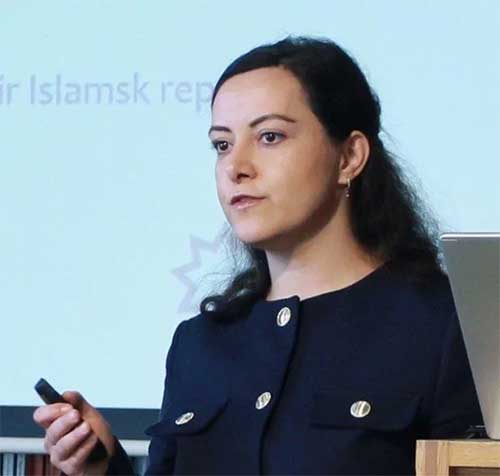
The Situation of the Baha’i Community in Iran
Kristine Tveit Jordet introduced each of the speakers. The first one was Elnaz Zabihyan, a member of the Baha’i community’s Office of Public Affairs.
She emphasized that the persecution of the Bahá’ís in Iran has deep historical roots, tracing back to the 19th century when Bahá’u’lláh founded the Bahá’í Faith with teachings centered on unity, equality, and harmony between science and religion. These progressive ideas, although widely embraced by many, were seen as a threat by Iran’s religious authorities and political leaders, leading to widespread opposition.
Zabihyan pointed out that despite their contributions – such as building public bathhouses and founding schools that educated around 10% of Iranian youth in the 1920s – the Bahá’ís began facing systemic persecution. In 1934, the Shah ordered the closure of all Bahá’í schools. This discrimination intensified further after the Islamic Revolution in 1979, when persecution was institutionalized under Ayatollah Khomeini’s regime.
Key events include the abduction and execution of the entire elected Bahá’í National Spiritual Assembly in 1980 and 1981, and the public hanging of ten Bahá’í women in Shiraz in 1983, who were offered their lives in exchange for renouncing their faith. All refused. Among them was 17-year-old Mona, who was forced to watch the others die before she was executed herself.
These atrocities represent not only visible acts of violence but also a deeper strategy of psychological warfare against the Bahá’í community. The persecution was later codified in a 1991 government memorandum signed by Supreme Leader Ayatollah Ali Khamenei, which instructed authorities to block the Bahá’ís from social and economic advancement. This policy remains in effect and is further reinforced by religious fatwas declaring Bahá’ís unclean and demanding their social exclusion.
As a result, countless Bahá’ís have been imprisoned, executed, or forced to flee, making the Bahá’í situation in Iran one of the most documented and ongoing examples of religious persecution in the modern era.
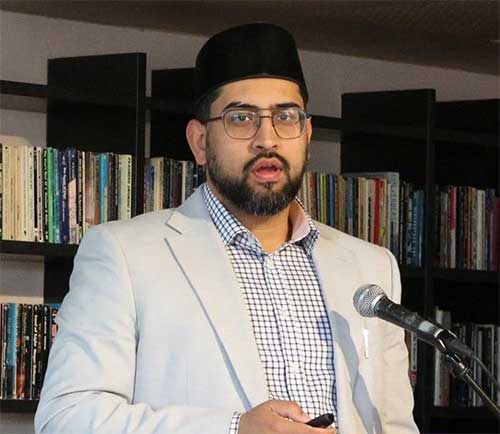
The Situation of the Ahmadiyya Community in Pakistan
The second speaker at the religious freedom event was Musawer Shahid, imam at the Ahmadiyya Muslim Community in Oslo, which was established in 1957 as the first organized Muslim faith community in the country.
Shahid explained how the Ahmadiyya Muslim Community, founded by Mirza Ghulam Ahmad in 1889 in British India, considers itself a faith within Islam that believes Ahmad to be the Promised Messiah and a subordinate prophet after Prophet Muhammad (peace be upon him). While Ahmadiyya Muslims follow all Islamic practices and read the same Qur’an, their belief in a prophet after Muhammad contradicts mainstream Islamic doctrine, which holds that Muhammad is the final prophet.
In Pakistan, this theological difference has led to systemic persecution. Despite early contributions to the country – including the first Foreign Minister, Muhammad Zafarullah Khan, being an Ahmadi – in 1974, Pakistan amended its constitution to officially declare Ahmadis non-Muslims. This laid the foundation for state-sponsored discrimination.
Under General Zia-ul-Haq’s Ordinance XX in 1984, Ahmadis were criminalized for practicing their faith. They are legally barred from calling themselves Muslims, using Islamic greetings like “Assalamu alaikum,” referring to their places of worship as mosques, or using Islamic titles. Even indirect signs of Islamic practice, such as growing a beard, owning a prayer rug, or fasting during Ramadan, can lead to arrest under Section 298-C. Penalties include up to three years in prison or, under blasphemy laws like Section 295-C, even the death penalty.
Imam Shahid pointed out that Ahmadis’ religious literature is banned, and police frequently raid homes searching for such material. Arrests are often made on weak or malicious claims, with trials delayed indefinitely, robbing many of their liberty for years without formal sentencing.
Since being declared non-Muslims, Ahmadis in Pakistan are also disenfranchised. To vote, they must sign a declaration denouncing their founder and their faith – something most refuse. As a result, many Ahmadis boycott elections to avoid betraying their beliefs.
Despite persecution, the community maintains its peaceful motto: “Love for all, hatred for none.”

The Situation of the Family Federation in Japan
Steinar Murud, head of the Family Federation in Norway 2008-2022 and currently the federation’s representative on Council for Religious and Life Stance Communities in Oslo, gave a brief overview of the fierce persecution that the Family Federation currently experiences in Japan.
The Family Federation, active in most democratic nations, including Japan where there are around 600,000 members, faced significant backlash following the assassination of former Prime Minister Shinzo Abe on 8th July 2022. The assassin, a young man with communist sympathies, claimed he targeted Abe due to perceived ties with the Family Federation, blaming the religious organization for personal family grievances linked to his mother’s past donations.
Murud pointed out that following the incident, the media and certain political groups radically shifted focus. They did not blame the perpetrator, but rather condemned the Family Federation for what had happened. Notably, a left-leaning legal network, NNLASS, held a press conference just days after the attack, labeling the Federation as an antisocial group and calling for its dissolution – actions that many criticized as purely politically motivated.
International scholars and advocates, such as Massimo Introvigne and Thierry Valle, condemned the media’s biased portrayal, arguing that facts were ignored and the Family Federation unfairly vilified. Historian Kevin M. Doak noted that left-wing forces, especially the Japanese Communist Party (JCP), exploited the situation to target both the Federation and the ruling Liberal Democratic Party (LDP). This hostility was rooted in long-standing ideological clashes, dating back to the 1960s and 70s when the Federation and its affiliates actively opposed communism.
According to Steinar Murud, Prime Minister Fumio Kishida initially stated that the Federation could not be dissolved due to a lack of criminal convictions. Still, he reversed his position under media and political pressure, controversially allowing civil disputes to justify dissolution. Critics viewed this as an unconstitutional overreach.
Furthermore, an investigative committee was formed, composed entirely of Family Federation opponents, including Masaki Kito, a leader of NNLASS, casting doubt on its impartiality. The outcome, influenced by longstanding political animosity, signaled a troubling precedent for religious freedom and due process in Japan.
Featured image above: The moderator and the 3 speakers at the religious freedom conference in Oslo 12th June 2025. Photo: Knut Holdhus