3-time victim of abduction and confinement, and a Christian pastor reflecting on the dissolution order based on lawsuits following the narrative of lawyers in league with professional faith-breakers
Tokyo, 24th May 2025 – Published as an article in the Japanese newspaper Sekai Nippo. Republished with permission. Translated from Japanese. Original article.
Interview with Supporters of Victims of Abduction and Confinement
Issue of Dissolution Order for the Family Federation
by Yasuhiro Uno (宇野 泰弘)
Prepared by Knut Holdhus
“Face the pain of the past” – Pastor Haruhisa Nakagawa (中川晴久)
“A chance for the religious organization to change” – Soichiro Kobayashi (小林宗一郎)
Haruhisa Nakagawa: Dropped out of Waseda University’s School of Letters and dedicated himself to his church. Since 2007, he has been the head pastor of the Christian Church of the Lord’s Sheep. He is also active in public discourse through the Christian opinion site “SALTY” and YouTube.
Soichiro Kobayashi: Born in 1971 in Tokyo. A current member of the Family Federation for World Peace and Unification and a three-time victim of abduction and confinement. He now supports victims and their parents in rebuilding relationships damaged by such experiences.
The hearing on the dissolution order against the Family Federation for World Peace and Unification (formerly the Unification Church) has moved to the Tokyo High Court. In this interview, we spoke with two individuals who work to repair family relationships broken by abduction and forced de-conversion (also known as “deprogramming” or “faith-breaking”) [See editor’s note below]:
- Soichiro Kobayashi (小林宗一郎), an active believer and former victim of abduction and confinement, and
- Pastor Haruhisa Nakagawa (中川晴久) of the Christian Church of the Lord’s Sheep in Yokohama.
Interviewer: Yasuhiro Uno (宇野 泰弘)
– What do you think about past court cases where individuals who left the Family Federation after being abducted and confined became plaintiffs, and how those cases influenced the Tokyo District Court’s decision?
Kobayashi: People in abduction and confinement situations can’t make sound judgments. Some were even coerced into lawsuits they didn’t want to be part of, and were exploited to fit a narrative. Using such trials as grounds for a dissolution order is highly questionable.
– Is the Family Federation an organization deserving of dissolution?
Nakagawa: Reading the court’s decision, I sensed they were trying hard to construct a rationale by adding weight and reasoning to prove continuity [of wrongdoing]. That suggests there actually was no continuity. This is essentially a politically motivated trial. We should be broadcasting to the world: “This trial is clearly unjust!”
Kobayashi: I choose to see the inclusion of civil issues in the dissolution criteria as an opportunity for the religious organization to repent for past shortcomings and undergo transformation.
– “Repentance” implies reflection and self-examination. What specifically do you mean?
Kobayashi: Through my experience of being abducted and confined, I’ve worked to help heal relationships between similarly affected parents and their sons and daughters. I’ve faced both the Christian pastors who instructed the abductions, and the parents who carried them out. Through this, I’ve realized that both the religious organization and the opposing side had their own biases. The organization seemed to assume that any voice of opposition was entirely bad, thereby shutting down opportunities for dialogue.
– How was the religious organization viewed by the opposition?
Kobayashi: There was a deeply rooted assumption among parents and pastors that “the Family Federation was evil, and its members are mind-controlled.” This often made meaningful communication impossible.
The widespread occurrence of abductions and confinements was likely due in part to issues with the religious organization’s evangelism methods and organizational structure. The same can be said for the current dissolution order. At this point, it’s essential for the Family Federation to sincerely ask itself, “Were there no problems on our side?”
Nakagawa: I’ve heard that the Family Federation went through a phase of pushing too hard “for the sake of the ideal”. That said, there is a teaching that says, “Cherish (Put) your family first.” If there is pain from the past, then facing it honestly is crucial.
– Mr. Kobayashi, you’ve now reconciled with your mother, who carried out your abduction and confinement.
Kobayashi: My mother told me, “Everyone went through it. Everyone was a victim.” In other words, the parents were deceived. She added, “If people just realized that, they’d all understand.”
Even parents who had a deeply negative view of the religious organization were able to understand the truth once we had calm, open conversations. They realized they’d been misled. I believe the same could be said for public opinion.
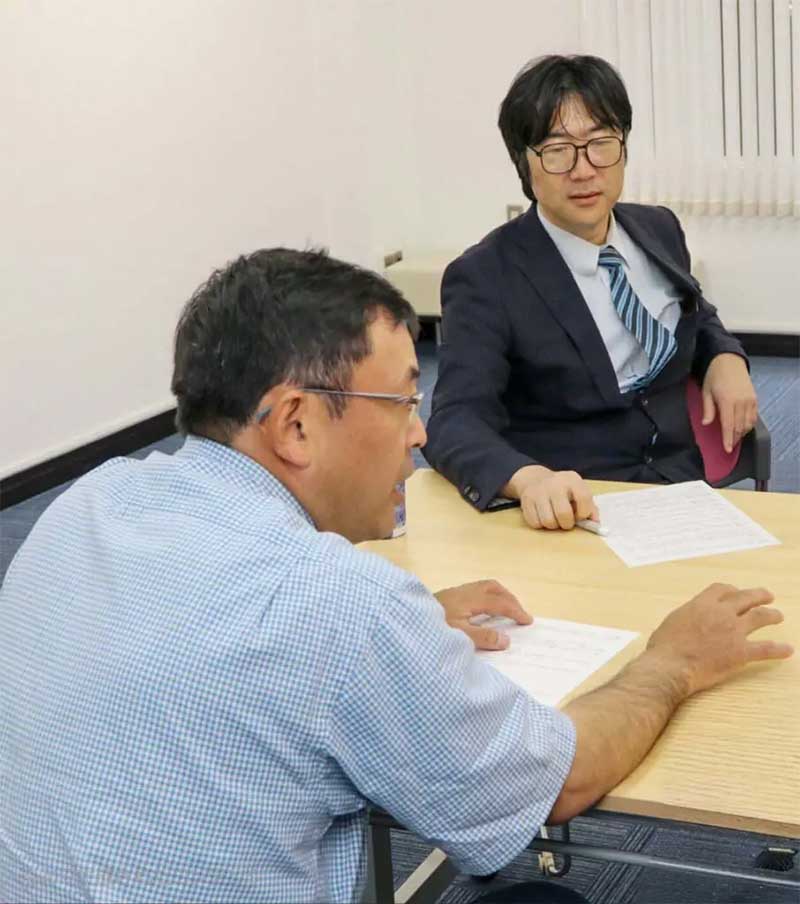
Featured image above: Soichiro Kobayashi (小林宗一郎) (left) and Pastor Haruhisa Nakagawa (中川晴久) in discussion — Shibuya Ward, Tokyo. Photo: Reiwa Kato (加藤玲和)
[Editor’s note 1: Coercive faith-breaking (“deprogramming”) in Japan refers to the practice of coercively attempting to separate individuals from their religious affiliations or beliefs, typically through intervention by family members, professional faith-breakers (deprogrammers) or organizations hostile to new religious movements (NRMs). This phenomenon often targets members of such movements, e.g. relatively large faiths like the Family Federation or Jehovah’s Witnesses, but also smaller groups like Happy Science (Kōfuku no Kagaku) and other newer religious movements.
However, also Soka Gakkai, a Buddhist-based lay organization with more than 8 million Japanese members, and affiliated with Nichiren Buddhism, has occasionally been subject to faith-breaking attempts.
The practice gained attention in the latter half of the 20th century, particularly in the 1980s and 1990s. Parents or concerned family members often hired faith-breakers who taught them how to abduct and forcibly detain believers. Almost all such cases involved confining the individual believer and cutting him or her off from the religious community. During the confinement, the believer was subjected to intense questioning or indoctrination designed to break his or her faith. The aim was to “rescue” the person from what the family often had been tricked by faith-breakers or lawyers to regard as harmful influence from the religious organization.
Critics of forced de-conversion argue that it violates fundamental human rights, including freedom of thought, religion, and association. Reports of psychological trauma and accusations of unlawful detention have sparked debates over its ethical and legal implications. In response, some religious groups, particularly NRMs, have lobbied for greater protections against such practices.
Japanese courts have been inconsistent in addressing cases of coercive faith-breaking. While some verdicts have condemned the practice as illegal detention, others have been more lenient, citing family concerns about “mental health” or alleged “exploitation” as mitigating factors.]