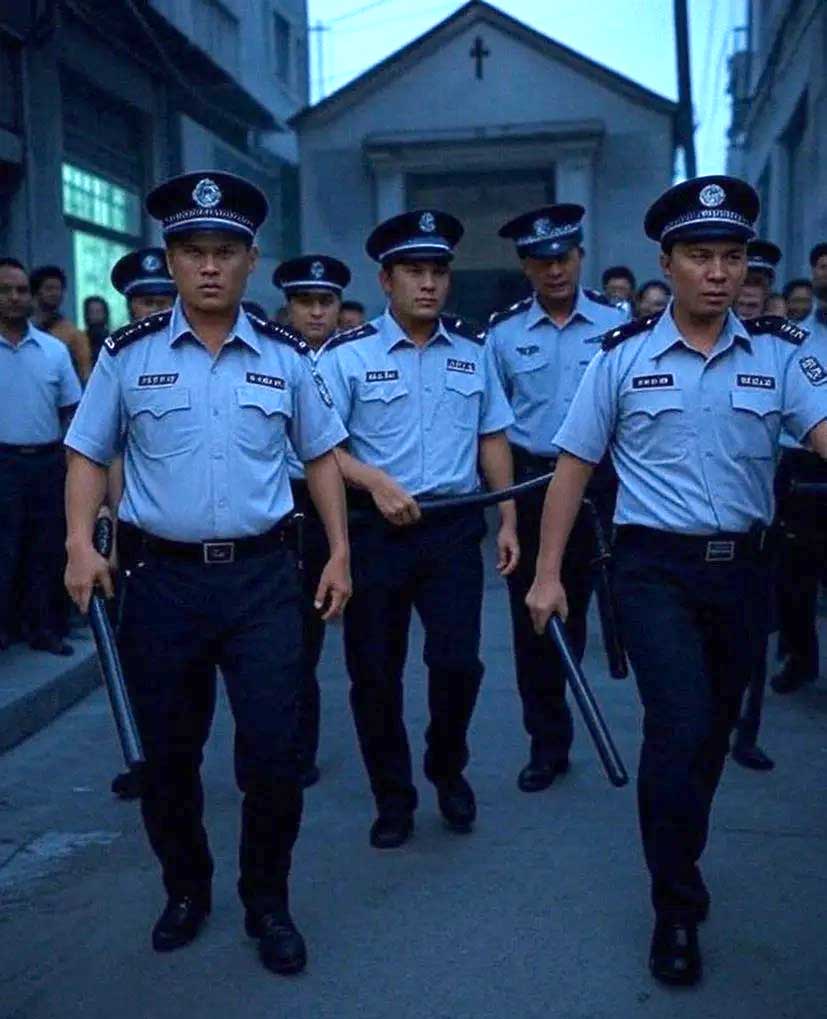
No Room for God in Xi’s China? China’s latest crackdown on religion brings new laws and a new dimension of control, where preaching becomes a crime
Tokyo, 17th May 2025 – Published as an article in the Japanese newspaper Sekai Nippo. Republished with permission. Translated from Japanese. Original article.
China Tightens Control Over Foreign Religious Activities
Christian NGO Issues Warning
by Satoshi Ogawa (小川 敏), reporting from Vienna
prepared by Knut Holdhus
Vienna, by Satoshi Ogawa – The non-governmental organization Open Doors, which reports on persecution of Christians worldwide, issued a press release [in German] in Vienna on 14th May, warning that the Chinese Communist regime implemented new laws earlier this month that further crack down on foreign religious activities in China, marking a “new dimension” in the government’s religious control policies.
Kurt Igler, head of Open Doors Austria, described the new laws as regulations that “effectively criminalize most forms of Christian witness and missionary work by foreigners in China.” He added that it is “the latest sign that the Chinese government is determined to bring every expression of Christianity under its control – or eliminate it entirely.” Specifically, the law bans activities such as preaching and evangelism by foreign missionaries and requires government permission even to attend church services.
The new laws are titled “Administrative Provisions on the Religious Activities of Foreigners”. According to Open Doors, preaching, joint religious services, missionary activities, and exchanges with Chinese religious groups or institutions now require government approval. Foreigners are also prohibited from bringing Bibles or Christian literature into China unless it is for personal use and has received formal permission. Violations may lead to deportation, fines, or criminal prosecution.
Since taking power in 2012, President Xi Jinping’s Chinese Communist regime implemented the “Five-Year Plan to Promote the Sinicization of Religion” (2018–2020). “Sinicization of religion” refers to a policy of assimilating religion under the guidance of the Communist Party. This has been implemented in places like Xinjiang, where over a million Muslims are believed to have been sent to forced re-education camps. As for Christianity, the state is advancing “Sinicization” through a government-controlled clergy organization called the Chinese Patriotic Catholic Association (CPCA) [See editor’s note below].
Featured image above: Chinese crackdown on believers. Illustration: Grok xAI, 23rd May 2025
[Editor’s note: The Chinese Patriotic Catholic Association (CPCA) was founded in 1957 by the Chinese Communist Party (CCP). Its purpose is to supervise and control Catholic Church activities in China in alignment with state policies, particularly ensuring loyalty to the Communist Party over the Vatican.
The CPCA operates independently of the Holy See (Vatican) and does not initially recognize the Pope’s authority in appointing bishops (although this has been partially addressed in recent agreements).
The CPCA manages church affairs such as bishop appointments, church operations, and religious education, and it aims to “Sinicize” Catholicism – making it align with Chinese socialist values and culture.
For decades, the Vatican and China had no formal diplomatic relations, mainly due to this split: while the Vatican insisted on the Pope’s authority over appointments and doctrine, the CPCA allowed the Chinese government to appoint bishops without Vatican approval.
In 2018, the Vatican and China signed a provisional agreement (renewed since) that gave both the Vatican and Beijing a say in the appointment of bishops – a historic but controversial compromise intended to unify the underground and state-sanctioned Catholic communities in China. However, tensions remain, and violations of the agreement (like unilateral bishop appointments) still occur.
Many Chinese Catholics continue to worship in the underground church – loyal to Rome but unrecognized by the Chinese state – often facing persecution, including surveillance, harassment, or imprisonment.]