Japanese MP urges persecuted religious minority to step up fight for religious freedom with new technology and strategic political action
Tokyo, 19th May 2025 – Published as an article in the Japanese newspaper Sekai Nippo. Republished with permission. Translated from Japanese. Original article.
“Hint for Communication Is Generative AI”
MP Hamada Speaks at Symposium on Freedom of Religion
by the editorial department of Sekai Nippo
Prepared by Knut Holdhus
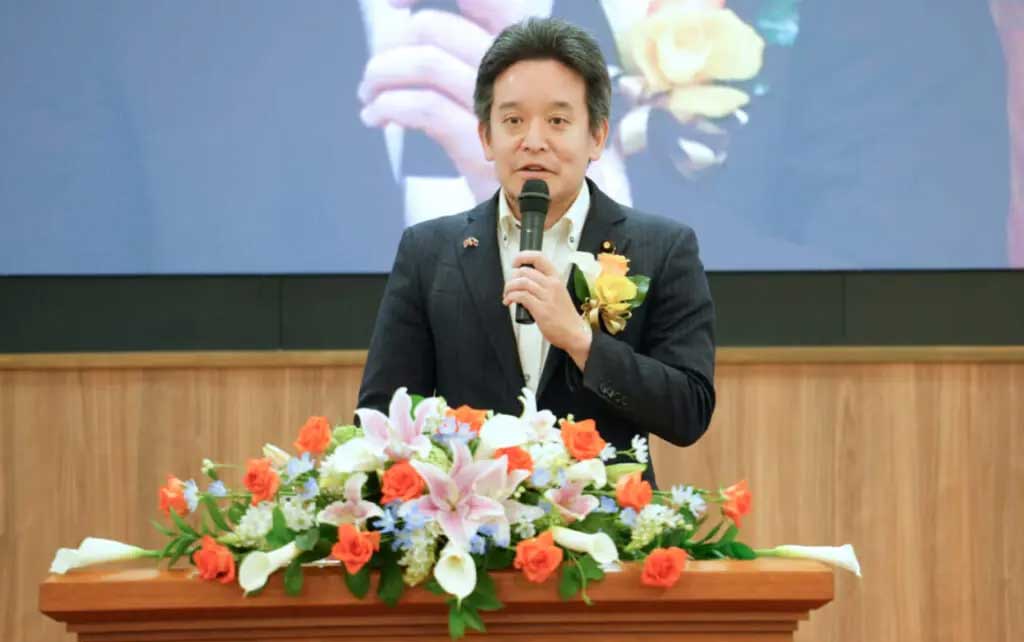
Satoshi Hamada, a member of Japan’s House of Councillors from the NHK Party [See editor’s note 1 below], gave a speech on 18th May at a symposium on freedom of religion held at the Nagano Family Church of the Family Federation for World Peace and Unification (formerly the Unification Church) in Nagano City. He stated, “To convey the value of freedom of religion, creative expression is essential, and generative AI – which can offer specific suggestions – may serve as a helpful tool.”
As one method of enhancing communication, Mr. Hamada suggested using written parliamentary questions to “expose issues”. He also mentioned that his political group, The Party to Protect the People from Jichirō and Jichirō-Ren [See editor’s note 2 below], which he leads, plans to field candidates in the Tokyo Metropolitan Assembly election in June.
The symposium drew around 300 participants, mostly followers of the Family Federation. Tetsuya Uchida (内田哲也), the church leader of the Nagano Family Church, emphasized, “The Puritans won religious freedom through American independence,” and declared, “Now is the time for us to advocate for our freedom of religion.”
Featured image above: MP Satoshi Hamada delivering his speech 18th May 2025, in Nagano City. Photo: Yasuhiro Uno (宇野泰弘)
[Editor’s note 1: The Party to Protect the People from NHK (NHKから国民を守る党, NHK kara Kokumin wo Mamoru Tō, often abbreviated as N-Koku) is a minor political party in Japan. It was founded in 2013 by Takashi Tachibana, a former NHK employee, with the primary goal of opposing Japan’s public broadcaster, NHK (Nippon Hōsō Kyōkai). The party criticizes NHK’s mandatory subscription fees and has campaigned to allow people to avoid paying for NHK if they don’t watch it.
Over time, the party has shifted its focus, rebranding multiple times and addressing broader issues, but its core stance remains opposition to NHK. It has gained attention for its unconventional campaigning methods and populist rhetoric but has had limited electoral success.]
[Editor’s note 2: “The Party to Protect the People from Jichirō and Jichirō-Ren” (in Japanese: 自治労と自治労連から国民を守る党) is a small and newly formed Japanese political group led by Satoshi Hamada, a member of the House of Councillors affiliated with the NHK Party (now often involved in populist or protest-style politics).
Jichirō (自治労): Short for Zenkoku Jichitai Rōdō Kumiai (全国自治体労働組合), or the All-Japan Prefectural and Municipal Workers Union. It’s a major public sector labor union representing local government employees.
Jichirō-Ren (自治労連): Short for Zenkoku Jichitai Rōdō Kumiai Rengōkai (全国自治体労働組合連合会), or the Japan Federation of Prefectural and Municipal Workers’ Unions. It is another public-sector labor union, separate from but similar to Jichirō.
These unions are influential in local government and often aligned with progressive or center-left politics, including support for the Constitutional Democratic Party of Japan (CDP) and other opposition parties.
The party’s name, “The Party to Protect the People from Jichirō and Jichirō-Ren” signals opposition to the influence of public sector unions, particularly their alleged political bias, power within local bureaucracies, and potential misuse of resources. It follows the naming style of the NHK Party, which originally branded itself as “The Party to Protect the People from NHK” (Japan’s public broadcaster), using exaggerated or provocative names to attract attention and highlight perceived grievances.
In essence, this new party appears to be a populist protest group criticizing the political entanglement and influence of public sector unions and aiming to mobilize voters who are skeptical of entrenched bureaucratic or union power, especially in local politics.]