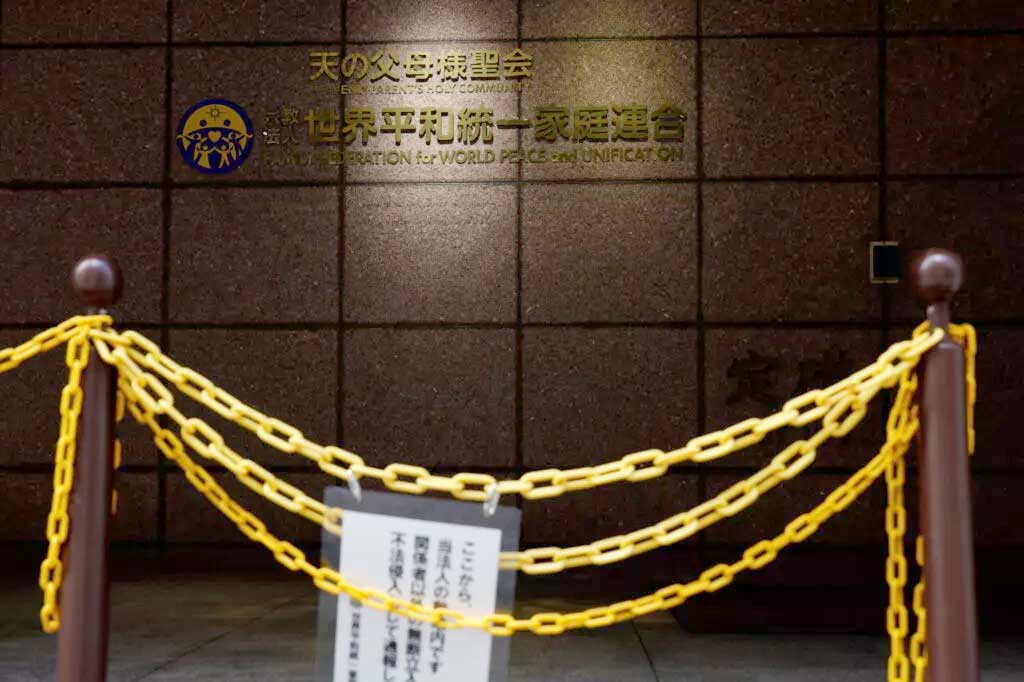
Swedish academic on how the 2025 dissolution order against the Family Federation stirs debate over religious freedom, political entanglements, and the “plundering of the coffers” of a religious organization that has committed no crimes
an article by Dr. Ernils Larsson, Postdoctoral Research Fellow at the Centre for Multidisciplinary Research on Religion and Society (CRS) at Uppsala University in Sweden, in East Asia Forum (EAF) 3rd May 2025.
Prepared by Knut Holdhus
East Asia Forum (EAF), an online publication and quarterly magazine known for its high editorial standards, published on 3rd May 2025, an article titled “The Unification Church dissolution and Japan’s evolving religious governance”. It is written by Ernils Larsson, a Swedish scholar specializing in the intersection of religion, law, and politics in postwar Japan.
Dr. Larsson points out that the ongoing case in Japanese courts against the Family Federation for World Peace and Unification, formerly known as the Unification Church, raises significant concerns about the limits of religious freedom in Japan
The article describes the Tokyo District Court’s landmark decision on 25th March ordering the dissolution of the Family Federation, following what Larsson calls decades of controversy surrounding the organization’s alleged use of so-called “spiritual sales” – a term coined by activist lawyers using consumer law to claim the return of donations, often given many years ago to the religious organization which until 2015 in Japan was called the Unification Church.
Larsson writes that the Family Federation has appealed to a higher court and claims that the organization may reestablish itself in another legal form, what he calls, “may continue operating under a different form,” and “The Church can still move its assets to a friendly corporation and carry on its activities mostly as before.”
As source for such claims, Larsson gives an UCA News (Union of Catholic Asian News) article from 10th April. There, Katsuomi Abe, one of the activist lawyers campaigning against the Family Federation, is quoted as saying that the Unification Church in 2009 “felt a sense of crisis and took preemptive measures.” UCA News wrote that the church “decided to transfer any assets remaining after the Church‘s dissolution to Tenchi Seikyo [See editor’s note below], a group based in Obihiro City”.
What Larsson fails to mention, is that in the same article Masaki Kito, a leading activist lawyer in the network working to dissolve the Family Federation, and regarded by many as the chief architect behind the government’s dissolution case, stated at a press conference on 27th March that “remaining assets could be calculated only after the victims are compensated.”
And the network of lawyers is doing its best to inflate claims from so-called victims as much as possible, so that what is left after those claims are settled are only token amounts. On top of that, the same Kito is campaigning that funds should be held back for possible future claims. A likely scenario may well be that next to nothing will remain after the activist lawyers have “plundered the coffers” of the Family Federation.
The Swedish academic describes that the Unification Church has been active in Japan since the end of the 1950s. Throughout its history, it had close connections with conservative politicians, especially from the ruling Liberal Democratic Party (LDP). Founded by Sun Myung Moon, who was known for his vehement anti-communism, the church aligned ideologically with the LDP, particularly during the Cold War era. According to Larsson, this alignment facilitated cooperation in political campaigns, with the church often providing volunteers and logistical support in exchange for political goodwill.
Japan’s Constitution, enacted in 1947, forbids public officials from engaging in religious activity but does not restrict religious organizations from participating in politics — as long as they do not exert direct political authority. This legal framework allowed the Unification Church members to campaign for conservative lawmakers without officially breaching constitutional boundaries. However, in the wake of the Abe assassination, the sensationalist media thrust the extent of this partnership into public view. This prompted then-Prime Minister Fumio Kishida to announce the severance of ties between the LDP and the federation.
Ernils Persson points out that it was only with Abe out of the way that a relentless media and activist campaigners spurred the government to take formal action against the Family Federation.
Until recently, Japanese authorities were hesitant to intervene in religious matters due to the strong legal protections enshrined in Japan’s postwar Constitution. These protections have traditionally ensured a high degree of autonomy and privacy for religious organizations. Japanese courts have often sided with religious individuals even when their beliefs conflicted with societal norms. Notable rulings include protections for Jehovah’s Witnesses who refused blood transfusions or abstained from school martial arts training.
However, according to Larsson, public attitudes toward religious groups began to shift dramatically after the 1995 Tokyo subway sarin attack carried out by Aum Shinrikyo, another religious organization. That attack exposed the dangers posed by fringe religious movements operating under the legal protections granted to religious corporations. Following the incident, public support for increased oversight of religious groups grew stronger, and tolerance for newer religious movements, such as Soka Gakkai and Jehovah’s Witnesses, began to erode.
Despite increased scrutiny, the Japanese government retains significant discretion in handling religious corporations under the Religious Juridical Persons Law. Court-ordered dissolutions of religious groups remain rare. Aum Shinrikyo was the first to face such a fate, with its dissolution confirmed by the Supreme Court in 1996. Since then, only two more groups – the Myokakuji in 2002 (due to criminal fraud convictions) and Dainichizan Hokekyoji in 2006 (after a civil dispute) – have faced dissolution through legal action.
Larsson writes that the legal path taken is what makes the Unification Church case notable. The Ministry of Education, Culture, Sports, Science and Technology (MEXT) – responsible for registering national religious corporations – filed the suit under Japan’s Civil Code, not through criminal prosecution. This marks the first time a government body has sought the dissolution of a religious organization without pursuing accompanying criminal charges, placing the case in a legal category similar to that of Dainichizan Hokekyoji.
While Japan’s Constitution upholds religious freedom, this right is not absolute. The Swedish academic emphasizes that Article 12 of the Constitution specifies that civil liberties must align with the public welfare. Likewise, Article 81 of the Religious Corporations Act allows for the dissolution of religious organizations that cause significant harm to society. This framework mirrors international norms, such as Article 18 of the International Covenant on Civil and Political Rights, which Japan has adhered to since 1978.
The Tokyo court’s decision has provoked concern among religious freedom advocates and Family Federation representatives, who argue that the ruling sets a troubling precedent. They warn that it could threaten the autonomy of other religious groups.
East Asia Forum (EAF), established in 2006, is a prominent English-language platform dedicated to delivering expert analysis and commentary on political, economic, and policy developments across the Asia Pacific region. The publication operates under the auspices of the Crawford School of Public Policy at the Australian National University (ANU) and is a joint initiative of the East Asian Bureau of Economic Research (EABER) and the South Asian Bureau of Economic Research (SABER).
Ernils Larsson serves as a Postdoctoral Research Fellow at the Centre for Multidisciplinary Research on Religion and Society (CRS) at Uppsala University in Sweden. His current research project, titled “From Secular Institution to Religious Organization: Shrine Shinto in Postwar Japan”, is funded by the Swedish Research Council.
Larsson earned his PhD in the history of religions from Uppsala University’s Faculty of Theology. Larsson’s expertise makes him a valuable contributor to discussions on the complex relationship between religion and state in contemporary Japan.
[Editor’s note: Tenchi Seikyo (天地正教), translating to “True Teachings of Heaven and Earth,” was founded in 1987 by Kawase Kayo as the Spiritual Stone Worshippers Club. In 1988, it was reorganized and officially registered as a religious corporation under Japan’s Religious Corporations Law. The group venerates a pure white marble statue of the Seated Maitreya (Miroku Bosatsu), aligning with certain Buddhist traditions. According to researcher Thomas H. Pearce, as of 1994, Tenchi Seikyo reportedly had approximately 111,000 members across 73 centers throughout Japan.]