Similarities to the treatment of Family Federation today: Japan’s horrible persecution of Christians during the religious inquisition
Tokyo, 4th January 2025 – Published as an article in the Japanese newspaper Sekai Nippo. Republished with permission. Translated from Japanese. Original article.
The Persecution of Christians and the First Religious Inquisition Officer: Masashige Inoue
Driving Believers to Apostasy Rather than Martyrdom – A Guidebook for Forced Apostasy Left Behind
by the editorial department of Sekai Nippo
Prepared by Knut Holdhus
Masashige Inoue (1585-1661 – 井上政重), also known as Governor of Chikugo, was a hatamoto – a direct retainer of the Tokugawa shogunate (1603-1868) – in the early Edo period who later became a daimyo – a powerful feudal lord. Though not widely recognized in Japanese history, he served as the first Shūmon Aratameyaku (Religious Inquisition Officer), wielding great power in the persecution of Christians. In a quiet residential area of Kohinata, Bunkyo Ward, Tokyo, there is a stone marker commemorating the site known as the “Christian Residence Ruins”, which was the location of Inoue’s lower residence and a detention center for apostate missionaries – missionaries who renounced their faith.
Inoue’s methods for forcing apostasy (renunciation of belief) and conversion were exceptionally harsh. One infamous technique was the ana-zuri (“pit hanging”) punishment, where believers were suspended upside down into a pit. Care was taken to prolong their lives and suffering to coerce recantation (statement that one no longer holds a belief) before death. At the same time, Inoue also employed more conciliatory measures, such as offering comforting words and even arranging female companionship, blending harshness with persuasion to achieve forced apostasy. This brutal yet cunning approach led American historian George Elison to compare Inoue to Adolf Eichmann, describing him as an “intellectual and demonic operator”.
Inoue played a significant role during the Shimabara Rebellion (1637-1638) as an advisor to Matsudaira Nobutsuna (松平信綱) – nicknamed “Izu the Wise” – the shogunate’s senior envoy, and was instrumental in post-rebellion governance. This pivotal involvement positioned him as the highest authority in Christian persecution as the first Shūmon Aratameyaku (Religious Inquisition Officer.
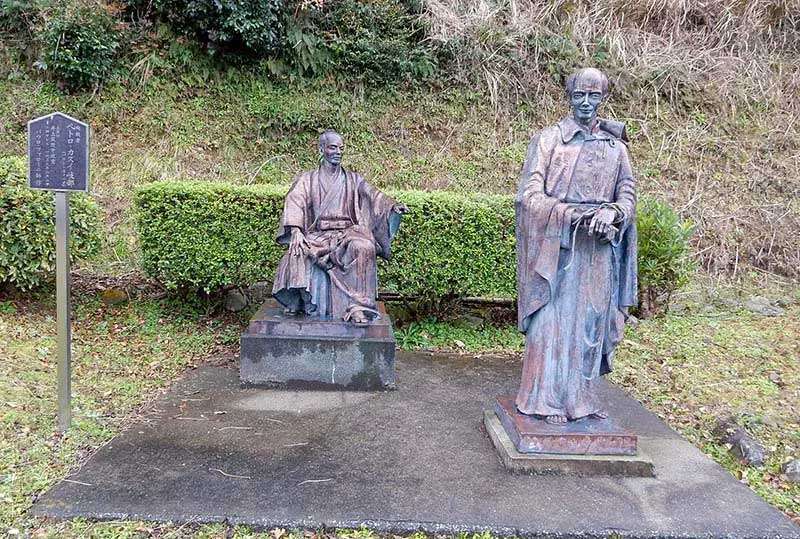
However, Inoue’s actions went beyond mere crackdowns. Traveling between Nagasaki and Edo, he reported to the shogun and senior officials to ensure the thorough enforcement of anti-Christian policies. Simultaneously, he actively sought overseas intelligence through Dutch factory chiefs, the sole foreign traders permitted in Japan at the time. In this sense, he was not merely an isolationist but held a crucial role in the shogunate’s foreign policy.
At the time, European powers such as Spain and Portugal were expanding into Asia. The Tokugawa shogunate was undeniably concerned about the prospect of colonization under the guise of missionary activity, even as trade and commerce flourished with these nations.
The system of the Shūmon Aratame (Religious Inquisition) and its legacy until the lifting of the Christian ban in 6th year of Meiji (1873)
The Shūmon Aratame (Religios Inquisition) system continued until the prohibition on Christianity was officially lifted in the 6th year of Meiji (1873). Until that time, the manual for forced apostasy and conversion authored by Masashige Inoue, titled Kirisuto-ki (“The Christ Chronicle”), served as a guidebook for successive Shūmon Aratameyaku (Religious Inquisition Officers). For instance, it instructed interrogators to pose pointed questions to Christians, such as:
- “If God created heaven and earth, why does His power not extend over everything?”
- “How can it be consistent to create a world in which humans fall into evil and then promote a teaching to save those very humans?”
These tactics aimed to undermine Christian doctrines and worldview, compelling believers to renounce their faith.
As German priest Hubert J. Cieslik (1914-1998) noted in Japanese Priests During the Christian Era: “The approach of Inoue, Governor of Chikugo, could be summarized in one sentence: Create apostates, not martyrs. To achieve this, he made every effort to ‘brainwash’ and persuade them.”
The interrogation of Giovanni Sidotti by Arai Hakuseki
The Seiyō Kibun (Record of Things Heard from the West) by Arai Hakuseki (新井白石 – 1657-1725), a Confucianist scholar, documents his interrogation of Giovanni Battista Sidotti (1668-1714), a missionary who infiltrated Japan. Sidotti ultimately did not convert and spent the rest of his life confined to the Christian Residence. During the interrogation, Hakuseki noted that Sidotti gave the impression of being both a “sage” and a “fool”. The “sage” aspect lay in Sidotti’s extensive knowledge of the humanities and global affairs, while the “fool” aspect was his insistence on clandestinely bringing Christianity to Japan.
According to the writer Shichihei Yamamoto (山本七平 – 1921-1991), Hakuseki’s issue with Christianity stemmed from its opposition to the Japanese hierarchical group-oriented order based on Confucianism. Yamamoto argued: “If Christianity were accepted, all societal order would collapse. Since the Meiji era (1868-1912) – or perhaps since Hakuseki’s time (1657-1725) – we have focused solely on the ‘wise’ aspects of Christianity, dismissing what we perceived as its ‘foolish’ elements. This isolationist philosophy continues to bind Japan even today.” (Study of “Air” –「空気」の研究 )
Editorial Advisor: Masahiro Kuroki (黒木正博)
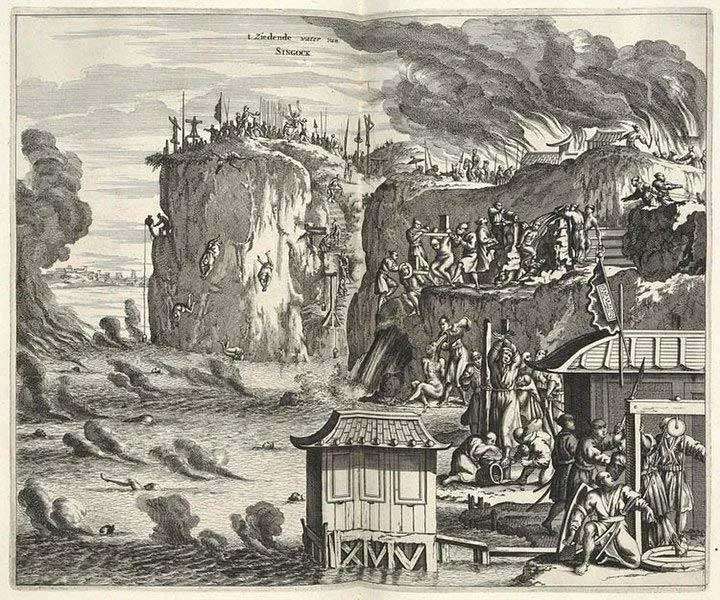
Featured image above: Persecution of the Christians in Japan. When the Spaniards and Portuguese arrived in Japan, they introduced more than just firearms and scientific knowledge—they brought Christianity. The missionaries succeeded in converting tens of thousands to the Catholic Church. However, this new religious influence was not welcomed by all. By the late 16th century, Toyotomi Hideyoshi (1536–1598), Japan’s de facto ruler, began issuing decrees against Christians in an effort to curtail their growing influence. As a result, priests and Japanese Christians were persecuted, killed, or exiled. Ultimately, Christianity was banned in Japan, forcing the few remaining adherents to practice their faith in complete secrecy. Illustration: National Library of the Netherlands. Public domain image