International leaders in the world of freedom of religion or belief (FoRB) issued a joint statement raising global alarm over the crisis for religious liberty in Japan
Prepared by Knut Holdhus
On 31st December 2024, a significant assembly of global leaders in freedom of religion or belief (FoRB) issued a joint statement addressing the escalating “religious liberty crisis in Japan.” The statement was published by Bitter Winter, the leading online magazine on human rights and religious freedom, headlined “The Global Religious Liberty Community Gathers to Denounce Religious Liberty Crisis in Japan”.
The statement highlighted concerns following the assassination of former Prime Minister Shinzo Abe in 2022, noting how certain groups exploited the tragedy to target conservative religions and stigmatized minorities labeled as “cults”. Initially focused on the Unification Church (now Family Federation for World Peace and Unification, FFWPU), the campaign has since extended to Jehovah’s Witnesses and other groups.
Newly enacted laws restrict religious minorities’ rights to solicit donations and transmit beliefs to their children, drawing criticism from the United Nations. A statement by four UN Special Rapporteurs and a pending visit request from FoRB Rapporteur Nazila Ghanea underscore growing international alarm. However, Japan has yet to respond to these concerns.
The signatories condemned the reinterpretation of Japan’s Religious Corporations Act, which traditionally allowed dissolution of religious organizations only for serious criminal conduct. Authorities now cite civil cases over donations as grounds for attempting to dissolve the Family Federation, despite no criminal offenses.
This crisis represents an unprecedented attack on FoRB within a democratic nation. However, the response of academics, human rights advocates, and religious leaders joining forces in solidarity offers hope. The coalition urged Japanese religious leaders to unite in defense of FoRB, warning that the implications of this crisis extend far beyond Japan.
The statement itself, co-signed by 31 leaders in the world of freedom of religion, had the title “Human Rights and Religious Freedom Impact Statement – A Religious Liberty Crisis in Japan”
The statement mentions how the assassination of Japan’s former Prime Minister Shinzo Abe on July 8, 2022, shocked the world, leaving millions mourning a tragic loss. However, the aftermath of this crime has raised deep concerns among scholars, human rights activists, and faith representatives regarding threats to religious freedom in Japan.
Abe’s assassin, Tetsuya Yamagami, claimed his actions were motivated by Abe’s ties to organizations affiliated with the Family Federation for World Peace and Unification, formerly the Unification Church. Yamagami’s animosity stemmed from his mother’s financial troubles after making substantial donations to the movement that is now called the Family Federation, though these donations were partially refunded through a mutual settlement in 2009. Notably, Yamagami himself was never a member of the movement and had acknowledged the settlement. Despite this, the assassination spurred renewed hostility towards the Family Federation and other religious groups, including Jehovah’s Witnesses.
This hostility invoked the populist but unscientific label of “cult” and focused on alleged practices such as high-pressure donation solicitations and insufficient education for second-generation members. Critics revived claims about “spiritual sales” from decades past, though such sales had mostly ceased. Media and political narratives amplified the grievances of individuals reporting negative experiences while ignoring the many second-generation members who thrived within these faiths.
Post-Assassination Legal Measures
The Abe assassination prompted three significant legal and administrative measures:
- Reinterpretation of Dissolution Laws: The legal grounds for dissolving religious corporations were redefined retroactively. Previously, dissolution required evidence of major crimes; now, losing civil cases may suffice. This precedent risks targeting any religious organization with civil litigation, creating a chilling effect on religious freedom.
- Restrictions on Donations: New provisions limit how “controversial” organizations can solicit donations and allow donors, their heirs, or relatives to reclaim contributions more easily. This introduces broad suspicion around religious fundraising and donations.
- Guidelines on Religious Practices: The Ministry of Health, Labour, and Welfare issued guidelines targeting alleged “religious abuse of children”. These include practices common in conservative religious groups, such as forbidding birthday celebrations (typical of Jehovah’s Witnesses), discussing sex-related sins in confession (as in Catholicism), and teaching views on Hell or abortion (common in Evangelical traditions). These vague provisions stigmatize religious teachings and practices fundamental to many faiths.
Threats to Religious Freedom
The implications of these measures extend beyond the Family Federation to threaten all religious groups. Labels such as “controversial” or “anti-social” lack clear definitions, enabling opponents to target minority religions arbitrarily. Concerns about donations often rely on discredited theories of “brainwashing” and “mental manipulation”, dismissed by Western scholars for decades. The new guidelines risk curbing the ability of conservative religions to socialize children with values differing from societal norms.
International Attention and Calls for Accountability
In response to these developments, prominent UN Special Rapporteurs, including Dr. Nazila Ghanea, have raised concerns. They issued a UN Mandate to Japan on 1st April 2024, questioning potential violations of the International Covenant on Civil and Political Rights (ICCPR), particularly regarding parental rights to guide children’s upbringing. The mandate highlighted how the Ministry’s guidelines, developed in consultation with the Japanese Society for Cult Prevention and Recovery (JSCPR), stigmatized minority religions. Despite a 60-day window for response, Japan failed to reply, prompting the mandate’s public release on 1st July 2024.
Dr. Ghanea’s request to visit Japan to investigate these issues remains unanswered. Meanwhile, hate crimes and hate speech against Jehovah’s Witnesses and other minorities have reportedly increased since the guidelines’ publication.
Attorney Patricia Duval, a respected French human rights specialist, also filed a report in September 2024 documenting decades-long religious discrimination in Japan. Her findings provide critical context for the UN’s concerns and underline the systemic nature of these challenges.
Upholding Religious Freedom and Human Rights
Japan, as a democratic nation committed to due process, must honor its international obligations and constitutional protections of religious freedom. Legal actions influenced by emotional responses to Abe’s assassination should not undermine the rights of religious organizations to operate freely, collect donations, and pass their beliefs to future generations.
A Call to Action
Faith leaders in Japan must stand united in defending religious liberty. The nation’s adherence to the International Covenant for Civil and Political Rights (ICCPR), the Universal Declaration of Human Rights, and its own Constitution’s guarantees of religious freedom is crucial. As history warns us, threats to one group’s freedom often presage broader erosions of rights.
German Lutheran Pastor Martin Niemöller’s words remain a stark reminder: “First they came for the socialists, and I did not speak out […] Then they came for me – and there was no one left to speak for me.”
The actions Japan takes now will resonate far beyond its borders, shaping global perceptions of its commitment to human rights and democratic values.
Impact Statement signatories:
- Alessandro Amicarelli, President, European Federation for Freedom of Belief, Rome and Torino, Italy
- Nicole Bauer, Assistant Professor of Religious Studies, University of Graz, Austria
- Luigi Berzano, Professor at the Department of Cultures, Politics & Society, University of Torino, Italy
- Sam Brownback, Co-chair of the International Religious Freedom Summit
- Dan Burton, Co-Chair International Association of Parliamentarians for Peace, U.S. House (R-IN, 1983-2012)
- Francesco Curto, President, Fedinsieme (Faith Together), Torino, Italy
- Raffaella Di Marzio, Director, The Center for Studies on Freedom of Religion, Belief, and Conscience, Rome, Italy
- Cole Durham, Professor Emeritus of Law & Religion, Brigham Young University, Provo, Utah
- Willy Fautré, Director, Human Rights Without Frontiers, Brussels, Belgium
- Jan Figel, former Special Envoy for the Promotion of Freedom of Religion or Belief outside the EU, Bratislava, Slovakia
- Holly Folk, Associate Professor of Global Humanities & Religions, Western Washington University, Bellingham, Washington
- Bispo Edson Galeano, Assembly of God Church, Brazil
- Massimo Introvigne, Managing Director, CESNUR, Center for Studies on New Religions, Torino, Italy
- Michael Jenkins, President, The Washington Times Foundation
- Karolina Maria Kotkowska, Assistant Professor, Centre for Comparative Studies of Civilizations, Jagiellonian University, Krakow, Poland
- Camelia Marin, Deputy Director, Soteria International, Copenhagen, Denmark
- Hans Noot, President, Gerard Noodt Foundation, Langenboom, The Netherlands
- Marco Respinti, Director-in-charge, Bitter Winter magazine
- Aaron Rhodes, President, Forum for Religious Freedom Europe, Vienna, Austria, Executive Director International Helsinki Federation for Human Rights 1993-2007
- James T. Richardson, Emeritus Professor of Sociology & Judicial Studies, University of Nevada, Reno, Nevada
- Bernadette Rigal-Cellard, Professor Emeritus in North American Studies & Religious & Social Studies, University of Bordeaux Montaigne (em.), Bordeaux, France
- Thomas Selover, President, Professors World Peace Academy International, former Associate Professor of Religious Studies, University of Saskatchewan, Canada
- Talib M. Shareef, Imam, The Nation’s Mosque, USA
- Rosita Šorytė, President, International Observatory for the Religious Liberty of Refugees, Vilnius, Lithuania
- G. Augustus Stallings, Jr., Archbishop, Imani Temple, Washington, D.C.
- Katrina Lantos Swett, President the Lantos Foundation for Human Rights and Justice, Co-Chair of Annual International Religious Freedom Summit
- Sue Taylor, National Public Affairs Director, Church of Scientology National Affairs Office
- Thierry Valle, President, Coordination des associations et des particuliers pour la liberté de conscience, Paris, France
- Maria Vardé, Institute of Anthropological Sciences, Faculty of Philosophy and Letters, University of Buenos Aires, Argentina
- Thomas Walsh, President, HJ International Graduate School for Peace and Public Leadership
- Catherine Wessinger, Rev. H. James Yamauchi, S.J. Distinguished Professor of the History of Religions, Loyola University, New Orleans, Louisiana
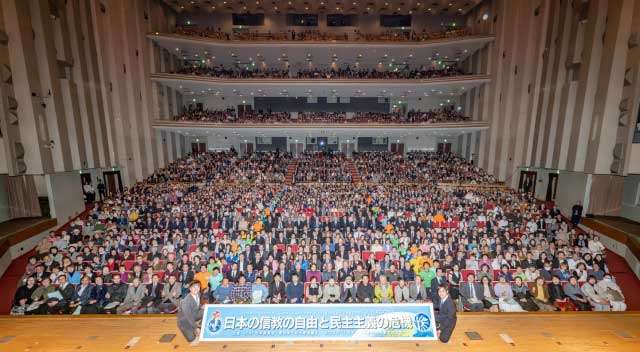
Featured image above: Participants in an event organized by the International Coalition for Religious Freedom (ICRF) Japan Committee at Niterra Civic Hall in Nagoya, on 9th December 2024. Photo: ICRF Japan.