Japan copying communist China: state prying into family matters and faith passed naturally from parents to children
Tokyo, 2nd November 2024 – Published as the 35th article in a series in the Japanese newspaper Sekai Nippo. Republished wzith permission. Translated from Japanese. Original article
“The ‘Ill-fitting Garment’ My Mother Made Me Wear”: The Achievements of Shusaku Endo, a ‘Second-Generation Religious Believer’
Overcoming Inner Conflicts to Portray a Unique Image of Christ
by the Religious Freedom Investigative Team of the editorial department of Sekai Nippo
Prepared by Knut Holdhus
As media coverage has increased around second-generation believers and former second-generation believers of the Family Federation for World Peace and Unification (formerly the Unification Church), the term “second-generation religious adherent” has become widely used. This term often carries a negative connotation, typically applied to cases where individuals became believers not by their own choice or where they faced disadvantages due to their parents’ religious beliefs.
Religion is commonly passed down from parents to children. Family education forms the foundation of personal development, and at its core often includes, to varying degrees, religious values. The simplistic view that a parent’s strong faith leads to child abuse is far removed from global common sense.
Even when children are raised and educated in a faith before they fully understand it, they typically make their own choice as they mature – whether to adopt the faith as their own or to leave it. Such inner struggles contribute to personal growth.
Catholic author Shusaku Endo (遠藤周作) experienced such inner conflicts and deepened them through his literary work, ultimately establishing a literary world that gained high international acclaim.
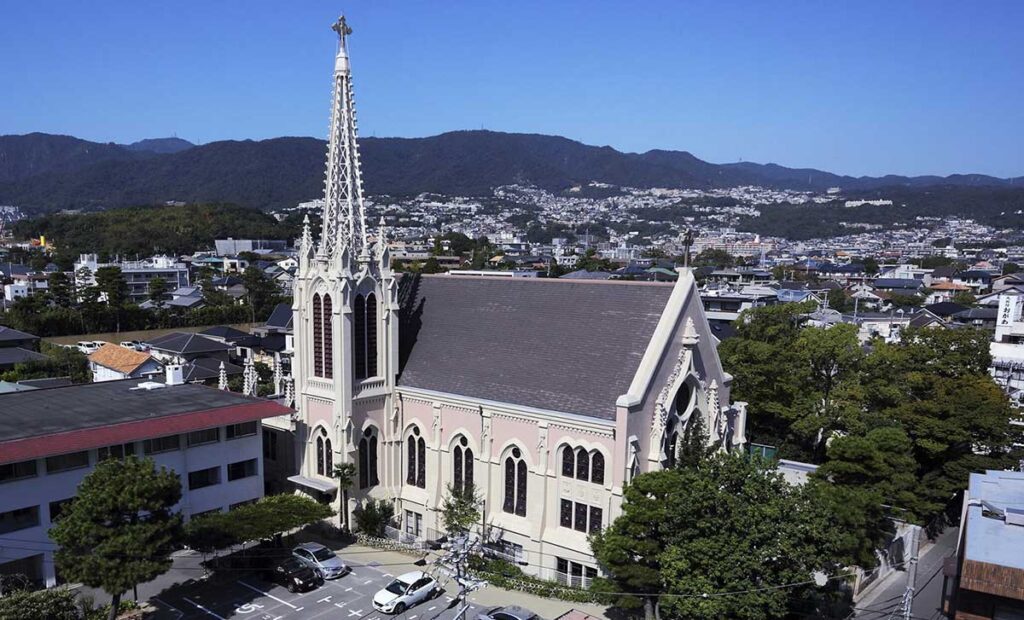
After his parents divorced in 1933, Endo returned to Japan from Dalian (大連), in former Manchuria, with his mother Ikuko (郁子), and they settled near a Catholic church in Shukugawa, Nishinomiya, Hyogo Prefecture. Encouraged by his aunt, Endo’s mother converted to Catholicism, leading Endo to attend church as well. He was baptized at the age of ten.
Reflecting on his baptism, Endo remarked, “To be precise, rather than saying I ‘received’ baptism, it would be more accurate to say it was ‘given’ to me. It was not an act born from an irrepressible personal conviction” (“The Ill-Fitting Garment”).
Endo’s wife, Junko Endo (遠藤順子), described his mother’s strict approach to religious education in her book, “Speaking of My Husband, Shusaku Endo”. She wrote, “Without his mother, I doubt the writer Shusaku Endo would have existed. She was a woman of profound faith, attending Mass every day even during the war, though it sometimes drew the attention of the military police […]. My husband wasn’t given breakfast on Sundays unless he attended Mass.”
She also mentioned, “He was never scolded for mischief or poor grades, but it truly affected him as a child when he was told, ‘That’s not holy.’” Endo felt Christianity was an “ill-fitting garment” that he hadn’t chosen himself and often considered casting it off. Yet, he ultimately could not bring himself to do so. “I couldn’t possibly throw away clothing that someone who loved me had given to me before I was confident enough in myself to fully embrace it.”
This internal struggle became a central theme in Endo’s literature, leading to the creation of highly acclaimed works like *Silence*. In his essay, “My Literature,” he explained, “In my novels, this single theme is almost always the core thread […]. I wanted to tell of the struggle with something given to me by my mother that didn’t quite fit.”
At one point, Endo resolved to stop trying to discard this “ill-fitting garment”, deciding instead to “tailor it into a kimono that would fit me”. This decision led him to explore the theme of Christianity through a Japanese lens, which resulted in his distinctive portrayal of a maternal, companion-like Jesus, contrasting with the paternal image often associated with Christianity.
The upbringing based on Endo’s mother’s Catholic faith could be considered a form of abuse by some according to the guidelines hastily prepared by the Ministry of Health, Labour and Welfare after the assassination of former Prime Minister Shinzo Abe (安倍晋三), titled “Q&A on Responding to Child Abuse Related to Religious Beliefs”. Those guidelines have been criticized domestically and internationally for potentially leading to religious discrimination.
However, Endo recognized the love that motivated his mother’s strict faith-based education.
When we reflect on Endo’s achievements, it becomes clear that it is a mistake to view the transmission of faith from parent to child negatively and to see so-called “second-generation religious adherents” solely as victims. We must not stifle the seeds of creativity that arise from genuine inner struggles.
Click here to read more on Religious Persecution
Featured image above: Part of the Catholic Shukugawa Church in Nishinomiya, Hyogo Prefecture, where Shusaku Endo was baptized. Photo: Sekai Nippo