Media initiative established by younger members as a platform for them to share their personal stories, promote dialogue, and challenge stereotypes
Tokyo, 15th October 2024 – Published as the 34th article in a series in the Japanese newspaper Sekai Nippo. Republished with permission. Translated from Japanese. Original article
Young people expressing themselves as they are
by the Religious Freedom Investigative Team of the editorial department of Sekai Nippo
prepared by Knut Holdhus
Since its so-called ‘Compliance Declaration’ in 2009, the Family Federation for World Peace and Unification (formerly the Unification Church) has worked on organizational reforms, one of which is making its organization more “visible” (transparent) by disseminating information.
Seisyun TV, a video series distributed via official LINE and other platforms, started in December 2021 and is one of these efforts. It is mainly led by young believers in the Kanto region. [Editor’s note: The region includes the Greater Tokyo area and seven prefectures – Gunma, Tochigi, Ibaraki, Saitama, Tokyo, Chiba, and Kanagawa.]
“We want to create content that can disseminate information through videos to viewers both inside and outside the organization, from the perspective of second-generation and other young believers,” says Toshiyuki Fujioka (藤岡俊之), the planning manager of Seisyun TV and the Director of Seiwa who is responsible for young believers in the metropolitan area.
The planning and production of the program are handled by volunteers from various parts of the metropolitan area. The program mainly consists of two types: ‘special broadcasts’ and ‘regular broadcasts.’ Initially, it was available only through limited release, but now it can be freely viewed on YouTube.
It was initially started to provide internal content for the religious organization, but the focus of the content has shifted to more candid views of second-generation members and church reforms following the assassination of former Prime Minister Abe. Fujioka and his team thought, “If one of the characteristics of an organization like a so-called cult is its closed nature, then we should communicate what kind of organization we are.”
To achieve this, they are also working on addressing the “negative aspects” that have been avoided in the past.
The regular broadcasts feature comments on current news related to the organization, such as fine trials, as well as personal stories told by second-generation believers, and appearances by second-generation members who grew up in families created through international marriages or through adoptions.
In the special broadcast, a project on the theme of church reform was featured. The program titled “Seiwa Department Renewal Conference”, which has aired three times so far, collects feedback from second-generation members through surveys and shares the results publicly. In the episode aired in March this year, a survey asking for suggestions to improve local churches was conducted via the official LINE account, receiving 233 responses.
Among the responses, there were positive opinions such as “the church has a lively atmosphere.” There were, however, also concerns like, “I feel that my value is not recognized unless I work hard in church activities.” Critical views also appeared like, “The educational concepts are outdated and feel too restrictive.”
Young staff members from various churches, invited as guests, expressed their own reflections, such as, “We may have created an uncomfortable atmosphere.” Others said, “We’d like to learn from the atmosphere of other churches.” These opinions have been fed back to local churches as materials for improvement.
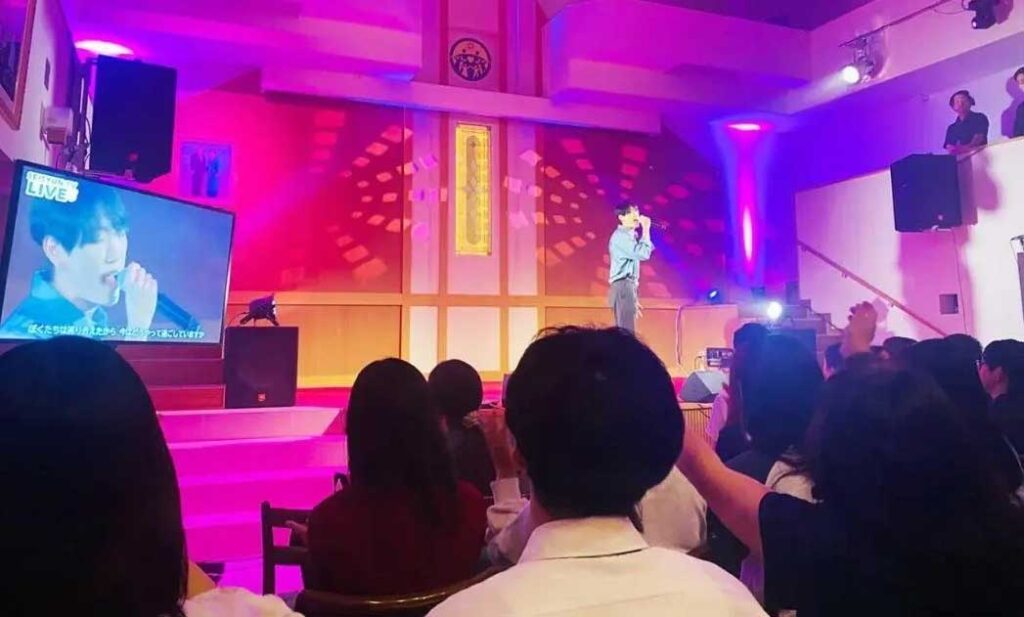
Starting this year, the general public has gradually been granted access to the videos, leading to a doubling of subscribers to the official channel. Initially, they launched an official YouTube channel and then expanded to X (formerly Twitter), monitoring reactions as they progressed. A live recording was also held on 28th September this year, where members of the mainstream media were invited.
Fujioka commented, “As we continue to open up to the public, I hope we can show that members of the Family Federation are just regular people. When people can’t see us, they tend to feel afraid. If we don’t want to be portrayed in a one-sided way, we must continue to engage in disseminating information.”
Kana Imanaka (今中華奈), 28 years old, who appears as a host on the program, was invited to join as a production staff member around 2022. Reflecting on her experience, she says, “Faith shouldn’t be something you practice with suffering. If it is painful, we want to create a space to share that experience with others.”
Imanaka also added, “There are things that are hard to talk about within the church, like wanting to date or dressing fashionably. I’d like to create an environment where people can discuss these things openly through the program.”
Click here to read more on Religious Persecution
Featured image above: At the live recording of Seisyun TV, a musical performance was also held on 29th September 2024 in Tokyo. Photo: Arisa Takezawa (竹澤安李紗)