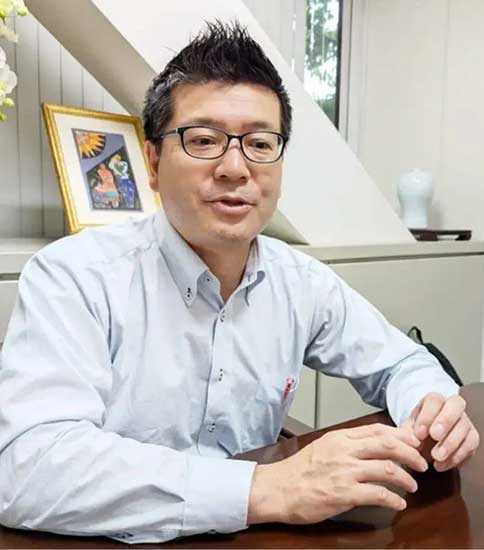
Japanese politician tells his story to Tokyo paper how he speaks up for discriminated, persecuted, and vilified socially excluded minority religion
Tokyo, 10th July 2024 – Published as the eighth article in a series in the Japanese newspaper Sekai Nippo. Republished with permission. Translated from Japanese. Original article
Series: Freedom of Religion Under Threat – Part 2: Ripples to local assemblies
Politicians have a responsibility to correct their mistakes
by the Religious Freedom Investigative Team of the editorial department of Sekai Nippo
prepared by Knut Holdhus
See the first article, second article, third article, fourth article, fifth article, sixth article, seventh article,
“I feel that I am partly responsible for causing a situation in which many of you suffered greatly. However, I believe that if a politician has made a mistake, he also has the responsibility to correct it. If I have the chance, I will do whatever it takes.”
In December 2022, the Kitakyushu City Council unanimously passed a resolution confirming that it would not be involved with the anti-social Unification Church. Shingo Inoue (井上真吾), an independent with progressive views, regrets having supported this resolution.
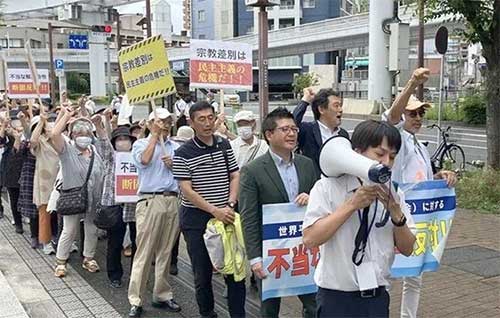
On 30th June, he took the stage at the “Kitakyushu Conference to Protect Fundamental Human Rights and Freedom of Religion,” held in Kitakyushu City, expressing deep self-reproach.
The city council resolution, which labeled the Family Federation as anti-social, stated in strong terms that “we will have no relationship whatsoever with the organization, such as participating in its events, sending messages, or receiving supporters’ membership fees.” [Editor’s note: Most city councilors and members of parliament have support groups or patronage associations.]
Despite consistently opposing opinions and resolutions submitted by the Communist Party, every member, including those from the Liberal Democratic Party and Komeito [Editor’s note: government coalition partner], supported this resolution. In an interview with this paper, Inoue revealed that he felt pressured by multiple council members who told him, “You are the only one opposing.” He confessed, “I thought it would be inappropriate to stubbornly disrupt the unity by being the only one to oppose, so I reluctantly marked approval.”
Then, three months later, in February of last year, a petition, including a request for consideration of believers’ rights and a statement, was delivered to all members of the Kitakyushu City Council. The only one who responded to this petition was Shingo Inoue. He said, “Isn’t it a personal freedom to associate with whomever one wishes? Being told by others not to associate with someone is unacceptable. It is problematic for political parties or the council to interfere in matters related to the inner lives of individuals, people’s way of living, their way of thinking, and their ideological beliefs.”
Inoue added, “It is unacceptable that believers and their children should be bullied at school and in the local community and excluded from social activities.”
After the resolution, Shingo Inoue felt uneasy, and the petition request was a much-welcomed opportunity.
“If things stayed as they were, it would have been a regrettable experience for me to have acted against my political will. I am grateful for being given the chance to correct my actions.”
Up until that point, Inoue had no connection with the religious organization. The only encounter, if it can be called so, was shortly after he joined the Communist Party, when he received a flyer from a friendly-looking elderly couple in front of a station in Kitakyushu City. Later, he found out they were members of the Family Federation. The thought that the resolution might deprive this couple of their freedom of religion crossed his mind.
Inoue debated against the “Statement of Opinion Calling for an Order to Disband the Former Unification Church” submitted by the Communist Party (JCP) in the Diet last September. He pointed out that because of the “public opinion of hatred towards the former Unification Church fueled by media reports”, there have been cases of victims, such as persons being forced out of their jobs, being bullied at school, and not being able to rent venues for events. He then appealed, “Isn’t it the duty of politics to listen to the painful stories of those who are still excluded and discriminated against because they have faith, and to make it possible for them to live peacefully as equal citizens?”
Before and after the resolution in December 2022, several statements and resolutions regarding the former Unification Church were submitted, but they were rejected due to opposition from both the Liberal Democratic Party (LDP) and Komeito [Editor’s note: government coalition partner]. Why was the resolution to sever ties the only one to be unanimously approved? Shingo Inoue speculated, “The LDP, the largest faction, probably didn’t want to appear reluctant or pressured into agreement by the opposition, especially with the unified local elections coming up in the spring of the following year.”
He expressed his indignation, stating that it is outrageous for the basic human rights of citizens to be sacrificed for political gains.
The day after the resolution, both local and national media extensively reported on the decision to sever ties. This made Inoue “realize the magnitude of the matter”.
Featured image above: Shingo Inoue, Kitakyushu City Councilor being interviewed 26th June 2024. Photo: Sekai Nippo