Campaigning against minority faith, Kishida administration ignores its voice and relies entirely on information provided by archenemy of faith
Tokyo, 8th July 2024 – Published as the sixth article in a series in the Japanese newspaper Sekai Nippo. Republished with permission. Translated from Japanese. Original article
A scapegoat to prolong the life of the government
by the Religious Freedom Investigative Team of the editorial department of Sekai Nippo
prepared by Knut Holdhus
In an unprecedented overnight change of policy, the Fumio Kishida administration included wrongful acts according to civil law as grounds for requesting the dissolution of religious corporations. Because of that, the administration could use its “right to collect reports from and ask questions to the Family Federation for World Peace and Unification (formerly the Unification Church) for the first time on 22nd November 2022.
The right to ask questions was used seven times, and interviews were conducted with former members who claimed to be victims. On 12th October 2023, almost one year after Prime Minister Kishida ordered the use of the right to ask questions, the Ministry of Education, Culture, Sports, Science and Technology decided to request a court order to dissolve the religious organization. The following day, 13th October, such a request was filed with Tokyo District Court.
This is the first time that the government has requested a dissolution based on acts that are wrongful according to civil law. Masahito Moriyama (盛山正仁), Minister of Education, Culture, Sports, Science and Technology, emphasized at a press conference that the damage from large donations had continued for many years, stating that it “had had a negative impact on many people.” In response, the Family Federation criticized the decision on its website, saying, “It is deeply regrettable that the Japanese government has made such an important decision based on biased information.”
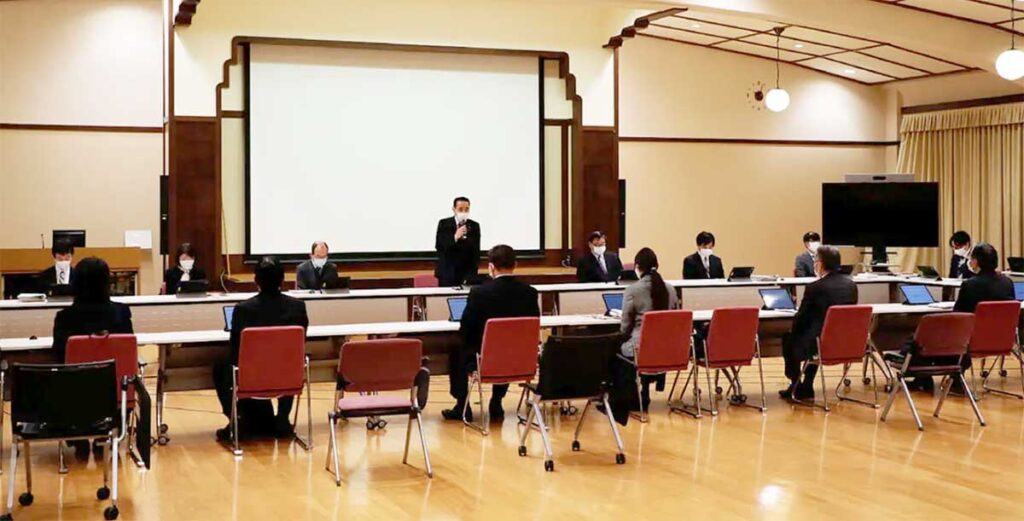
Prior to the decision, at a meeting of the Council of Religious Corporations held on the 12th October, Moriyama, Minister of Education, Culture, Sports, Science and Technology, announced his intention to make the request. It was unanimously recognized as “appropriate”. He obtained the consent of the Council, which consists of academics and religious leaders.
However, although the decision was said to be “unanimous”, it was not without dissenting voices. There were serious behind-the-scenes developments before the decision was made that cannot be overlooked. The Sankei Shimbun reported as follows on 13th October,
“A certain Council member selected from the religious community revealed to those around him in September of this year, when the investigation by Agency for Cultural Affairs was in its final stages, ‘I still do not agree with the government’s change of opinion.’ The religious community was concerned about the impact on ‘freedom of religion’ due to the legal interpretation that was overturned overnight. Nevertheless, the Agency for Cultural Affairs appealed during the deliberations at the meeting [of the Council of Religious Corporations], stating ‘if nothing is done about the religious organization, the Cabinet will be blown away.’ The Agency emphasized that the use of the right to ask questions – the basis for requesting a dissolution order – had to be legitimate. [Editor’s note: Only the Council of Religious Corporations could grant them such a legitimacy.]”
The Council was established to hear objective and fair opinions from experts. Advocating from the outset for the Council to legitimate the dissolution request is putting the cart before the horse. Moreover, the fact that the reason for this is that “the Cabinet will be blown away” is tantamount to using a religious organization as a scapegoat for the prolongation of political power. The administration is only temporary. However, if freedom of religion, which is the foundation of a democratic society, is blatantly violated for the sake of prolonging the administration’s life, it will leave a legacy of problems for the future.
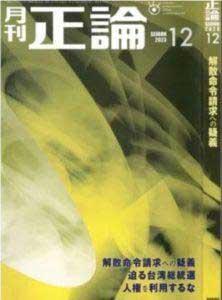
The December 2023 issue of the monthly magazine Seiron (正論) featured a special section titled “Doubts about the Dissolution Order Request”. In an article titled “Why the Government’s Approach is Problematic,” Haruhisa Nakagawa (中川晴久), secretary of the Tokyo Christian Theological Institute, has a discussion with Tsutomu Nishioka (西岡力), professor at the Institute of Moral Science of the Ethics and Moral Education Foundation.
Criticizing the government, Nakagawa said in their discussion,
“For example, in the current request for a dissolution order, evidence, court documents, and various insights collected by the National Network of Lawyers Against Spiritual Sales (Zenkoku Benren) are being used. Some may say, ‘It’s based on facts, so there’s no problem.’ However, it’s highly questionable that the government is advocating for an organization’s claims – especially a private group that has long been at odds with the religious organization – and relying on their information. It raises serious concerns about procedural impartiality.”
Nishioka commented,
“There were many religious figures among the members of the Council of Religious Corporations. There was a former president of the university where I used to work. He was a Protestant pastor I know well. There was also a General Secretary from the United Church of Christ in Japan, as well as representatives from Shintoism and Buddhism. It’s shocking and hard to believe that all of those individuals, without any dissent, unanimously supported it. What exactly are their thoughts on freedom of religion?”
In addition, Nishioka cited an article in the Sankei Shimbun newspaper and raised serious concerns, saying,
“It seems that officials from the Agency for Cultural Affairs secretly went to the homes of the members of Council of Religious Corporations, persuading them one by one. Could that be why religious figures, especially Protestant pastors, hardly voiced any dissent? Hearing this, I get a strong feeling of fear and disbelief.”
Click here to read more on Religious Persecution
Featured image above: The Council of Religious Corporations discussing the use of the questioning rights by the Ministry of Education, Culture, Sports, Science and Technology against the Family Federation for World Peace and Unification (previously known as the Unification Church) – 14th December 2022, Chiyoda Ward, Tokyo. Photo: Sekai Nippo