by Peter Zoehrer
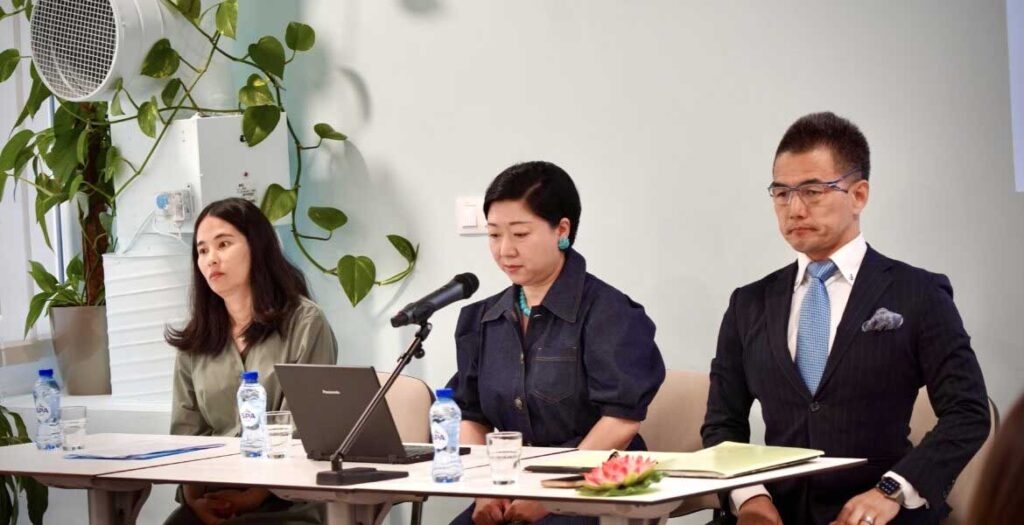
A delegation from the Family Federation for World Peace and Unification (FFWPU) Japan traveled to France to highlight the ongoing crisis of religious freedom in Japan and brought to light the severe social, political, and legal challenges facing the organization, writes Peter Zoehrer.
President Tomihiro Tanaka, who did not travel to France, sent a compelling video to support the initiative in which he expressed his deep respect for Europe’s historical journey toward achieving religious freedom, which is now protected under the International Covenant on Civil and Political Rights. He reported on the regrettable escalating violations of religious freedom in Japan, where the FFWPU has faced significant persecution. Founded in 1954 by the renowned religious leaders Rev. Dr. Sun Myung Moon and Dr. Hak Ja Han Moon, the organization has seen substantial growth since its establishment in Japan in 1958.
President Tanaka detailed the difficult history of FFWPU in Japan, including the illegal abduction and coercion of members by various groups opposed to their beliefs. He emphasized that despite these challenges, the organization has remained committed to its mission of promoting global peace and mutual understanding. The FFWPU has a long-standing history of advocating for freedom, with a membership that has grown to over 600,000 in Japan.
The assassination of former Prime Minister Shinzo Abe in 2022, which the media linked to the FFWPU due to the assailant’s alleged grudge against the organization, has significantly worsened the persecution. President Tanaka explained that, following the assassination, media attacks against FFWPU members intensified, leading to widespread discrimination. Members have faced difficulties in renting properties, finding employment, and maintaining their livelihoods.
In October 2022, Prime Minister Kishida’s administration escalated the government’s campaign against the FFWPU by altering legal interpretations to facilitate the organization’s dissolution. A formal request for the dissolution order was made to the court in October 2023, with hearings commencing in February 2024. President Tanaka warned that such an order would represent a major setback for religious freedom in Japan, potentially increasing state control over all religious activities.
Nakayama, a lawyer advising the FFWPU, provided a comprehensive legal analysis of the situation. He emphasized that the dissolution of a religious corporation in Japan requires evidence of extreme harm to public welfare, typically through criminal activity. Nakayama pointed out that in its 60-year history in Japan, the FFWPU has committed no crimes. He also highlighted the human rights violations inherent in deprogramming efforts, where members are forcibly kidnapped and coerced into renouncing their faith.
Nakayama shed light on the issue of deprogramming in Japan, where over 4,300 members have been victims of abduction and forced deconversion. These human rights abuses, often underreported, have led to significant psychological and physical harm. Nakayama argued that many civil lawsuits against the FFWPU are driven by deprogramming victims coerced into legal action, undermining the legitimacy of claims used to justify the dissolution.
Nakayama called for international attention and support to safeguard religious freedom in Japan. Despite intense political pressure, he stressed the importance of upholding justice and preventing the unjust dissolution of the FFWPU based on coerced and unfounded allegations.
Moriko Hori, President of the Women’s Federation for World Peace in Japan and a second-generation FFWPU believer, provided a heartfelt testimony. She detailed the global humanitarian efforts of the Women’s Federation, an NGO with General Consultative Status with ECOSOC at the UN. Since its founding in 1992 by Rev. Sun Myung Moon and Dr. Hak Ja Han Moon, the Federation has empowered women and children in over 100 countries through international cooperation projects.
Moriko Hori, President of the Women’s Federation for World Peace Japan, began by detailing the organization’s extensive work. Since its inception, WFWP has supported over 400,000 women and children through various projects, stabilizing families in developing countries. However, after the assassination of former Prime Minister Shinzo Abe, the Women’s Federation of Japan who shared the same founders with FFWPU faced intense persecution.
Hori recounted a specific incident in November 2022, where Communist Party Parliamentarian Keiji Kokuta attacked the Foreign Ministry for awarding Mrs. Akiko Hozan, a school chairwoman in Mozambique, the prestigious Foreign Minister’s Award. The Foreign Ministry, succumbing to political pressure, revoked the award. This decision, driven by fear of further attacks, damaged the federation’s reputation and led to the loss of 2,000 paying members, jeopardizing the lives of 20,000 beneficiaries of their projects.
One of the federation’s flagship projects, the JAMOO vocational school, aimed at empowering women to achieve economic independence, has seen significant success. Recognized by the UN in 2008 as one of “the Best Practices,” this project, along with others, faced severe setbacks due to government interference. Hori narrated how the Ministry of Foreign Affairs, under political pressure, conducted investigations and demanded the removal of all traces of the WFWP from their projects, even causing the resignation and illness of key personnel.
The persecution extended beyond organizational setbacks to personal attacks on members. Maria H., a second-generation believer in the Unification Church, shared her harrowing experiences at university. Despite their community service efforts through the CARP student association, Maria and her peers faced defamatory campaigns and institutional discrimination. This culminated in legal battles, where Maria’s rights to religious freedom were defended in court, setting a precedent against such discrimination.
The testimonies emphasized the dire need for international intervention and solidarity among religious entities. Hori and Maria both stressed that the fight for religious freedom and human dignity cannot be won in isolation. They urged other religious organizations and the international community to stand against the rising tide of religious intolerance and discrimination in Japan.
The testimonies presented in Paris paint a grim picture of the current state of religious freedom in Japan. The Japanese delegation’s message is clear: the international community must act to protect the fundamental rights of religious organizations and their members. The struggle of the Family Federation for World Peace and Unification, alongside the Women’s Federation for World Peace, exemplifies a broader battle between secularism and spiritualism, materialism and morality. Upholding these values is essential for a just and free society.