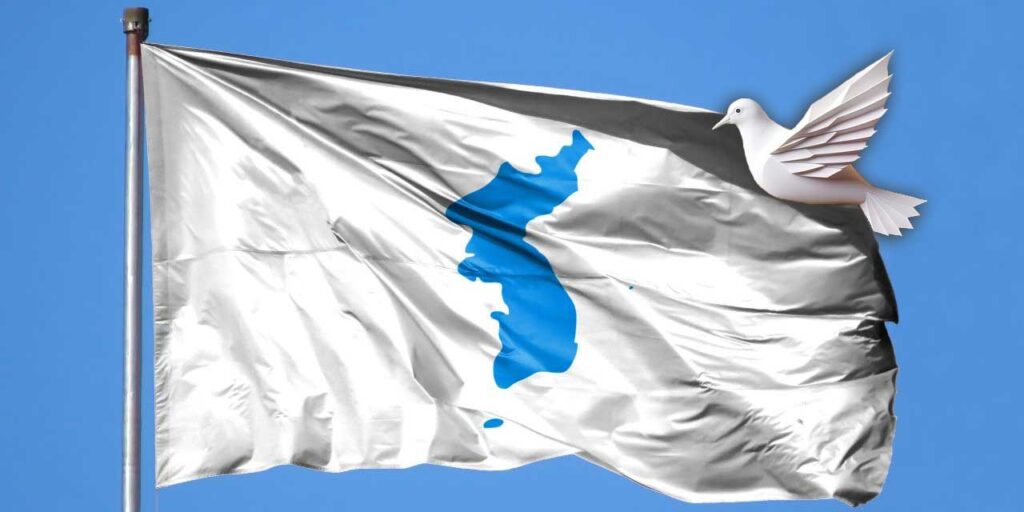
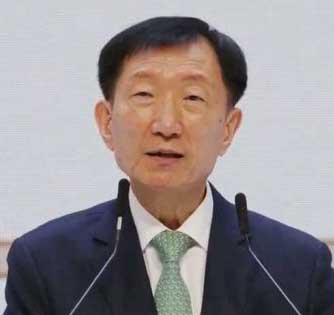
Joint Service to Support North-South Unification, October 22, 2023 (천일국11년천력9월8일), Lecture on Peace & Unification, Rev. Park Sang-seon, Cheonwon Church Main Pastor, 설악천원대교
Greetings! I would like to express my sincere congratulations to all those who were appointed to the Citizens Unification Preparation Committee today.
In speaking of reuniting North and South, the first thing everyone feels is that it is not easy for the leaders of North and South Korea to meet and open the door to dialogue. The Asian Games ended not long ago, and this time, athletes from North and South Korea met each other in the stadium and the stands. When we met and talked with each other, we could feel we’re of the same race, yet we know the road to unification is not easy.
When North and South Korea reunite, the limit on the number of reunions of the 10 million separated families will be lifted, the enormous financial burden of maintaining opposing military forces will be reduced, North and South Korea will become one, and we can develop many of our country’s resources with excellent technology and human resources, making our country much more competitive and prosperous than we are now. Isn’t it frustrating to think that the road to unification is so long and difficult when it is certain that we can open up a better future?
First, I would like to talk about two countries that you all know well, which were divided after World War II and then reunified. I can only imagine how great it will be if we can truly achieve this level of unification. These two countries, in order of unification, are Yemen and Germany.
(Slide: Unification of Germany and Yemen) Yemen and Germany both declared unification in 1990. Unification was declared in the same year, five months apart: May in Yemen and October in Germany.
(Slide: End of East Germany) First, let us briefly examine the moment and process of German unification.On Oct. 2, 1990, the East German People’s Assembly held its last meeting, dissolved the East German government, and declared the end of East Germany.
(Slide: East German Chancellor) Erich Honecker, last chancellor of East Germany, said, “We are one people, and now we are one nation. “This is a moment of joy and a time of farewell without tears,” he said. East Germany disappeared into history. It was a miracle that not a single drop of blood was shed. At midnight that night, a unification ceremony was held in front of the Reichstag in Berlin with about 1 million citizens gathered. Beethoven’s Symphony No. 9 ‘Ode to Joy’ rang out. As of midnight on Oct. 3rd, Germany was unified. So is it truly impossible for our country to be unified like this?
Let’s imagine for a moment: Declaring the dissolution of the North Korean communist regime and the disappearance of North Korea, the leader says in a speech, “We are one people, and now we will become one nation.” How touching would it be to hear someone say, “This is a moment of joy and a time of farewell without tears.” What kind of music ought to be prepared for such a historic moment? Germany played Beethoven’s Ninth, “Ode to Joy,” but what kind of music should we prepare to herald Korean reunification?
(Slide: Yemen Map) Next, I’ll briefly explain Yemen’s unification process. Yemen is a country bordering Saudi Arabia on the south. It’s a fairly large country three times the size of the Korean Peninsula, with a population of about 30 million. Yemen was divided into North and South Yemen after being a British colony, with North Yemen gaining independence first in 1918 and later South Yemen gaining independence in 1967. North and South Yemen attempted unification twice. The first attempt was in 1972. It was declared but could not be consummated, and the second attempt was in 1990. In fact, unification was achieved sooner than the announced date.
(Slide: Yemen’s first unification attempt) The first attempt at unification occurred on Oct. 28, 1972, in Cairo, Egypt, when the prime ministers of the two countries met and agreed to unite into a single country and signed the Cairo Agreement, which contained the basic principles and procedures of unification and the characteristics of a unified country. This was announced. A month later, they met again in Tripoli from Nov. 26 to 28 and announced the Tripoli Declaration. And a year later, in Nov. 1973, they declared that unification would be carried through to completion.
(Slide: Tripoli Declaration:) The Tripoli Declaration for unification is actually really great. It was announced by the leaders of the two countries as follows:
- The name of our country is the Republic of Yemen, and the capital is Sanaa.
- Islam is the state religion and the Islamic temple is the main court.
- Arabic shall be the official language.
- The state aims to realize socialism.
- The political system shall be a national democratic government and a single integrated political organization.
- To institute this basic idea, eight joint committees are to be formed.*
In this first attempt at unification, North and South Yemen declared they would achieve unification, yet they did not manage to achieve actual unification.
(Slide: Second Unification Attempt) The second attempt at unification was the summit held from April 19 to 22, 1990. At the summit, North and South Yemen set the date for unification as May 26, 1990. A date was set for unification one month after the summit. After unification, it was decided to hold a general election after a 30-month transition period and establish a completely unified country. Isn’t such a discussion on unification truly fantastic and refreshing? And unification was actually achieved on May 22, 1990, four days earlier than the date set at the summit, May 26, 1990. Isn’t that inspiring? The leaders of the two countries met for three days and declared unification exactly one month later. After unification, a national referendum on the new constitution was passed with 98% approval, and a constitution containing democracy, a plural party system, and freedom of the press policy was established.
How’s that? How great would it be if the leaders of South and North Korea met and agreed, “Let’s reunite,” and even set a date for achieving unification?
Let me tell you a little more about the unification of Yemen. This year marks the 33rd anniversary of Yemen’s unification. What has happened to Yemen since that time, 33 years after unification? If you look up Yemen, the first word that comes up is the Yemeni civil war.
(Slide: Yemen civil war map) In Yemen, the civil war that began in 2014 is still ongoing, and the UNDP (United Nations Development Program) estimates that 80% of the Yemeni population is in a humanitarian crisis and the situation is worsening. If the civil war continues like this by 2030, 30 million people will die. It was announced that the number of deaths due to the civil war will reach 1.3 million and 9 million will suffer from malnutrition.
Yemen achieved rapid unification through a dream-like process in 1990, yet how did it end up suffering in such a civil war?
First, there was a reason why the two Yemeni countries were active in discussing unification. The biggest one was that in 1988, a huge abundance of oil fields was discovered in the border area of North and South Yemen, and there was an expectation to jointly develop the oil fields and gain economic benefits, so the two countries Yemen’s unification discussions were not very trying.
Unification was achieved with the dream of creating a wonderfully prosperous country by jointly developing the enormous amount of oil discovered in the border area. However, 33 years after unification, the two countries have experienced two civil wars, and the civil wars are still continuing. As a result, the country has wound up suffering the most misery in the world without being able to properly develop its enormous resources.
(Slide: Two civil wars) To explain a little more about the two civil wars that Yemen experienced, first, after unification in 1990, four years later, in 1994, socialist separatists in South Yemen started a civil war by demanding that Yemen be divided again into North and South Yemen. The background to this civil war is Yemen’s unified constitution, which contains democracy, a plural party system, and a freedom of the press policy, but this constitution was not acceptable under socialist ideology. For example, would North Korea be able to accept democracy, a multi-party system, and freedom of the press? This would be absolutely unacceptable. How can North Korea accept freedom press? How could they accept a multi-party system?
Yemen’s unified constitution also includes a multi-party system and a freedom of speech policy, but socialists in South Yemen were unable to accept this constitution. So, four years after declaring unification, socialists in South Yemen insisted on separation and launched a civil war. However, this civil war ended when North Yemen suppressed the civil war started by South Yemen within two months.
Although the first civil war ended, the activities of separatists who hold fast to socialism have not stopped and they are still active today.
The second civil war was caused by Islamist Sunni Houthi rebels in North Yemen in 2014, while Yemen’s president was religiously a Shia Muslim. The Sunni sects of North Yemen, who share the same Islam but adhere to different sects, started a civil war, stormed the presidential palace and took over the capital, Sanaa, causing the President to be driven out to South Yemen. The civil war between Shia and Sunni rebels goes on to this day.
Yemen first suffered a civil war due to separatists with socialist ideology, and after that, it is still experiencing civil war due to sectarian conflict, what’s more, the activities of socialist separatists continue, with Yemen divided between Sunnis and Shiites. The nation suffers from the inability to resolve Islamic sectarian and political ideological conflicts. We must realize from the civil war in Yemen and all the numerous wars currently taking place on earth that ideological and religious fights are not problems that can be solved by saying let’s stop fighting and start talking instead of confronting each other.
Doesn’t Yemen’s history illustrate that very well? Everyone knows that if we work together instead of fighting and develop enormous oil resources, we can definitely make great progress, but fundamentally, the ideological conflict between communism and democracy and the conflict between religious sects have not been resolved, so unification was achieved, yet a civil war broke out. Hasn’t Yemen become a country that was born and now suffers?
(Slide: Germany’s unification process: a process of liquidating the East German communist regime) The process of German unification was also a process of doing away with the East German communist regime, and it has many things to teach us. Germany declared the dissolution of the East German communist regime on Oct. 2, 1990, and declared unification on October 3, but first the Berlin Wall fell, a year earlier, on Nov. 9, 1989.
(Slide: Berlin Wall) The Berlin Wall is the symbol that best expresses the character of all communist regimes. The construction of the Berlin Wall began in 1961, and the controversy over the relative fortes and drawbacks of communism vs. democracy was already concluded by that act.
(Slide: Ulbricht) East Germany’s Ulbricht, who ordered the construction of the Berlin Wall, made a proud speech on public occasions, but in private he complained “The Berlin Wall amounts to self-defeat, admitting that we lost the competition between systems.”
(Slide: Hungary) The reaction was similar in other Eastern European countries other than East Germany, and it is said that Kadar Jánosz, the Secretary General of the Hungarian People’s Republic, warned, “The erection of the wall will tarnish the reputation of the entire communist cause.” Khrushchev also described the wall as an “abomination,” but admitted it was inevitable in order to prevent the outflow of manpower from East Germany.
(Slide: President Kennedy) Let me introduce the famous speech that President Kennedy gave on his visit to West Berlin in 1963. The title of his speech was “I am a Berliner”:
“People who don’t know what the biggest problem is between the First World and the Second World, people who think communism is the wave of the future, people who think we can cooperate with communism, people who think that communism will at least bring about economic progress. Anyone who does, please come to Berlin and look for yourself. There are many problems with freedom and democracy is not perfect, but at least we do not need to build walls and imprison people.” He strongly criticized the Berlin Wall.
Even as President Kennedy watched East Germany, a communist country, build the Berlin Wall to confine its citizens, he said it would not work if we do not have a proper understanding of communism. Kennedy also said something about the democratic system. He criticized the communist system by saying that it is true that the democratic system is not perfect and that it has many problems while it is said to be free, but at least it does not build walls to keep its people from leaving.
If a person commits a crime, they go to jail. Even in prison, you’re still provided food three times a day, clothed, and treated if you get sick. It’s free too. If you hear that you can eat, wear, sleep without paying, and go to the hospital for free, you might wonder, among the citizens of the world, who would not want to live in such luxury? But if that place were a prison, you would think differently.
No matter how much you feed them, clothe them, put them to sleep, and take them to the hospital for free, no one will really like it if they have to eat, dress, and sleep when others tell them to, instead of doing what they want. Even young children protest that no matter how expensive or good a thing is given them, they don’t like it unless it’s the thing they wanted. People say something is good only if they like it.
That’s what freedom is. I feel true happiness when I can choose and have what I like and want at my own discretion, when I can freely go where I want to go, and when I can stay where I want.
Communist leaders themselves knew full well what it meant to build walls to restrict their own people. No matter how much communism is advertised as a good idea, it is up to the people living in that country to decide whether or not their country is a good place to live. What is the use of shouting loudly that communism is an idea that will make people live well and be happy when their citizens are desperately fleeing to other countries?
(Slide: Trying to trap even your thoughts) Communist countries not only build walls to confine their people within their borders, but they also try to control the thoughts of their own citizens. A representative example is state control of the media and, if necessary, distortion of history. The most problematic thing is that freedom of religion is repressed. They go out of their way to teach kids and advertise that God does not exist.
By trying to confine the people by building a wall, communism admitted that it already lost the contest between systems; furthermore, by trying to confine the people’s free thoughts within the wall, it also blocked the people’s path to a happy life.
East Germany propped up the communist regime by building the Berlin Wall in 1961, but when the wall was torn down, the regime could no longer be supported. In 1990, one year after the wall was torn down in 1989, East Germany ceased to exist as a communist country.
West Germany put a lot of effort into helping East Germany tear down the wall. Although limited, exchange and cooperation took place in areas such as family visits, postal communication, broadcasting, and trade. From a reciprocal standpoint, the East German government implemented the requested measures in accordance with the support provided by the West German government, including allowing the emigration of dissidents, restoring cultural properties, and preventing water pollution and forest damage.
(Slide: North Korean communist regime) The inter-Korean issue also has similarities with East-West German relations. Instead of walls, the North Korean communist regime surrounds the country with barbed wire to restrain its citizens. The North Korean communist regime will disappear the day the barbed wire is removed. Therefore, efforts to remove the barbed wire erected by North Korea are absolutely necessary. However, the barbed wire cannot be taken down overnight. Even if it is limited, communication must be established so separated families can exchange news with each other, and continuous efforts must be made to find areas in which North and South Korea can cooperate.
Through this continuous exchange and cooperation between North and South Korea, the day when the barbed wire that imprisons North Korean people disappears and the North Korean regime disappears will be the day of peaceful unification we all long for.
In order for continuous exchange and cooperation between North and South Korea to occur, the most important thing is to maintain a balance of power between North and South Korea. Both South and North Korea must equally accept that unification cannot be achieved through military force. That is why our country must demonstrate its military capabilities. Even though North Korea is armed with nuclear weapons, in the South we are dependent on the nuclear deterrent through our alliance with the United States.
(Slide: Pres. Yoon Seok-yeol’s report on the work of the Ministry of Unification) Let me introduce what Pres. Yoon Seok-yeol said in his closing remarks at the work report of the Ministry of Unification on Jan. 27, 2023.
He emphasized the importance of preparing for unification: “Unification is a matter of preparation, not something that just happens on its own. Unification will come suddenly, but it can only be realized if we are prepared.” He also said, “No matter how well we prepare for unification, even if we prepare, still it can never be enough.” Thus he strongly urges preparations for unification. So then, how should we prepare for unification?
(Slide: Trilateral Summit) On Aug. 18th, the leaders of Korea, America, and Japan gathered for a very important meeting in the United States at Camp David. This summit was a practical meeting specifically aimed at responding to North Korea’s nuclear weapons. They discussed the strategic and operational posture of Korea, the U.S., and Japan to deal with North Korea’s nuclear weapons. As military exercises between Korea, United States and Japan become regular, there is likelihood that these exercises will include missile detection, tracking, and interception. So the meeting was held to substantially strengthen the effectiveness of countermeasures to North Korean nuclear weapons. That was the report.
According to Sun Tzu’s Art of War, there are different strategies to win a war, some of which are the best, and some of which can be said to be the lowest level strategy. The best strategy is to strengthen cooperation with alliances among neighboring countries and break the enemy’s will to go to war by eroding their network of alliances.
According to Sun Tzu’s Art of War, if the leaders of Korea, the United States, and Japan break the enemy’s will to war by strengthening our alliance and expanding cooperation, this is the optimum strategy.
(Slide: Ukraine) The war between Ukraine and Russia is a model example of this principle. Many European countries, including the U.S., are currently helping Ukraine’s war effort. Ukraine has warm relations with its neighbors while Russia, in contrast, is becoming increasingly isolated. Ukraine is in the best strategic situation, while Russia is in the worst strategic situation. For that reason, even though Russia is a powerful country that Ukraine cannot realistically stand up to, still, even though Russia has carrying on its offensive for almost two years, it has not been able to engulf Ukraine, and it now seems Russia is backed into a corner.
(Slide: Acheson Line) What about the Korean War, in terms of American involvement? North Korea was allied with the Soviet Union. What was our country, South Korea, like back then? U.S. Secretary of State Acheson had announced on Jan. 12, 1950, five months before war broke out on June 25th, that the United States’ Far East Defense Line for Northeast Asia would be a defense line connecting the Philippines and Japan, and Taiwan and the Korean Peninsula would be excluded from this defense line.
In the end, at the time of the Korean War, South Korea had weak alliances with neighboring countries, while North Korea had strong alliances with its neighbors. From North Korea’s perspective, it was the most favorable condition.
What does North Korea always keep insisting even after the 6.25 War? Aren’t they incessantly demanding that the U.S. military withdraw from the Korean Peninsula? They consistently seek to weaken our nation’s relationship with the United States.
Next, even once a balance of power between North and South Korea is achieved, the important thing is to prevent internal division.
(Slide: The Best Strategy) Sun Tzu’s Art of War holds that the best strategy is not to fight 100 times and win 100 times, but to win without fighting. On the other hand, losing without even fighting is the worst. The shortcut to losing without a fight is internal division.
If balance of power is attained and military conflict does not occur, we must now be most wary of internal division. In this way, the systems of North Korea and South Korea have already become a reality in which there is no competition, but strange things are happening in South Korea. Citizens and social leaders in South Korea are supporting the North Korean system!
(Slide: “Let’s welcome great leader Kim Jong-un!”) Let’s look at this photo. At Gwanghwamun in the heart of Seoul, young people call North Korea’s Kim Jong-un “great leader” and advocate warmly welcoming him to Seoul.
Sun Tzu said winning without fighting is the best, and the opposite, losing without fighting is the worst. Looking at this photo stirs thoughts of what it is like to lose without fighting. What does it mean if Kim Jong-un appears in Seoul and is hailed as a great leader and people welcome him and submit to him even without a fight? What is it but losing without fighting?
(Slide: Losing without fighting) Losing without fighting means going down the path of self-destruction. The sure path to self-defeat is internal division. Division lays us open to destruction. The system competition between North and South Korea has ended, but the road to self-destruction is still open.
(Slide: Citizens Committee for Unification Preparation prevents the path to self-destruction.) The purpose of today’s appointment ceremony for the Citizens Committee for Unification Preparation is to protect us from going down that path of self-destruction. Political divisions must be prevented. It is healthy to have diverse views, but those views that do not acknowledge but kill each other should not raise their voices. Lies and fake news are different from a plurality of opinions. If counterfeit money is not filtered out, the society is an unhealthy, sick society. Just like when lies are rampant and fake news is not filtered out, it is not a healthy society where diverse opinions are respected, but a sick society on the path to self-destruction. This possibility looms over us now.
(Slide: Israel-Hamas War) There is now a war between Israel and Hamas in Palestine. On Oct. 7th, Hamas fired 5,000 rockets in just 20 minutes at 6:30 a.m. under the code name “Operation Al-Aqsa Flood.” Israel’s vaunted defense network, the “Iron Dome”, failed to function properly, resulting in many casualties. As the war rages on in its 15th day, over 5,000 deaths on both sides have been announced.
However, many experts are unanimous in saying why Israel was attacked by Hamas in this war even though they had the Iron Dome missile defense system, which Israel is proud of, is because so many rockets were launched in a short burst that it was not possible to ward them all off. But the fact is, we should have been able to obtain information about such an attack in advance and defend against it, but there was a problem with Israel’s information system. The analysis concludes that the most problematic factor is the political division inside Israel.
(Slide: Israel’s Internal Division) The verdict is that, because Israel was politically divided, they were unable to foresee Hamas’ attack in advance and had no choice but to suffer through it. When there is political division, even nations like Israel will have problems gathering information and fall victim to enemy attacks.
What all of us preparing for unification need to be most wary of is internal division within our country. The Israel-Hamas war clearly shows that no matter how powerful a weapon you have, if there is internal division, you are vulnerable to enemy attack. As members of the Citizens Committee preparing for unification, there is one more important thing that we must prepare.
(Slide: Resolution of religious and sectarian fights) The problem here is how to solve the issue of quarreling among religions and sects that believe in God, even though the communist wall is torn down, religious freedom is granted, and the way to God is open. Even looking at the ongoing religious fight between Israel and Palestine and the civil war resulting from sectarian conflict in Yemen, no one can deny that a serious problem to be resolved on the way to a world of peace is resolving inter-religious and sectarian conflicts.
Today, almost all religions and all faiths begin with God. The truth is there is only one God. In particular, the God of Christianity, the God of Islam, and the God of Judaism are one and the same. Christians, Muslims, and Jews all talk about heaven. All faiths speak of heaven. Then, since the owner of heaven is God, is there a separate heaven for Christianity, a separate heaven for Islam, and a separate heaven for Judaism? Is the God in heaven in each religion different? People of all religions pray. The one who hears the prayer is God. If the God of Christianity, the God of Islam, and the God of Judaism are the same God, would the answers be different, or the same, if Christians, Muslims, or Jews pray about the same topic in prayer? If one God listens to prayers on the same subject and responds, but His answers are different, that wouldn’t make sense. This is a time when all religions and all faithful people must get an answer from God. It is time to receive from God the answer to peace, the answer to love, the answer to reconciliation, and the answer to unification.
(Slide: The God whom we all meet in the very end) The God whom all religions meet in the end is God, our Parent. Everyone finds their true self when they realize the love of their mother, who gave birth to us, raised us, wishes us well, and endures all kinds of hardships and ordeals for our sake.
No matter how well I learn and reach a high position, no matter how much money I make, no matter how much power I accumulate, when I stand in front of my mother who gave birth to me and raised me, her face is full of wrinkles, she has no strength anymore and has a hard time to even walk. Even though my mother has nothing, when I stand in front of my mother’s pure love, I feel my mother’s love is like a mountain that I cannot climb, and my mother’s love is like a mirror that reflects me, so I see myself reflected in my mother’s love as the most precious thing in all the world. It is then that you realize that she is a noble and precious being who cannot be measured or exchanged for anything.
(Slide: Filial piety) That’s why, since ancient times it has been taught that filial piety is the most virtuous of all kinds of conduct. It has even been said that a person who cannot be filial to his parents is not a human being but an animal. People who boast about having rich parents, people who boast about parents who are in high positions, or people who boast about powerful parents still have a long way to go before they can fulfill their duty of filial piety to their parents.
People who truly practice filial piety are those who have opened their eyes to the hard work and love of their parents who gave birth to them, raised them, taught them well, and tried to raise them to be children who won’t fall behind in society. When you feel the insurmountable love and grace of your parents from their wrinkled faces, bent waists, and struggles even to walk, you can finally see your true parents and yourself, and show true filial piety toward them. In this way you will be well equipped.
With God it’s the same way. People who understand God, their parent, as a God with infinite power and ability, a God who gives blessings, and a God who calls down terrible judgment find it difficult to perform the duty of true filial piety before God. We are the only ones who understand that our parents are heartbroken and have worked hard to raise their children correctly. Then we’re able to look back on ourselves in front of the love of God and realize the true duty of filial piety. Only when we realize that God is a parent to people of other religions and sects and is patient with them and us to the end in His effort to raise His children right, will our true eyes open to people of other religions and sects. People who think that the God they believe in is more powerful or who want to say that they are more powerful do not have their true eyes opened to those of other religions and sects, and with such a mind, the path to true peace between religions and sects cannot be found.
(Slide: When the home is harmonious, all goes well) Rev. Moon and Dr. Hak Ja Han, who have devoted their whole lives to Victory Over Communism and the unification and peace movement, have a favorite saying: “When the home is harmonious, all goes well.” So, Father Moon and Mother Hak Ja Han hung the calligraphy “가화만사성” over their bedroom door. When Reverend Moon uses the term “Family harmony and all is well,” it refers of course to an individual family, but more broadly, he is thinking of the family of all mankind where we attend God as our parent. Just as harmony between parents, children, spouses, and siblings is important for a family to prosper, it is natural that peace and harmony among nations, races, and religions is absolutely essential for the world to achieve peace and prosperity.
The reason why Rev. Moon and Dr. Hak Ja Han dedicated themselves to Victory Over Communism throughout their lives is because communist ideology denies God, the Parent of mankind, and oppresses freedom of religion. If we deny God, the parent of mankind, we cannot achieve harmony, so how can we enjoy peace and progress?
Father Moon and Mother Hak Ja Han have always sternly declared their stand against communism which denies God and suppresses freedom of religion. They do not hesitate, facing any communist leader, to declare that communism, which denies God, cannot develop and will eventually go down the path of decline.
(Slide: Gorbachev) When Rev. Moon met then Communist Party Secretary General Gorbachev in the Soviet Union in 1990, he said, “The success of the Soviet Union depends on whether it centers on God or not.” He strongly said, “Atheism will only lead to self-destruction and disaster,” and he said that communism would not work, and that Lenin’s statues should be taken down. In fact, it is well known that after the dissolution of the USSR, statues of Lenin were pulled down in many countries. (Slide: Lenin statue dismantled)
(Slide: Kim Il-sung) In 1991, the scene of his visit to North Korea and his meeting with Chairman Kim Il-sung was reported on the front page of North Korea’s Rodong Sinmun, and although they hugged each other and smiled, the words that Reverend Moon said in front of the North Korean leaders were not words that could be heard with a smile. They absolutely weren’t reported!
(Slide: Kim Dal-hyeon) This scene is a speech at the Mansudae Capitol in front of leaders including then-North Korean Deputy Prime Minister Kim Dal-hyeon and Vice Chairman of the Korean Peaceful Unification Committee Yoon Ki-bok at the Mansudae Capitol the day before the meeting with President Kim Il-sung. In front of those leaders, he said that economic development and unification of North and South Korea could not be achieved with the Juche ideology based on materialism, and that they should accept Godism and also that President Kim Il-sung should listen to Reverend Moon.
When Father said this in front of North Korean leaders at the Mansudae Capitol, in the room next to him, about 200 people, including ideological leaders and professors who study communist ideology in North Korea, were watching the whole scene on TV. No one knew who that person was, but they were sure the next morning he’d never see the light of day. This is what I heard from Prof. Kim Heung-kwang, who was one of those 200 officials watching TV in the next room—who was invited to this very event here, our Citizens’ gathering, on Aug. 27th. Everyone thought Rev. Moon wouldn’t live another day, yet they went ahead and held the meeting with Chairman Kim Il-sung the very next day.
(Slide: Yeouido 1.2 million National Salvation Rally for Korean Freedom) This photo is a scene from the 1.2 million national salvation rally held at Yeouido Plaza in 1975. Did you see the video of this Rally for Korean Freedom a little while ago? After Vietnam fell to communism, the National Salvation Rally was held in Yeouido gathering 1.2 million people, including youth from 60 countries, facing an international danger where North Korea could harbor ambitions to communize South Korea. At this convention, brothers and sisters of the worldwide Unification Church resolved to rush to defend the Republic of Korea if North Korea should invade the South again. At the rally they shouted that communism, which denies God, must disappear from this land. In Chairman Kim Il-sung’s eyes, the person who was decidedly the No. 1 enemy of communism was Reverend Moon, but instead of coming to Yeouido Square, Rev. Moon has now entered North Korean territory and told North Korean leaders at the Mansudae Capitol that unification cannot be achieved by Kim Il-sung’s Juche ideology. Didn’t you just declare that North Korea can’t develop? Well, we can only conclude that President Kim Il-sung must also be a great person, as he met and held a personal meeting with Sun Myung Moon the day after hearing such a declaration!
(Slide: Great Hall of the People in Beijing) President Hak Ja Han gave a lecture at the Great Hall of the People in China in 1992, the year after meeting President Kim Il-sung in North Korea. Chinese officials censored her lecture manuscript in advance and warned her not to use the word “God”. President Hak Ja Han went ahead and used the word God 12 times in her lecture and shouted that we must establish a world of peace centered on God.
(Slide: Lecture at the Kremlin Palace) Mother gave her speech at the Great Hall of the People in China. Then the following year, 1993, Dr. Hak Ja Han gave a lecture at the Kremlin Palace in Russia. In that lecture, she also testified of God and presented a path for the former Soviet Union to develop centered on God. She said this was the only way to go. She said right to the face of liberal democratic world leaders who recognize freedom of belief and do not deny God, that there is no hope for their nation if it becomes a society or nation that turns its back on God, Our Parent.
(Slide: United States) When he went to the USA to do missionary work in 1971, the most cogent thing Father said was that if America continues in the way it’s going, God will leave the United States, and that there is no hope for America after God has left. God warned that if a couple does not take responsibility for their love for each other, and if youth cannot escape from drugs and the decadent culture, God will have no choice but to leave the family, and not only the family but also the nation will eventually lose hope and move away from the path of prosperity.
(Slide: 2001 UN HQ Blessing Ceremony) This is a photo of the World Peace Blessing Ceremony held at the UN Headquarters in Jan. 2001. Representative families from all over the world preparing to receive the Blessing participated in the World Peace Blessing Ceremony at the United Nations Headquarters wearing their national folk costumes. The purpose of holding such a large Blessing event at the UN Headquarters was to remind people of the importance of the family and further inform the world that there is no hope for the world if harmony and peace in the family are destroyed.
(Slide: God’s Most Important Message) President Moon says that the most important message God wants to convey to all mankind on this earth is the message that reminds us of the importance of family. The reason is that God and humans are in the position of parents and children, and the relationship between parents and children is the foundation and pillar of the universe.
As I conclude today’s lecture, I would like to tell you once again why we would like to appoint ten million citizens of the Republic of Korea as members of the National Unification Preparation Committee to prepare for peaceful unification of North and South Korea. South Korea has already surpassed North Korea politically, militarily, and economically. Even if North Korea makes any military provocations, the South maintains international alliances and cooperative relationships that can ward off such provocations. However, what all citizens of South Korea must be wary of is that divisions are arising within South Korea, and our country risks collapsing without a fight and heading down the path of self-destruction. We must make sure that communist ideology does not raise its voice in Korean society. More importantly, Korean society must ensure that our children and young people do not head down the path of moral self-destruction. We must become a nation where the spirit of filial piety is alive and where the importance of family is upheld. That is what the Citizens Committee for Unification Preparation must keep in mind.
(Slide: National Committee) Best think of the Citizens’ Committee for Unification Preparation as a reserve force mobilized to achieve peaceful unification of North and South Korea without war. It is like a reserve force mobilized in advance to avoid being mobilized as a reserve force after a war breaks out. The reserve forces mobilized in war time are forcibly mobilized. We are a reserve force where you have to go even if you don’t want to go. The National Committee for Unification Preparation are Korean citizens who are moved in our hearts and have gathered together to prepare the ground for unification.
(Slide: Dr. Hak Ja Han) President Hak Ja Han emphasized that the hearts of the people of Republic of Korea must become one in order to welcome the fortune of unification that is quickly approaching. Along with the hearts of the people of our Republic of Korea coming together as one, God, the heavenly hosts of angels, and the great sages and saint and heroes in history will all join in. She told us to pray that the loyal martyrs will also join us in this great reunion.
I sincerely hope that through this Joint Service today, the people of the Republic of Korea will become one, and that heaven will help and be with us so that North and South Korea will lay down their nuclear arms and open the way for peaceful unification. At the same time, we hope that humanity in this world will be free from individualism and materialism. I sincerely hope that all walls will be torn down, that we will be freed from the trap of decadent culture, that all humankind will become one family under God as our Parent, and that the door will open for us to realize the world of peace and happiness. I would like to extend my sincere well-wishes to all those who have been appointed to the National Committee for Unification Preparation today. Congratulations on your success. Thank you!