By UPF Canada
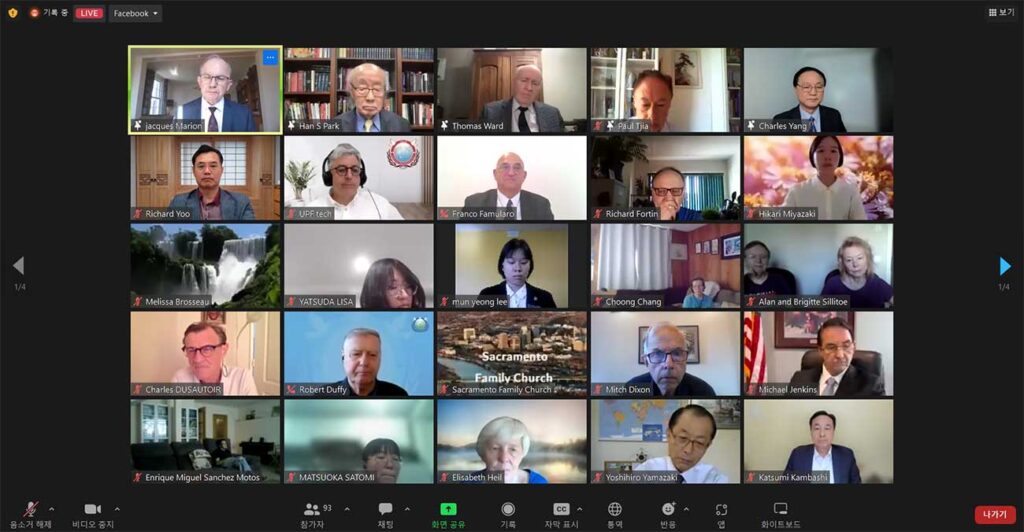
As part of an ongoing series of webinars on the theme “Viewing the DPRK (North Korea) from Within” the sixth session was held on September 7, 2023, with a panel from Europe, North America, and Korea that attracted participants from around the world.
Jointly organized by Universal Peace Federation chapters of Canada and Europe-Middle East (EUME), the webinar began with an introduction by Dr. Franco Famularo, President of UPF Canada, emphasizing that the gathering features speakers and commentators who have either lived or visited North Korea.
Mr. Jacques Marion, Co-Chair of UPF EUME, skillfully served as moderator and introduced the principal speaker, Professor Han Park, who shared his expert views on the DPRK, a country he has visited over fifty times.
Park is Professor Emeritus of International Affairs and Founding Director of the Center for the Study of Global Issues (GLOBIS) at the University of Georgia and was instrumental in helping former presidents Jimmy Carter’s and Bill Clinton’s visits to the DPRK.
The audience then heard from the respondents to Professor Park’s presentation led by Mr. Paul Tjia, Director of GPI Consultancy in The Netherlands, a businessman who has had extensive experience with the DPRK since 1997 and engaged in various business efforts and also organizing tours to the mysterious country.
Dr. Thomas Ward, Provost and Professor of Peace and Development Studies at HJI Graduate School for Peace and Public Leadership then noted that Dialectical Materialism does not seem to have primacy in Juche Thought that it has in other adaptations of Marxism-Leninism.
He noted that Kim Il Sung very rarely used the term and that his son Kim Jong Il on several occasions expressed the view that Dialectical Materialism and the correlative of the Unity and Struggle of Opposites was an inadequate way to approach problems in a socialist society, emphasizing Juche Thought’s prioritizing of man-centered (human-centered) outlook over dialectical materialism.
Dr. Ward felt that this “Human-centered” outlook could be a starting point for fruitful dialogue between academics from the DPRK and other societies. He, along with other participants, expressed the view that in today’s geopolitical climate, Canada and Europe might be the best venues for Korean Peninsula-related Track II initiatives.
Dr. Chang Shik Yang, the International Chairman of UPF, shared about the international efforts of UPF and its founders to bring the two Koreas into a healthy and constructive dialogue in the move toward peace. He suggested that the United States should be more generous toward the DPRK and ease on the sanctions based on his conversations with diplomats of the six-party talks over the destiny of the Korean peninsula.
Dr. Yang used concrete examples from the global efforts of the late Rev. Sun Myung Moon and co-founder Dr. Hak Jan Han Moon ranging from meetings with Kim Il Sung, Kim Jong-il, and other leaders of the DPRK. He suggested that cultural exchanges and dialogue among academics and other civil society leaders will help to establish a better environment for rapprochement on the Korean peninsula.
The meeting continued with a discussion among the panelists and the speakers responding to questions provided by the audience.
To summarize Professor Park’s talk, he began with the problem of Perception or Misperception) of reality; There are two contrasting realities of North Korea: One viewed from the Outside and another viewed from the Inside.
The purpose of his presentation was to present both perspectives in the hope that an objective and reliable set of characteristics of the DPRK might be discerned.
1. The DPRK viewed from the outside (South Korea included):
- Totalitarian Dictatorship with militant control of the people by the government;
- Charismatic leadership of One person;
- Three-generation hereditary succession system;
- Poor human rights, especially freedom;
- Closed system with restrictions on movement and travel within and without;
- Economic poverty with mass starvation;
- Indoctrination is the goal of education and in all levels of socialization;
- Party Dictatorship with Inequality throughout the system.
2. Sources of the negative information in Professor Park’s view are:
- ROK Government (KCIA);
- Education Promoting the Red Scare Syndrome;
- Defectors from North Korea with good reasons to criticize the system they defected from;
- Incentives made available by South Korean establishment;
- Christian Missionary
The above sources are designed to demonize the DPRK
3. Values of North Korea to South Korea and the United States
- American Security Alliance with South Korea
- South Korean Legitimacy
- US Hegemonic Power in the Cold War and Post-Cold War World Order
4. The DPRK Viewed from Within:
- Socialism with DPRK Characteristics: collectivism, public ownership;
- North Korea is a developing system with security, ideological legitimacy, and welfare;
- North Korea is a socialist system with North Korean Characteristics;
- Peoples’ basic needs are secured by the government;
- Highly egalitarian society with Distributive Justice;
- North Korea is a paternalist political system;
- The national community has become a theocracy with Kimilsungism;
- A highly nationalistic system;
- Legitimacy of the Korea Labor Party.
5. The Sources of the affirmative Conceptions
- People and Groups who have first-hand information about the System who have lived in or traveled to North Korea multiple times, and are familiar with the political system;
- Some defectors who chose to maintain alternative perspectives different from the above demonizing perspectives;
- Most of this categorial people are peace lovers and peacemakers in South Korea and abroad;
Professor Park concluded his remarks by suggesting that: A peacemaker must know all parties, especially North Korea, the way they are without any preconceived prejudice. The knowledge must be explanatory rather than merely descriptive.
The session continued for longer than the allotted seventy minutes with an engaging question-and-answer session and further commentary from the principal speaker and panelists. The series will continue and the ultimate objective is to eventually have dialogue with academics and policymakers from the DPRK.
Many thanks to Professor Okkyung Park for her advice and help, Dr. Moonshik Kim, Chair of UPF Canada for his ongoing support for this effort, Robert Duffy and Pierre Beauregard for practical support and the many members of the UPF staff who make this webinar series possible.