By Henry Masters
Henry and Avril Masters were witnessed to by their daughter Rosalind. They joined our movement in the early 1970s. Years earlier, Henry Masters had inherited an estate of several hundred acres of land and buildings located in a picturesque village in southwestern England. In 1973, the Masters donated this estate in support of God’s providence. True Parents were moved by this gesture of total offering. Henry and Avril found themselves working closely with True Parents on a number of projects over the ensuing years. Here we bring you extracts from Henry Masters’ personal story, which he published as a full-length autobiography.
Part 2 (final) Click to read Part 1
While acting as Father’s driver, I had to be ready, at any time, to leave immediately. I often had no idea of where we were going until we were already on the road. It might be to Devon or Cornwall or to a factory in East London, or simply to a Chinese restaurant in Soho. I was grateful for having a good sense of direction. We were followed everywhere by a second car with two American security brothers, Mike McDevitt and another guard. I knew of many shortcuts through central London but had always to make sure that Security was following.
I took very seriously the responsibility I had in carrying Father safely and comfortably. I rejected any inappropriate or negative thinking from my mind and thought only of good things. I endeavored to concentrate totally on how to drive most smoothly and safely, alert to everyone else on the road.
I was always very much aware of Father sitting in the seat behind me. I felt that he could read every thought that passed through my mind as he watched my hands on the steering wheel. I knew he could read my character and see every one of my limitations. When, as we sped down the motorway and I could hear the soft breathing of innocent sleep, I felt that I was cradling his life in my hands.
One day Father put me to the test. I was driving, either on the M4 or M3, travelling towards London, when Colonel Han, who was sitting beside me, said “Father wants you to drive faster.” The speed limit on the motorways was 70 miles per hour. I was already travelling at 80, which was normal. I put pressure on the accelerator, 85. “Faster” came the voice from the back seat. Then 90, 95. “Faster, faster.” We reached 100 miles per hour on the speedometer. We were passing everything on the road, weaving this way and that through the stream of traffic. Then “Ok – you can slow down now.” It took some while for the security car to catch up. Tears came to my eyes as I thought “How much Father trusts me; he trusts me with his life.”…
Designing and building boats
On the Celebration Day [of True Father’s 60th Birthday], Father spoke at length to a crowded Ballroom in the morning and he attended a special celebration at the Manhattan Center in the evening. During the afternoon, however, I received a message that Father wanted to see me in his fortieth floor apartment. He wanted a report on the boat design.
I took a roll of drawings under one arm and the model under the other and ascended to the fortieth floor. Father greeted me at the door and led me to a side room (the main part of the apartment was full of children). I showed Father the working drawings and gave a report on what we had been doing, but what Father really wanted to see, more than anything, was the model. This was our birthday offering. I had fitted out the model for various types of fishing which included outriggers that could be raised or lowered, a stern ramp and net reel, a mast with derrick and winches. It was by no means a professional model—it was made with cardboard, plaster and sticks of wood—but it served to show Father, three dimensionally, what the boat would look like and how it could be rigged for different types of fishing. Father was so happy with the result of our exercise. I felt that it meant so much to him on this very special day….
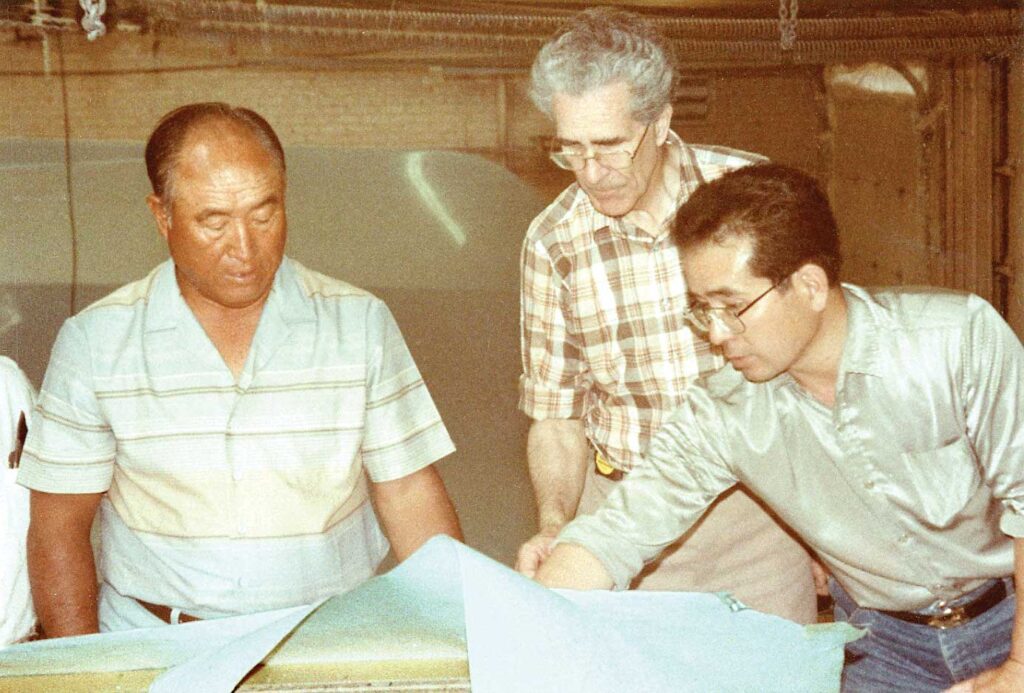
Father visited us almost every week to check on progress. Our working area was approached by a metal stairway leading down from the main floor of the building. The stairway had a loose tread at the top. We would all be working away industriously when there would be a clank as a foot trod on the top step and there was Father—looking as if he had just alighted. He would then descend the steps to see how we were progressing. When the three-dimensional outline of the hull was clearly visible, Father made some fundamental adjustments to the lines. He described a rounded bow instead of a pointed one. This was to provide a valuable fishing platform and also establish a considerable overhanging flair which would help to keep the boat dry. Actually, it gave the boat a certain oriental flavor. He deepened and lengthened the foot of the bow stem so as to give a better cutting edge to slice through the waves. We then made further adjustments to the keel line to prevent “cavitation”[1] from taking place.
The inspired improvements that Father made gave a totally new look to the boat. They gave the boat an appearance of purpose and urgency that was quite unique. They also greatly improved the performance. These were ideas that developed out of Father’s observation, intuition and insight while fishing on the ocean.
The hull and deck plugs, together with some other boxes, were then covered with fiberglass and putty and were sanded and polished to give a perfect shiny surface. Molds were made from the plugs and boat parts were made from the molds.
A Norwegian brother, Geir Isaksson, had the responsibility of building a mold for a rope locker. It was an oddly shaped black lump but Geir had put his heart and soul into sanding and polishing it until it positively glowed. On one occasion, when Father was visiting, I led him into the side room where Geir was working. Father walked over to the mold and, without saying a word, he gently rubbed his cheek against the surface. Father’s action said everything and Geir was totally elated….
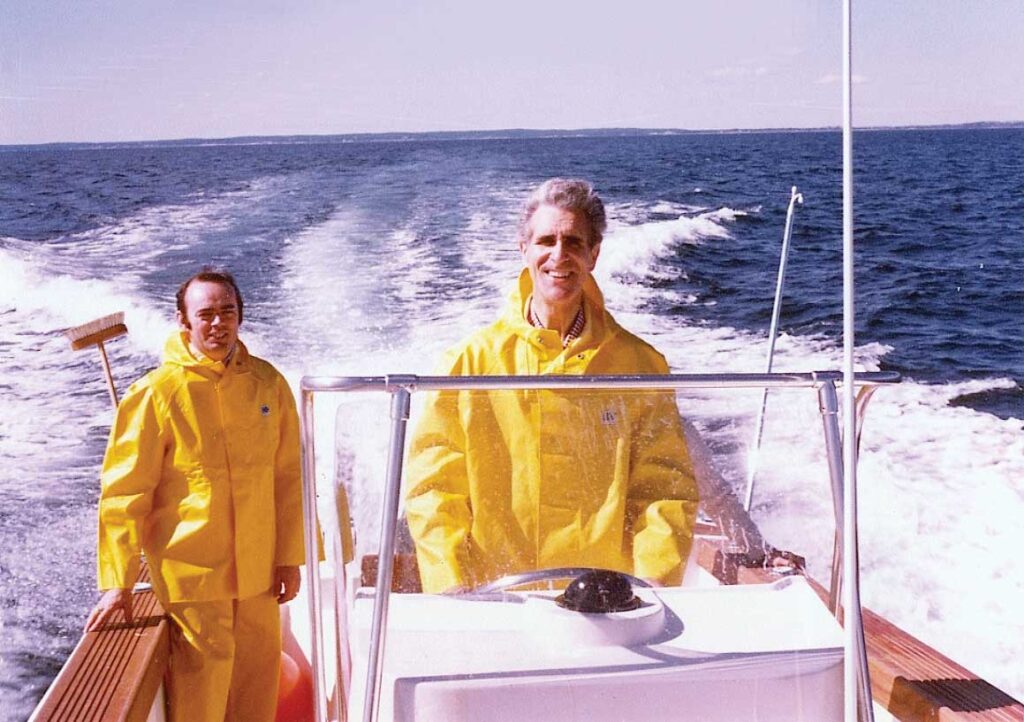
The first One Hope: Brian and I flew up to Gloucester on the first flight in the morning. The boat was immediately taken down to the harbor, picked up by a crane and lowered into the water. No previous tests had been done so it was with great relief that we saw it sitting there in the water—on an even keel. We filled the tank with fuel and climbed aboard. Brian started the engine, pushed the throttle forward and we glided across to a jetty on the other side of the harbor where Father and Mother were waiting. They immediately stepped on board and we set off for a test drive around the harbor. The performance was better than we dared hope. If Father had any reservations, he kept them to himself. This was Father’s One Hope and the first of many to come.
A week or two later the fourth Good Go, the One Hope 4 came off the production line and was delivered to Gloucester. Brian and I received a call to meet with Father there. When we arrived, we found that Father was already out fishing on the New Hope, the boat that he had acquired some six years earlier and on which I had had the privilege of fishing with Father on my forty-eighth birthday.
We were told that Father was fishing with the fleet at a spot some twenty miles offshore. Neither of us had any experience of navigating at sea but we were told that, if we followed a course at a certain compass bearing, we would, in due time, meet up with the fishing fleet. It was a great relief when, after losing site of the coast, the fishing fleet finally appeared on the horizon.
Father observed with a keen eye the way the boat handled in the waves and, at the end of the day, he switched boats and returned home on the One Hope 4. Brian was at the helm. After a while Father beckoned me to follow him forward and we sat down together on a fish box. Father said “Congratulations!”
I replied “Father, this is your boat, your design.” Father smiled a little coyly, studied his feet for a moment and returned to the stern of the boat.
Father has the last word
In September 1982 Father gave a speech at East Garden on “Why we have an Ocean Church.” He spoke to the Ocean Church membership of the great hope he had in the development of Ocean Church as a testing ground for future leadership and about taking responsibility for America. I quote one paragraph:
“When I first met Mr. Masters, I noticed his hair was completely white and thought he was an old man. I treated him kindly and didn’t push him too much. Then I found out he was only fifty-six and I thought, “Oh, I should have pushed him much more, he is only a young man! Why is this man here from Britain? Does he have a separate destiny from you? No, the world is only one world. America is not just by itself. We share whatever happens.”
Henry and Avril both lived until well into their nineties, and ascended to the spirit world a few months from each other a few years ago.
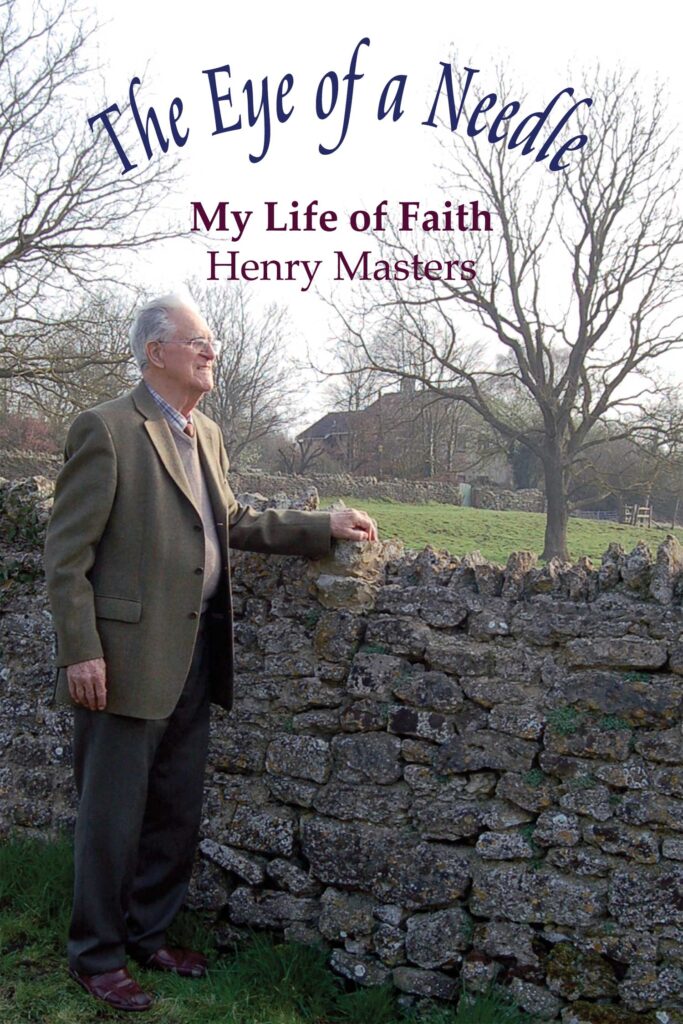
Father has at various times suggested to us to write the story of our life for the benefit of our descendants (see Cheon Seong Gyeong, English version, pages 715 and 813). Mr. Masters is one of a number of members who have written down their life story for the benefit of future generations. These extracts were reproduced with his kind permission.
[1] The formation and collapse of air bubbles causing vibration and drag